Best No-Code App Builders in 2026: Lovable vs Bubble vs Glide
Lovable, Bubble, and Glide compared on architecture, pricing, learning curve, and code portability. Clear picks for founders, agencies, and ops teams.

Picking the wrong no-code platform doesn't just cost you a wasted weekend. It costs you a rebuild three months later, after you've already onboarded users and discovered the tool can't do what your app actually needs.
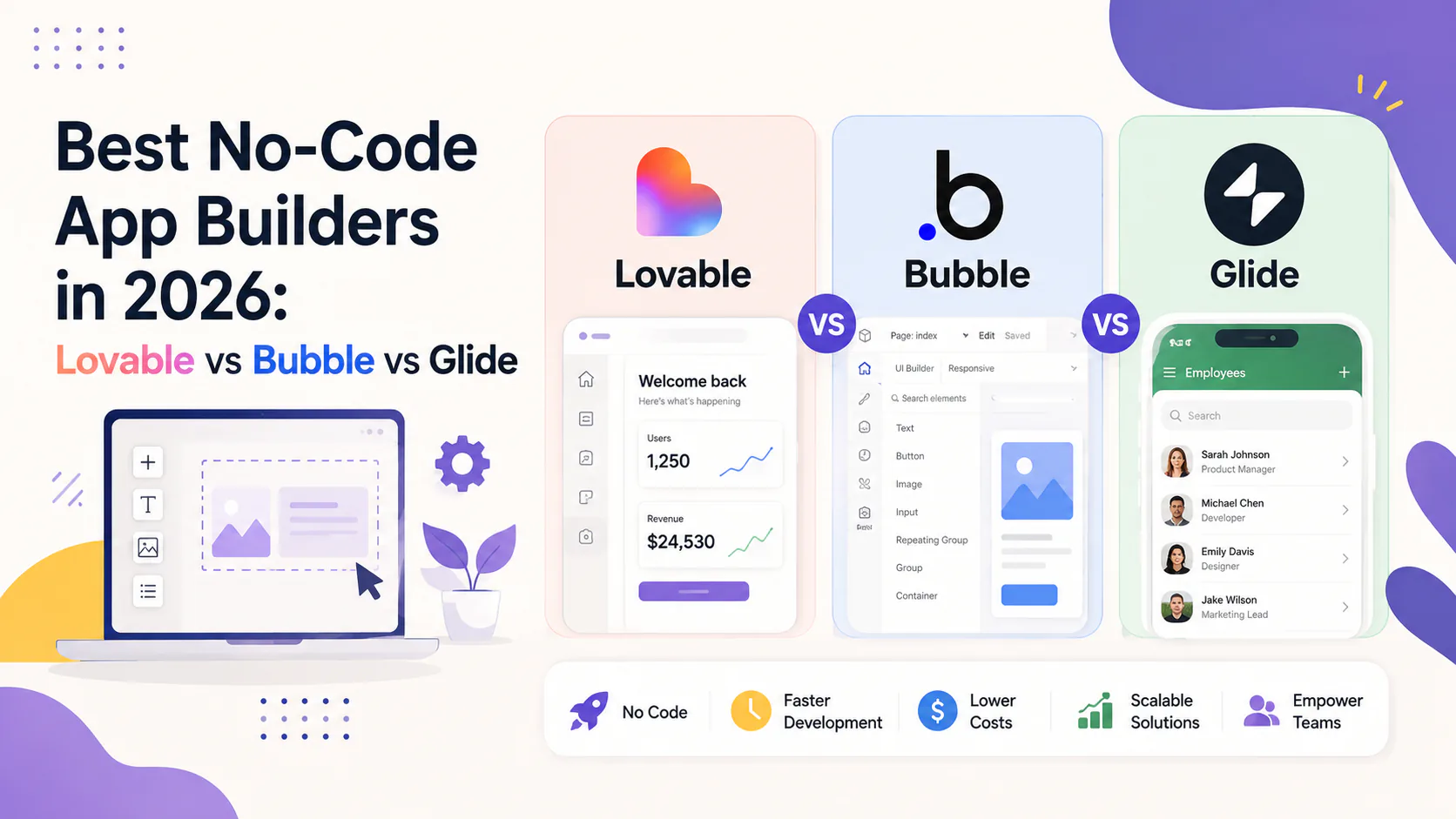
Lovable, Bubble, and Glide all get lumped into "no-code app builders" in comparison articles, but they're answering three different questions. Lovable answers "can I describe an app in plain English and get real code back?" Bubble answers "can I build something as complex as a custom-coded SaaS product without writing code?" Glide answers "can I turn this spreadsheet into an app by Monday?"
This comparison is built around that distinction rather than a generic feature checklist, because the right answer for you depends entirely on which of those three questions you're actually asking.
TL;DR: Lovable wins for fast, professional-looking web app prototypes with genuine code ownership. Bubble wins for complex, logic-heavy applications like marketplaces and SaaS products where you're willing to invest months learning the platform. Glide wins when your data already lives in a spreadsheet and you need a usable interface on it by the weekend.
What each platform actually is
These three tools represent fundamentally different architectural bets on how software gets built without a traditional engineering team.
Lovable: AI-generative, code-producing
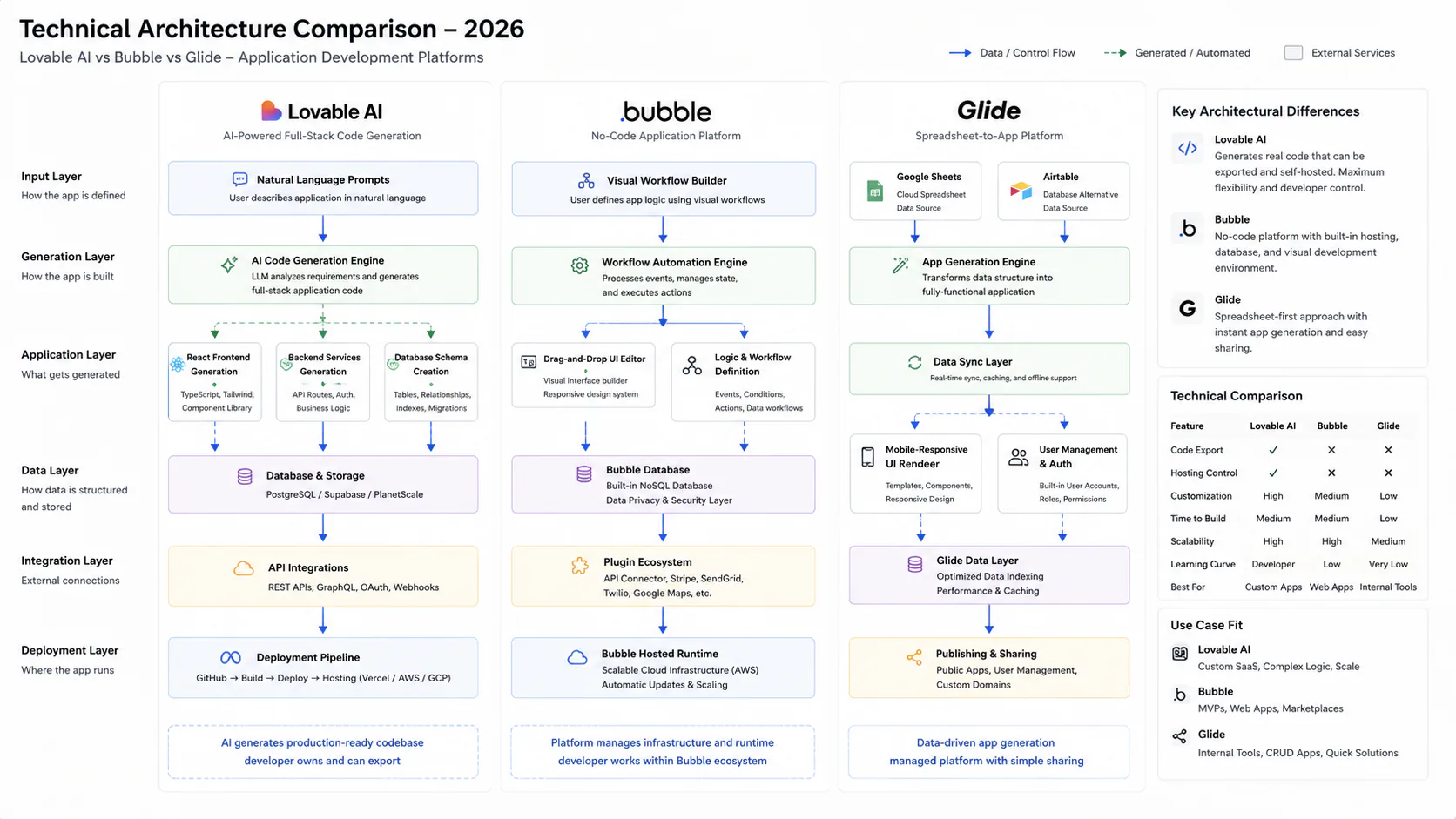
Lovable belongs to the "vibe coding" category alongside Bolt.new, V0, and Base44. You describe an application in natural language, and the platform's AI generates real application code: TypeScript and React on the frontend, Supabase for backend, auth, and data. The output exports to GitHub with two-way sync, which means the app you build is not permanently dependent on Lovable's continued existence.
Founded in late 2023 by Anton Osika and Fabian Hedin in Stockholm, Lovable's growth curve is the fastest in software history by several public measures. The company reached $100 million ARR faster than OpenAI, Cursor, Wiz, or any prior software company, according to CEO Anton Osika. It then doubled to $200 million ARR within four months, and reached $500 million in annualized revenue by May 2026, up from $100 million just ten months earlier. As of February 2026, the platform had roughly 8 million users and had surpassed 25 million total projects, with more than 100,000 new projects created per day.
Bubble: visual programming, no code export
Bubble represents the mature, decade-plus tradition of visual-programming no-code. There's no AI generating an application from a prompt; instead, you build using a drag-and-drop interface paired with a sophisticated workflow engine and a native database. Bubble is technically "low-code" rather than strictly no-code, since it permits custom plugins and JavaScript, but the primary workflow requires writing none.
What Bubble trades for that flexibility is portability. There is no code export. An app built in Bubble lives inside Bubble's ecosystem permanently; migrating off the platform means a full rebuild, not an export.
Founded in 2012 by Joshua Haas and Emmanuel Straschnov, Bubble has over 3 million users by its own count (or 500,000+ creators by other industry measures) and a plugin ecosystem exceeding 1,000 plugins. It raised a comparatively modest $106 million in total funding, a fraction of Lovable's capital raised despite being more than a decade older. Native mobile app building entered public beta in mid-2025, a significant step for a platform that was historically web-only, though deep links and third-party plugin support for mobile remain in progress.
Glide: spreadsheet-native, fastest to ship
Glide starts from a data source you already have: Google Sheets, Airtable, Excel, or a SQL database, and generates an app interface on top of it. Changes in the spreadsheet appear instantly in the app. The data model is the spreadsheet, the logic lives in Glide's visual builder, and the app runs entirely in Glide's hosted runtime.
This is the fastest of the three to a working result for the right kind of app, and the most architecturally constrained. Glide outputs Progressive Web Apps, not native applications, which means Glide apps cannot be distributed through the Apple App Store or Google Play Store without a third-party wrapper service. That's not a roadmap gap; it's a structural consequence of how the platform is built.
Learning curve: the gap is bigger than marketing suggests
This is where the "no-code" label gets stretched thinnest, and where most buyers get the most surprised after committing.
Lovable and Glide both genuinely deliver on "minimal learning curve." With Lovable, you describe an outcome in plain English and get a working result; with Glide, the mental model (spreadsheet rows become app records) maps to something most people already understand. Neither requires a meaningful investment before you can build something usable.
Bubble is a different proposition entirely. Independent agency testing across more than 320 apps built on Glide, Bubble, FlutterFlow, and Webflow found that mastering Bubble's workflow and database-relationship logic typically takes about five months of daily practice. One frequently cited case from agency testing: a marketing manager with zero coding experience built her first functional form in two hours, but needed three weeks of daily practice before she could independently create complex conditional workflows. Reddit threads from experienced no-code builders and programmers consistently echo the same complaint: Bubble's logic system is powerful, but it is not actually easy to learn despite the no-code label.
The practical implication is that Bubble's learning curve isn't a one-time cost you pay and move past. Database query optimization (avoiding nested searches inside repeating groups, for instance) becomes an ongoing performance-engineering skill you need to develop to avoid unpredictable cost spikes, which the next section covers in more detail.
Pricing: where the real surprises live
All three platforms use pricing models that look reasonable on the marketing page and become a source of frustration once an app actually has users. The mechanisms differ in ways worth understanding before you commit.
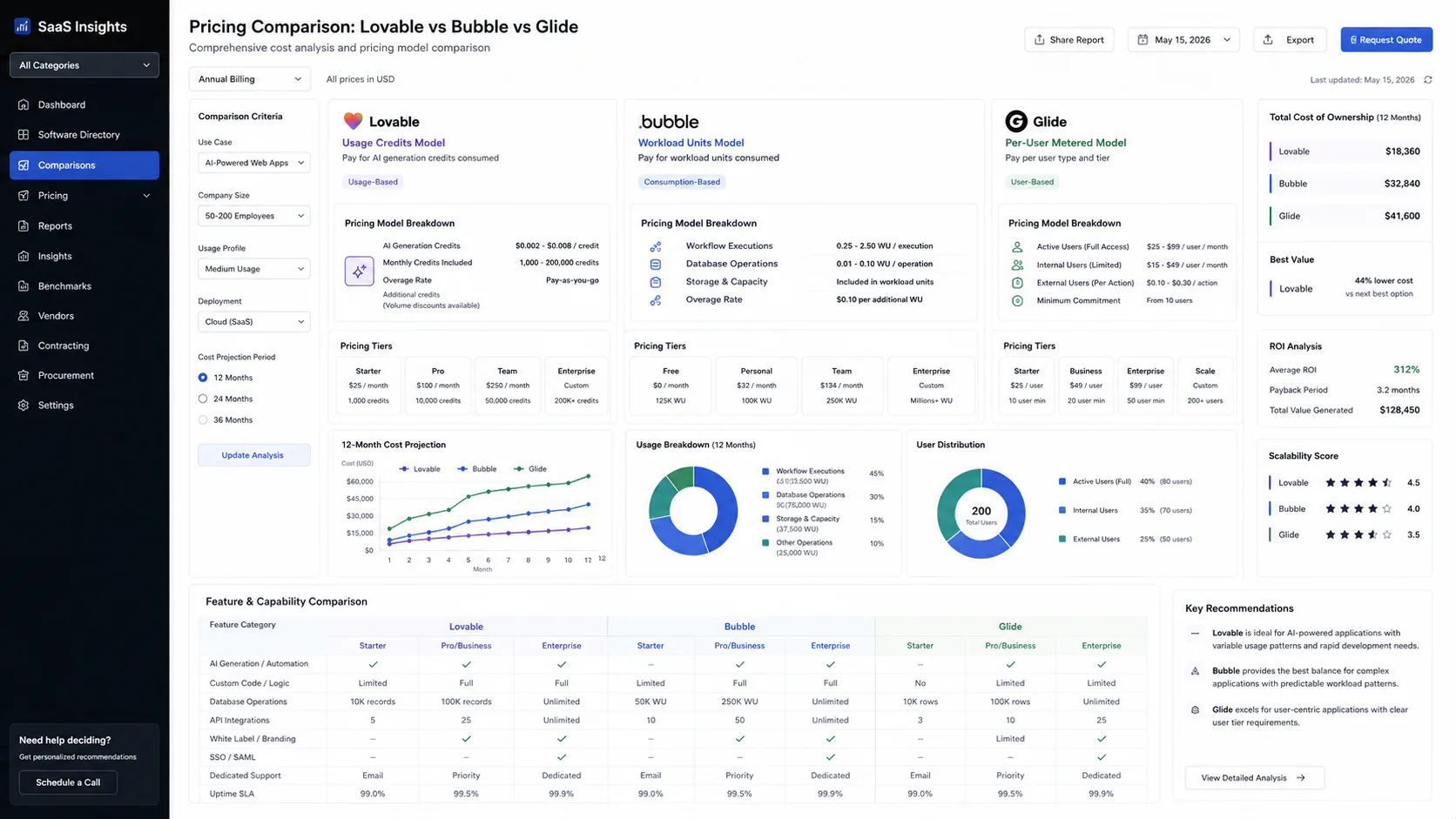
| Dimension | Lovable | Bubble | Glide |
|---|---|---|---|
| Entry pricing | $20-$100/month tiers + usage credits | $29/month Starter (50,000 Workload Units) | $25-$60/month Maker plan |
| Pricing model | Flat tier + AI generation credits | Consumption-based Workload Units | Per-user/editor + metered "updates" |
| Cost predictability | Moderate (credits scale with app complexity) | Low (usage spikes as users grow) | Low (overage on users and syncs) |
| Data source access | N/A (Supabase native) | N/A (native database) | Pricing-gated: Sheets on Maker, Airtable/Excel on Business, SQL/CRM on Enterprise |
| Free tier ceiling | Limited credits | 50,000 WUs on Starter | 10 users |
Lovable's usage-based credits scale with app complexity rather than user count: a basic app might cost roughly $1 in credits, while a complex application can run $50 or more. That's predictable in the sense that it correlates with what you're actually building, but it can still surprise founders who underestimate how "complex" their app turned out to be.
Bubble's Workload Units meter actual platform usage: database operations, workflow executions, API calls. The problem reviewers raise most consistently is that WU costs spike unexpectedly as an app gains real users, not because the app got more complex but simply because more people are using it. GetApp's aggregated user reviews flag "high and unpredictable pricing" as a recurring theme even among reviewers who otherwise praise Bubble's capability.
Glide's pricing surprise comes from two directions at once. First, data source access is gated by tier: syncing a Google Sheet requires the Maker plan, Airtable and Excel require Business, and SQL databases, HubSpot, Salesforce, or BigQuery require Enterprise (starting around $1,200/month). Second, "updates" (every time the app pulls fresh data) and signed-in users are both metered, meaning an app with heavy real-time use or growing adoption can generate overage charges that weren't obvious at signup. The free tier caps at just 10 users, which trips up founders trying to validate an idea publicly before committing to a paid tier.
Code and data portability: the decision that compounds
This is, in our view, the single most consequential technical decision buried inside this comparison, because it determines what happens to your app years from now, not just what it costs to build today.
Lovable generates standard TypeScript and React code with Supabase for the backend, exported to GitHub with two-way sync. Any developer can pick up that codebase and extend it. If Lovable changed its pricing tomorrow, or shut down, your application code still exists and still runs. That's a genuine exit strategy, not a marketing claim.
Bubble and Glide offer no equivalent. Bubble's visual logic and Glide's app configuration both live entirely inside the platform's proprietary runtime. Migrating off either platform means rebuilding the application from scratch on new infrastructure, not exporting and redeploying existing logic. For a quick internal tool or short-lived prototype, that's a non-issue. For anything you expect to depend on for years, or anything investors or acquirers will diligence, it's a real structural risk you're accepting in exchange for the platform's other strengths.
FlutterFlow, mentioned later in this comparison as a native-mobile alternative, shares Lovable's code-export advantage by generating standard Flutter code that compiles independently. That's the closest analog if your project needs mobile rather than web.
Where each platform actually wins
Lovable wins when:
- Speed to a working, professional-looking prototype matters more than deep custom business logic, and you need something demoable in days rather than weeks.
- You're a founder without a coding background but want output that a developer could eventually take over and extend, rather than a dead end requiring a full rewrite.
- The project is fundamentally a web application rather than something requiring native iOS or Android distribution.
- You want to short-circuit the traditional "find a technical co-founder before validating the idea" bottleneck. Non-technical founders increasingly use Lovable to reach a demoable product before they know whether the idea has traction at all.
Bubble wins when:
- You're building something genuinely complex: a two-sided marketplace, a social network, or a full SaaS product with intricate multi-role permissions and database relationships that would challenge even AI-generative tools to reason about coherently.
- Your team is willing to invest real time, realistically months, into learning the platform properly, in exchange for a depth of customization that the faster alternatives can't match.
- You need a mature plugin ecosystem and a decade-plus track record of production hardening. Bubble has been running real businesses since 2012; that history matters for risk-averse teams.
- You're an agency building production-grade B2B SaaS or marketplace MVPs for clients, where Bubble's depth lets you deliver outcomes that would otherwise require a traditional development team.
Glide wins when:
- The underlying data already lives in a spreadsheet or Airtable base, and the goal is simply to put a usable interface on top of existing data without migrating it anywhere.
- The use case is an internal operational tool with a known, controllable number of users rather than a customer-facing product expected to scale to thousands of sign-ins.
- Speed genuinely is the only thing that matters: a weekend, not weeks, and you're willing to accept Glide's hard ceiling on customization (color, text, and layout tweaks rather than deep structural flexibility) in exchange.
- You don't need App Store or Google Play presence. If native distribution is a requirement, Glide's PWA-only architecture rules it out before any other consideration matters.
Real-world examples worth knowing
Lovable: Fortune 500 companies have reportedly onboarded entire teams onto the platform, according to Lovable's own December 2025 funding announcement, shifting use cases from pure prototyping toward production internal tools with real authentication requirements. Some technical teams use Lovable not to replace developers but to generate a fast first draft that a developer then refines, treating it as an accelerant inside an existing engineering workflow.
Bubble: Seagate reportedly shipped enterprise portals five times faster using Bubble compared to traditional development, illustrating that even large, technically sophisticated organizations reach for Bubble when speed-to-deployment for internal tools outweighs the benefits of fully custom infrastructure. No-code agencies regularly build B2B SaaS platforms and marketplace MVPs on Bubble for clients, citing the platform's depth as the reason they can deliver production-grade results.
Glide: Manfield Paris reportedly achieved a 750% productivity improvement with a Glide-built inventory management app, turning an existing operational spreadsheet into a usable mobile interface for frontline staff. Service professionals and retail businesses commonly use Glide for client management and inventory tracking apps that sync directly with spreadsheets their teams already maintain.
The category context: why this comparison matters more in 2026
The "no-code" category is in the middle of a structural redefinition, and understanding why clarifies a lot about why these three tools feel less comparable than marketing language suggests.
The vibe coding sub-segment, which Lovable anchors, is estimated at $4.7 billion in 2026 with a 38% compound annual growth rate, growing nearly twice as fast as the broader no-code and low-code category it emerged from. By 2027, vibe coding alone could represent more than a quarter of the entire combined category, up from roughly 5% in 2024. Taskade's State of Vibe Coding 2026 report frames the trajectory bluntly: vibe coding "is not a subset of the no-code market. It is becoming the market."
That growth is happening alongside, not instead of, continued enterprise adoption of traditional no-code. Gartner projects 75% of new enterprise applications will be built on low-code platforms by 2026, and 80% of low-code users now come from outside formal IT departments entirely. Citizen developers already outnumber professional developers roughly 4:1 in enterprises that have formally adopted no-code platforms, according to Kissflow's 2026 statistics.
The practical takeaway: this isn't a category where one architecture wins and the others fade. Lovable's AI-generation approach is becoming the default entry point for new builders, while Bubble's visual-programming depth increasingly serves as the tier you graduate to once your AI-generated app outgrows what AI generation alone can reason about. Glide and similar spreadsheet-native tools face real competitive pressure from AI-generative alternatives that can build comparably simple CRUD apps without Glide's data-source pricing gates, but the spreadsheet mental model still has genuine appeal for teams who already think in rows and columns.
For developers comparing AI-generative coding tools more broadly, including how Lovable stacks up against Bolt.new and v0 specifically, see our head-to-head comparison of Lovable, Bolt.new, and v0. If you want a step-by-step walkthrough of building a real application in Lovable, including auth and payments, our full-stack Lovable tutorial covers the process end to end.
Final recommendation
If you're starting from zero and need a working web app fast, with the option to hand it to a developer later without a rebuild, Lovable is the right starting point for most founders in 2026. The code export removes the main risk that comes with every other no-code choice on this list.
If your application's complexity genuinely exceeds what a prompt can reason about coherently, marketplaces, multi-role SaaS products, anything with intricate custom business logic, Bubble remains the more capable platform. Budget the learning curve honestly; treat it as a real time investment, not a weekend project.
If your data already lives in a spreadsheet and you need an interface on it by Monday, Glide is still the fastest path there. Just verify the pricing tier you'll actually need before you start, since the data-source gating can force an upgrade you didn't anticipate.
Frequently asked questions
It depends on the SaaS product's complexity. For a straightforward SaaS app with standard authentication, billing, and a moderate feature set, Lovable's speed and code ownership make it the better starting point. For a SaaS product with intricate multi-role permissions, complex database relationships, or marketplace-style logic, Bubble's visual programming depth handles that complexity more reliably than current AI-generative tools can reason through.
No, and this is the most important structural limitation to understand before committing to either platform. Both Bubble and Glide keep your application logic and configuration entirely inside their proprietary runtimes. Migrating off either platform requires rebuilding the application from scratch on new infrastructure rather than exporting existing code. Lovable and FlutterFlow are the main alternatives that offer genuine code export among major no-code options.
Beyond the $29/month Starter tier (50,000 Workload Units), costs scale with actual platform usage: database operations, workflow executions, and API calls all consume Workload Units. This means costs can spike as your app gains users, not just as it gains features, which is the most frequently cited pricing complaint in independent reviews. A well-optimized app (avoiding nested searches inside repeating groups, for instance) can serve hundreds of users on the Starter plan, but verify current Workload Unit pricing directly with Bubble before budgeting.
Not directly. Glide builds Progressive Web Apps rather than native applications, which is a structural consequence of its spreadsheet-and-web-runtime architecture rather than a feature gap. Getting a Glide app into the App Store or Play Store requires a third-party wrapper service. If native app store distribution is a hard requirement, Bubble's public beta native mobile support or a dedicated tool like FlutterFlow is a better starting point.
Vibe coding refers specifically to AI-generative platforms like Lovable, Bolt.new, and v0, where you describe an application in natural language and the AI generates real, readable application code. Traditional no-code platforms like Bubble require you to manually construct every screen and workflow through a visual interface, with no AI generating the application from a description. The vibe coding segment is growing roughly twice as fast as the broader no-code category and is projected to represent over a quarter of the combined market by 2027.