Android's Big 2026 AI Overhaul: Gemini Intelligence Reviewed
Google's Gemini Intelligence reshapes Android in 2026 with task automation, smarter Autofill, and generative widgets. Here is what actually ships.

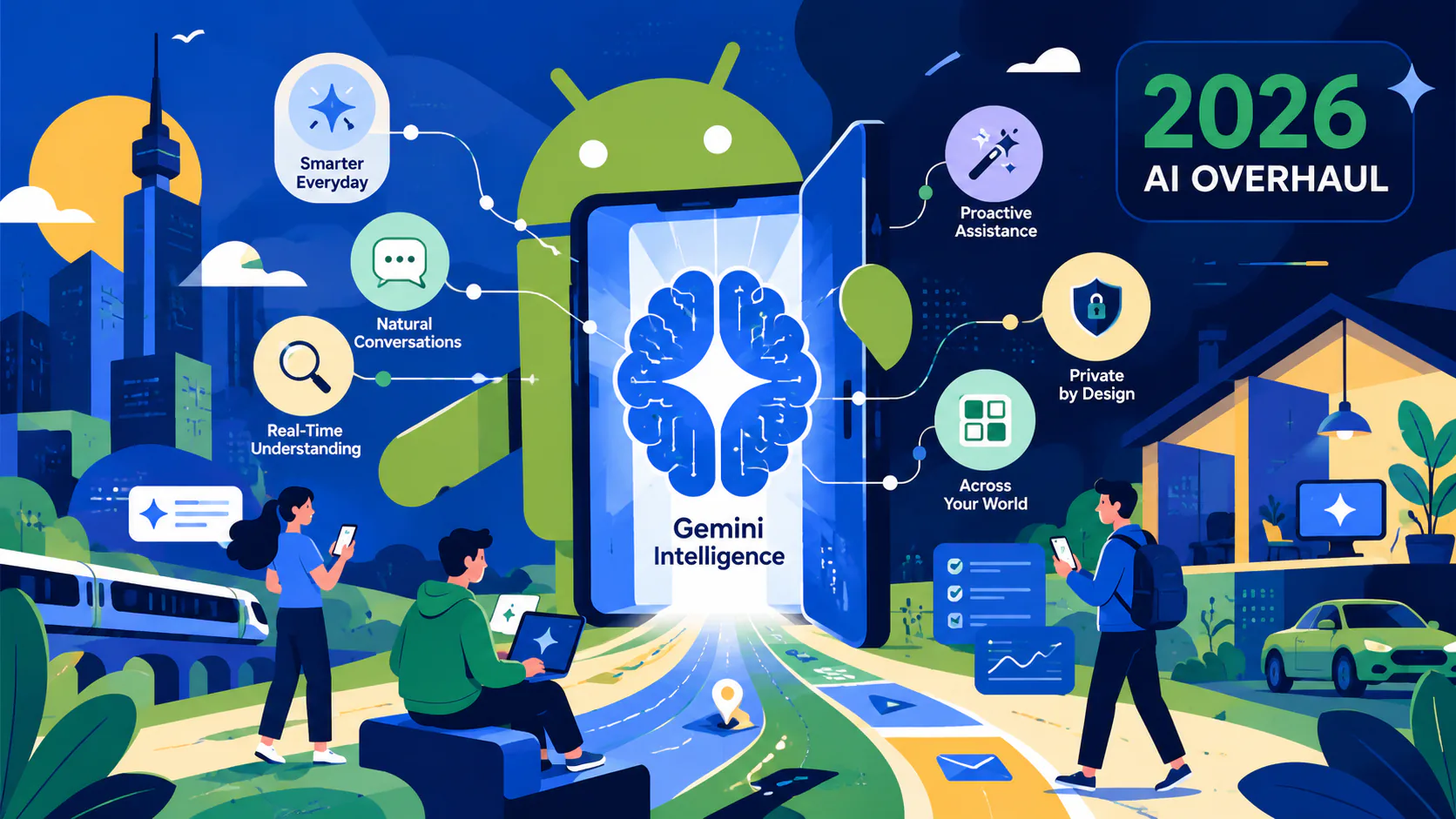
Google just told you what your next Android phone is going to do without being asked. At The Android Show: I/O Edition on May 12, 2026, Google introduced Gemini Intelligence, a system-wide push to make Android act before you tap anything.
This is not another Gemini app update. It's a rebrand of how Android itself behaves, tied to the upcoming Android 17 release. Here's what actually shipped, what's still vapor, and why it matters if you're choosing between a Pixel, a Galaxy, or an iPhone this year.
Gemini can now finish tasks across multiple apps
The headline change is multi-step automation. Instead of answering one question at a time, Gemini can chain actions across apps to complete a task you describe in plain language. Google's own examples include booking a spin class, pulling a course syllabus out of Gmail and adding the required textbooks to a shopping cart, or spotting a travel poster and asking Gemini to find a similar trip on Expedia.
That's a real shift from how Google Assistant worked. Assistant handled one instruction and stopped. Gemini Intelligence is built to read your screen, check apps you've authorized, and act across several of them in sequence. Google says the final purchase, payment, or booking step still requires your confirmation, which matters given how often automated web actions hit a login wall or a CAPTCHA.
Chrome on Android is turning into a task-execution browser
Starting late June 2026, Gemini in Chrome on Android gets smarter at research, summarizing pages, and comparing information across tabs. The bigger move is "auto browse," which can handle repetitive web tasks like appointment scheduling and parking reservations on its own.
This pushes Chrome from a page-reading tool toward something closer to a browser agent. The risk is obvious: websites are messy, forms break, and payment flows need a human in the loop. Google appears to know this, since it's keeping final submissions confirmation-gated rather than fully autonomous.
Autofill and Gboard get a Gemini upgrade
Autofill with Google now pulls from Gemini's Personal Intelligence to fill in complex form fields, things like passport numbers or full addresses, across apps and inside Chrome. Connecting Gemini to Autofill is strictly opt-in, and you can switch it off in settings at any time.
Gboard also picks up a feature called Rambler, which cleans up rambling speech into polished text. It strips the "ums," repeated phrases, and self-corrections that show up when speech-to-text is taken literally. If you've ever sent a voice-dictated text that read like a transcript of you thinking out loud, this is aimed directly at that problem.
Widgets you build by describing them
Create My Widget lets you generate a functional home screen widget just by describing what you want. Ask for a weather and commute dashboard, and Gemini builds the layout instead of you configuring it manually. It's the same idea as "vibe coding," applied to your home screen instead of a code editor.
There's also a new Scheduled Actions interface for recurring routines, like asking Gemini to compile a personalized morning news digest automatically. Combined with the updated Material 3 Expressive design language, the overall effect is a phone interface that adapts to you instead of the other way around.
Gemini is replacing Google Assistant, but slowly
Google confirmed Gemini will fully replace Assistant on Android, eventually reaching smartphones, tablets, Wear OS, and Google Home. The transition was originally planned to move faster, but reports point to a gradual rollout through 2026 because of technical and compatibility hurdles.
If you're still relying on Assistant routines for your smart home setup, expect overlap for a while rather than a hard cutover. Google Assistant apps are expected to disappear from supported devices over time, not overnight.
Rollout is staggered, and most phones won't get this first
Here's the part that matters for your buying decision. Features start on the Samsung Galaxy S26 series and Google Pixel 10 line in summer 2026, then expand to watches, cars, glasses, and laptops later in the year. Availability depends on device, region, language, and account settings, so this is not a one-day global switch.
Google also used the event to announce Googlebook, a new category of premium Android-powered laptops built around Gemini Intelligence, with Acer, ASUS, Dell, HP, and Lenovo confirmed as manufacturing partners. That's a separate hardware bet, not something existing Android phones gain through a software update.
Gemini Intelligence's agentic features are gated to flagship-tier hardware at launch. If you're on an older or mid-range Android phone, you'll get baseline Gemini features, not the automation layer described here.
How this stacks up against Apple Intelligence
Google's timing, weeks before Apple's WWDC, is not a coincidence. Apple Intelligence runs most tasks on-device for privacy, with Apple's Private Cloud Compute handling heavier workloads without retaining data afterward. Gemini Intelligence leans on cloud processing for its most capable features, which means broader device support and faster feature shipping, but a different privacy posture: data sent to Gemini can be retained on Google's servers, reportedly for as long as 18 months under Google's AI privacy policy.
Neither approach is strictly better. Apple's bet is a phone that does less, more carefully. Google's bet is a phone that does more, with less local control over where your data goes. If you've read our comparison of leading AI meeting tools, you've already seen this same tradeoff play out between on-device and cloud-based transcription.
What this means for developers and users
For users, the practical advice is simple: don't expect Gemini Intelligence on your current phone overnight unless you're on a Pixel 10 or Galaxy S26. Watch for new toggles in Gemini, Chrome, Gboard, and Autofill settings after the summer 2026 update window, and check what data access you're granting before turning Personal Intelligence on.
For developers, the bigger signal is that Google is normalizing agentic behavior at the OS level, not just inside a chatbot. If you're building Android apps, expect more API surface around screen context and intent handling as Google opens this up. That mirrors a pattern we covered in our breakdown of 255 LLM releases in Q1 2026: platforms are racing to embed agents everywhere, and the orchestration layer underneath is becoming the real battleground.
Frequently asked questions
Gemini Intelligence is Google's 2026 system-wide framework that brings Gemini's automation, Autofill, and generative UI features into Android, Chrome, and Gboard. It's tied to Android 17 and focuses on completing multi-step tasks across apps rather than answering single questions.
Google says features start rolling out on the Samsung Galaxy S26 series and Google Pixel 10 line in summer 2026, before expanding to other Android devices, watches, cars, and laptops later in the year.
Yes. Google confirmed Gemini will fully replace Assistant across Android, Wear OS, and Google Home, but the transition is gradual and expected to continue through 2026 rather than happen as a single cutover.
No. Connecting Gemini to Autofill with Google is strictly opt-in, and you can turn the connection on or off in Android settings at any time.