Google's AI Agents Vibe Coding Course: What You'll Learn
Google and Kaggle's free 5-day AI Agents Vibe Coding Course reviewed: full curriculum, who it's really for, what you'll build, and honest limitations.

Free courses from big tech companies usually follow a predictable arc: vague slides, surface-level demos, a certificate nobody asks about, and no actual code you can take anywhere. Google's 5-Day AI Agents: Intensive Vibe Coding Course is not that.
It drew 1.5 million learners in its November 2025 run. The 2026 edition, which ran June 15-19, upgraded the tooling, added a real capstone project, and made "vibe coding" the organizing idea. The materials are now self-paced on Kaggle. If you're a developer or data professional wondering whether it's worth five days of your time, this is the breakdown you need.
TL;DR: Five days, 1-2 hours each, completely free. You'll ship a working AI agent to Google Cloud by Day 5. It's built for developers who already know some Python. If you've never written code before, start with the DeepLearning.AI + Replit vibe coding intro first.
What "vibe coding" actually means in this course
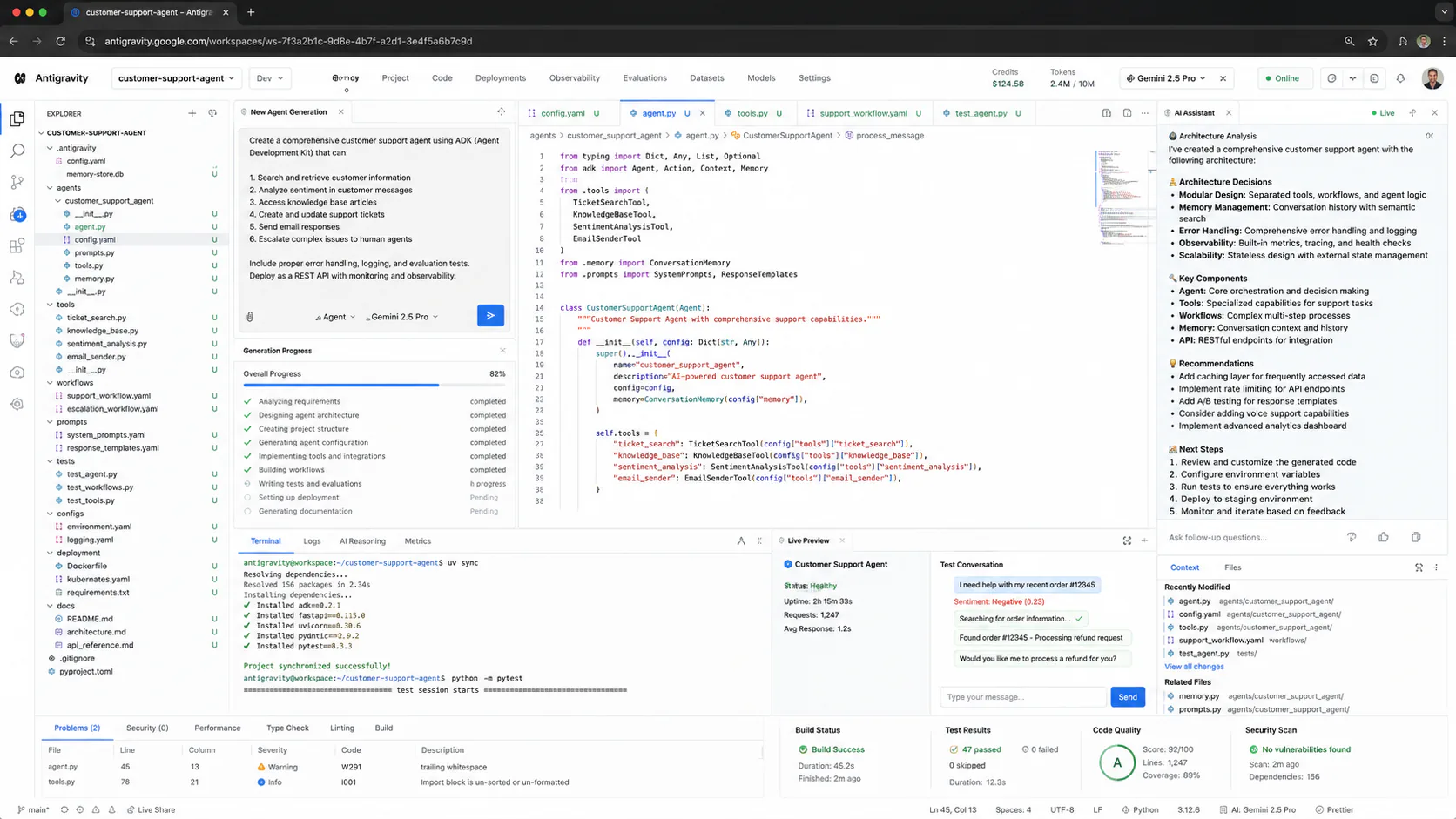
The term gets used loosely, so let's pin it down. In this course, vibe coding means you describe what you want in plain English and an AI IDE (Google's Antigravity) writes, edits, and executes the code for you. You act as the architect and reviewer. The machine does the typing.
That sounds like a small shift. It isn't. The course frames it as a transition from manual syntax coding to intent-driven programming, and draws a direct line to how production agentic systems are actually built inside Google. Developers in this model are "system orchestrators" who design evaluation harnesses, set constraints, and guide autonomous execution - not people who hand-craft every function.
The practical difference shows up in the codelabs. On Day 1, you describe an expense-report agent in natural language. Antigravity scaffolds the ADK 2.0 project structure, writes the routing logic, and sets up the local test environment. You review, run it, and move on to the next concept. The ratio of "intent expressed" to "working code produced" is the real metric the course trains you to optimize.
The five-day curriculum, broken down honestly
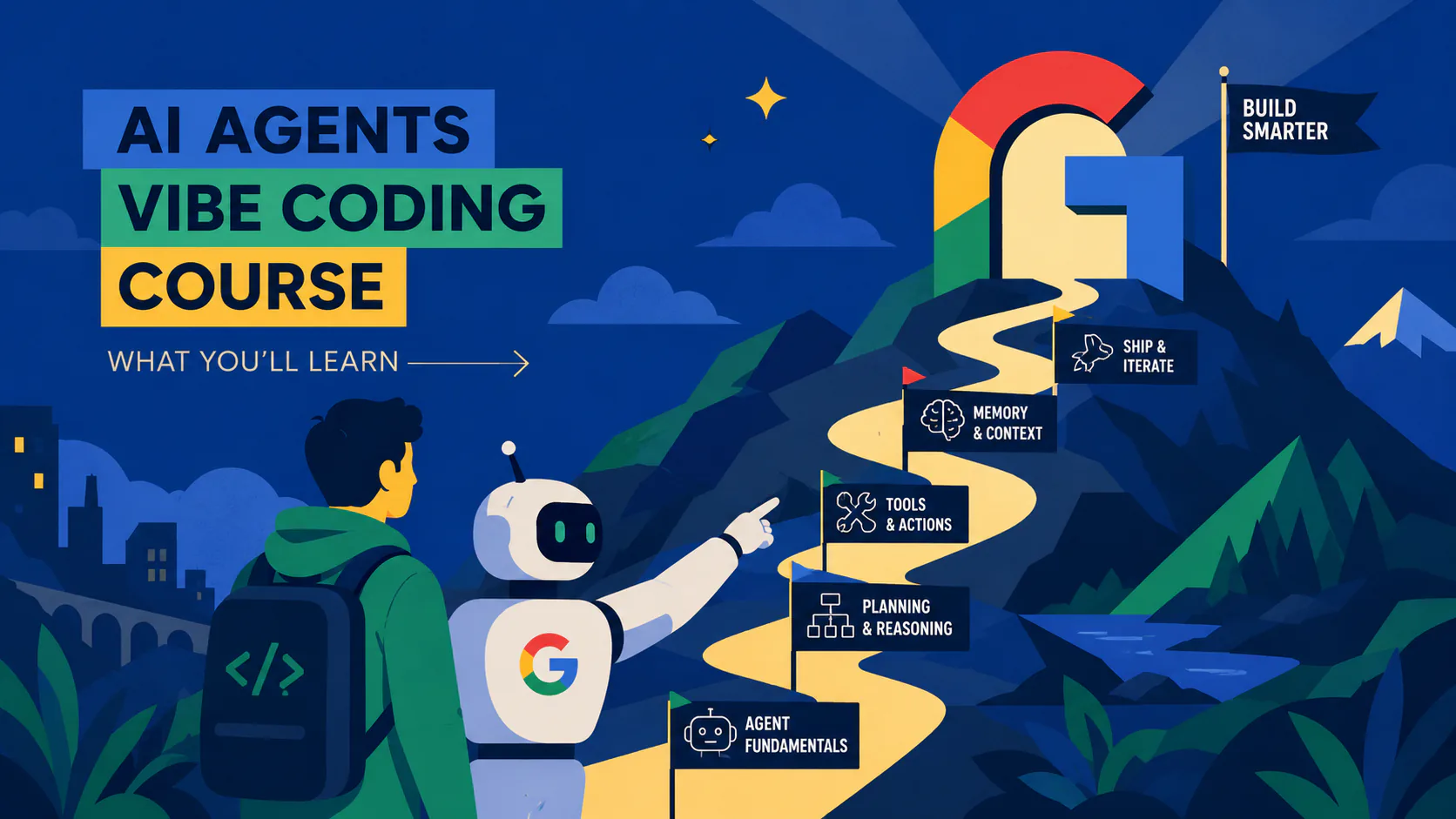
Each day follows the same structure: a Google-authored whitepaper, a companion podcast, one or two Kaggle Notebook codelabs, and a 45-60 minute YouTube livestream with the course authors. Figure on 1-2 hours of active work per day if you do the codelabs properly.
Day 1: Agents and the vibe coding foundation
You build two things: your first AI agent and your first multi-agent system, both using Google's Agent Development Kit (ADK) 2.0 powered by the Gemini API. The whitepaper introduces a useful taxonomy - agents are not just chatbots; they perceive inputs, reason about goals, use tools, take actions, and coordinate with other agents. The five core components the course returns to across every day are models, tools, orchestration, memory, and evaluation.
The Day 1 codelab puts Antigravity IDE in your hands immediately. By the end, you've deployed a small app to Cloud Run, which is a more meaningful milestone than most free courses hit in an entire week.
Day 2: Connecting agents to the real world via MCP
Day 2 focuses on how agents reach outside themselves. The tool is the Model Context Protocol (MCP), Anthropic's open protocol that connects AI agents to external APIs and data sources. Google adopted MCP across its own services in December 2025, so the lesson is grounded in how Google's own infrastructure works today.
You connect an agent to external APIs, wire up code execution, and get a first look at agent-to-agent communication. If you've read our guide to building your first MCP server, the concepts here will feel immediately familiar. The codelabs extend that foundation into ADK's tool-calling layer.
Your Agent (ADK 2.0)
      │
      ├── MCP (vertical layer)
      │     Connects agent to tools, APIs, and data sources
      │     e.g. Google Maps, BigQuery, a custom REST API
      │
      └── A2A (horizontal layer)
            Connects agent to OTHER agents
            e.g. a retrieval agent handing off to an analysis agent
            across different platforms or vendors
Day 3: Context engineering - memory and stateful sessions
This is the day most tutorials skip and the reason most AI agents fail in production. A stateless agent forgets everything the moment a session ends. Day 3 teaches you to fix that.
You build agents with working memory that persists within a session, then add long-term memory that survives across sessions entirely. The whitepaper defines the distinction precisely: sessions are the container for one immediate conversation; memory is the persistence mechanism that carries context forward. You implement both using ADK's context engineering API.
The practical payoff: agents that can carry on a coherent multi-turn conversation, reference earlier user preferences, and accumulate knowledge over time. This is what separates a demo from a tool someone will actually use.
Day 4: Security - the day most courses don't have
Day 4 is what makes the 2026 edition worth taking even if you've done similar agent courses elsewhere. The focus is STRIDE threat modeling applied to AI agents, test-driven development workflows using pytest, and agent-specific execution hooks that gate what an agent is allowed to do before it does it.
The codelab builds a retail shopping assistant with a discount redemption tool. The twist: you're intentionally asked to include a simulated vulnerability (a hardcoded mock API key) so Antigravity's security hook catches it before the code runs. You then write outcome-based security tests that assert on final state rather than internal implementation - a pattern that holds up when the agent rewrites its own internals.
Security note: AI agents that call external APIs or handle user data need security review from the first commit, not as a post-launch afterthought. Day 4's "shift security left" approach applies to any agent you build - not just the ones in this course.
Day 5: From a local prototype to a deployed system
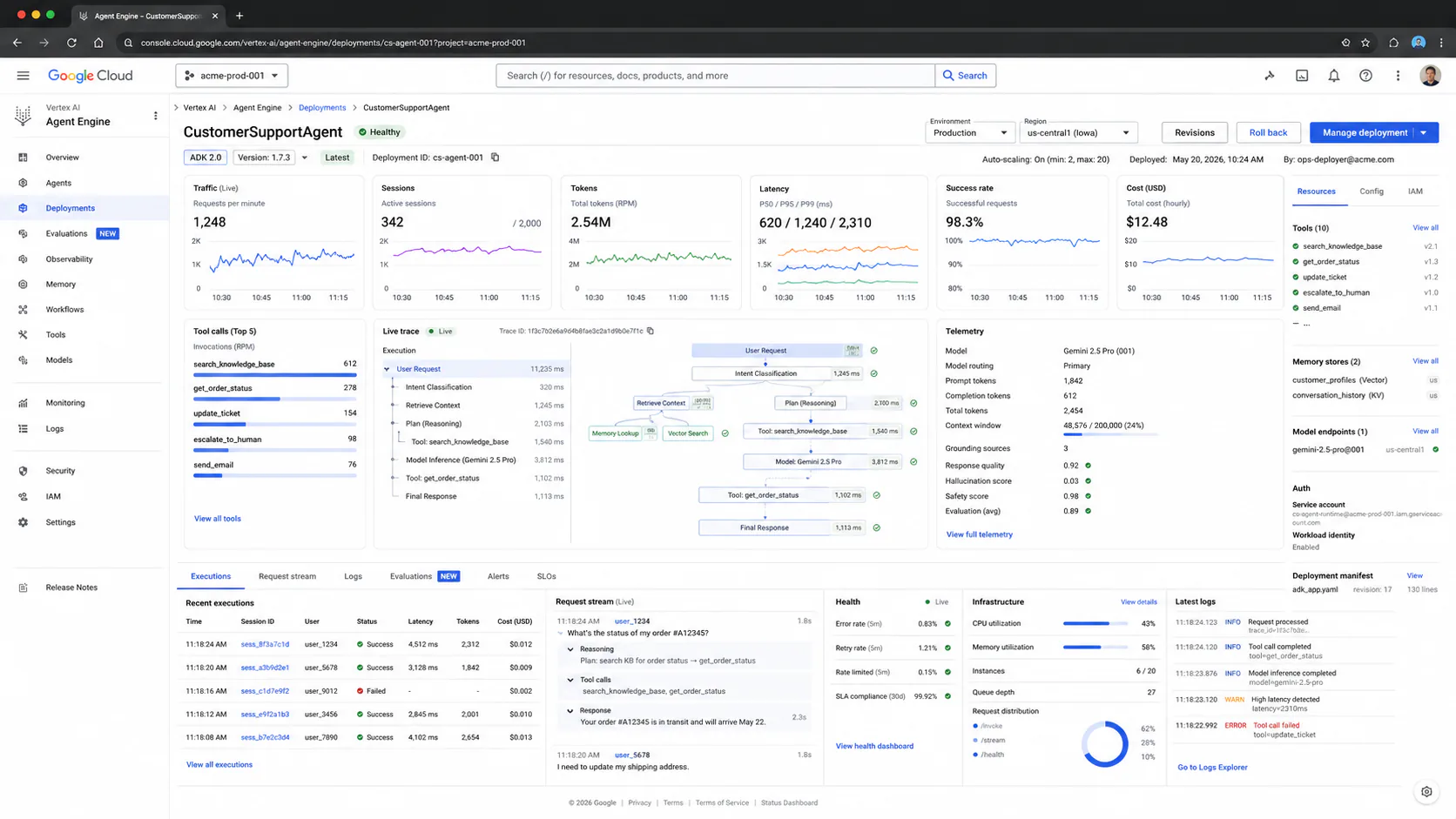
The final day covers deployment to Vertex AI Agent Engine on Google Cloud, real observability, and the Agent2Agent (A2A) Protocol. A2A is what lets independently built agents discover and delegate tasks to each other across different platforms and vendors. As of mid-2026, A2A v1.2 is in production at 150+ organizations including Microsoft, AWS, Salesforce, and ServiceNow.
You build a working multi-agent system using A2A, then deploy it. By end of Day 5, you've gone from describing an agent in plain English on Day 1 to having a production URL you can share with someone else.
The tools you'll actually use
Understanding the stack before you start saves you from confusion in the codelabs.
Google ADK 2.0 is the open-source framework that structures how agents are built. It uses a graph-based workflow API, which means you define the routing logic as a directed graph rather than imperative code. The agents-cli companion tool handles scaffolding, local testing, evaluation runs, and deployment commands. ADK 2.0 has stable releases for Python, Go, Java, and TypeScript.
Antigravity IDE 2.0 is Google's agentic development environment. You describe what you want; it writes the code. It integrates with agents-cli and can execute terminal commands, manage Git state, and run tests on your behalf. Think of it as a coding agent that operates your development machine, not just a code completion plugin.
Gemini API powers the underlying LLM throughout every codelab. You need a Google AI Studio account (free) to generate an API key. The codelabs use Gemini but the ADK is model-agnostic at the architectural level.
Vertex AI Agent Engine is where your agents live after Day 5. It's Google Cloud's managed runtime for AI agents, handling scaling, logging, and the plumbing needed for production traffic.
| Tool | What it does | Where you need it |
|---|---|---|
| ADK 2.0 | Structures and runs your agent logic | Days 1-5 |
| Antigravity IDE 2.0 | Vibe codes your agent from natural language | Days 1, 4, 5 |
| agents-cli | Scaffolds, tests, and deploys ADK agents | Days 1, 3, 5 |
| Gemini API | Provides the LLM powering your agents | All days |
| MCP | Connects agents to tools and external APIs | Day 2 |
| A2A Protocol | Connects agents to other agents | Day 5 |
| Vertex AI Agent Engine | Hosts deployed agents in production | Day 5 |
Who this course is genuinely for
Take it if:
- You know Python at a basic level and want to build AI agents without learning a new language from scratch.
- You work in data science, backend engineering, or DevOps and need to understand how agentic AI systems actually get deployed.
- You're building on Google Cloud and want to understand how ADK, Vertex AI, and the Gemini API connect in practice.
- You want a credential that signals hands-on agent experience, not just theoretical AI knowledge.
- You have 1-2 hours per day and prefer structured, daily releases over a self-directed open-ended curriculum.
Skip it (or do it after something else) if:
- You've never written Python before. The vibe coding workflow reduces how much you write, but you still need to read and review the output. Non-programmers will be lost on Days 3-5.
- You're deep in the AWS Bedrock or Azure AI ecosystem. The course teaches Google's toolchain specifically. The conceptual knowledge transfers; the codelabs don't.
- You want deep mastery of any single topic. At 1-2 hours per day, the course is deliberately broad. Security and context engineering each get one day. Real production systems need more than that.
- You're in a sanctioned region or under 18. The Gemini API and Kaggle Notebooks are geo-restricted.
The capstone: "Kaggriculture"
The optional capstone project runs from June 19 through July 6, 2026, with submissions still open at time of writing. The challenge is a farming simulation where you build and deploy an autonomous agent that competes on a live Kaggle leaderboard.
Completing the capstone earns an official Kaggle certificate and a profile badge. Top submissions get social recognition from Google's channels. The leaderboard format is competitive by design - if you prefer collaborative learning, the daily codelabs are satisfying on their own.
The submission requirements are practical: a Kaggle writeup documenting your agent, a video walkthrough, a short rationale for your design choices, and a link to the code. It's structured enough to be a real portfolio piece.
What the course doesn't cover
Honest limitations matter, so here's what you won't get from these five days.
The curriculum is built entirely around Google's ecosystem. ADK, Antigravity, Vertex AI, and Gemini are the tools. If you want framework-agnostic agent skills, you'll need to complement this with LangGraph, CrewAI, or LlamaIndex tutorials. The concepts transfer; the hands-on habits don't always.
Each topic gets roughly one day of treatment. Context engineering alone is deep enough for a week-long course. Security for AI agents is a full discipline. The course gives you a working foundation and the vocabulary to go deeper, but it's not a substitute for dedicated study in either area.
The A2A protocol is taught as production-ready, and it is for many use cases. But enterprise adoption is still maturing. Treat A2A skills as forward-looking infrastructure knowledge - valuable, but validate before staking a production system on it at scale.
How it compares to alternatives
The direct alternatives worth knowing about:
DeepLearning.AI + Replit (Vibe Coding 101): Free, ~4 hours, browser-based, no code prerequisites. Better for complete beginners. Weaker on agent architecture and has no production deployment path.
DeepLearning.AI + Google/IBM (A2A Protocol course): Free short course that goes deeper on A2A specifically and builds a multi-agent healthcare system. A good follow-on after completing Day 5 here.
Google's prior GenAI Intensive (2025 edition): Still available as a self-paced Kaggle Learn guide. Covers foundational LLMs, embeddings, RAG, and MLOps. A better starting point if you're new to generative AI and haven't worked with the Gemini API before.
Coursera/Scrimba Vibe Coding Specialization: Paid, multi-week, tool-agnostic. Better if you want a structured career-track credential that's not tied to Google's platform.
The Google/Kaggle course has a specific niche that none of the above fill: free, production-grade, Google-ecosystem, agent-focused, with real deployment and a credentialing capstone. For that combination, it's in a category of one.
What to build next after the course
Finishing all five days puts you in a specific position: you can build and deploy a working AI agent on Google Cloud, you understand how MCP and A2A connect agents to tools and to each other, and you've done at least one security-aware codelab. That's a usable foundation.
Three directions worth pursuing from here:
First, go deeper on context engineering. Long-term memory and session management are what turn a clever demo into a tool people keep using. The ADK documentation and the course's Day 3 whitepaper have more detail than the codelab covers.
Second, add observability. Deployed agents that you can't trace are a production liability. Vertex AI's logging integrates with Google Cloud Monitoring, and the Day 5 materials point toward what to instrument. Build that habit early.
Third, practice cross-framework agent communication using A2A. The protocol is framework-agnostic by design - a LangGraph agent and an ADK agent can coordinate over A2A. Building that bridge yourself, outside the guided codelab environment, is where the real learning sticks.
If you want to pair agent skills with broader no-code and builder workflows, the Lovable full-stack tutorial covers a complementary stack for teams who need to move from idea to deployed app without deep backend knowledge.
Where to go from here
The capstone is still open. The self-paced materials are on Kaggle Learn for free. If you've been waiting for a structured, free, hands-on path into AI agent development, this is the one to start with.
The course won't make you an agent infrastructure expert in five days. It will give you a working mental model, hands-on deployment experience, and enough fluency with ADK, MCP, and A2A to build something real. That's a better outcome than most paid courses deliver.
Frequently asked questions
Yes, fully free. There are no paid tiers, upsells, or subscription requirements. You need a Kaggle account (free, phone verification required) and a Google AI Studio account (free) to access the codelabs and API keys. Livestream recordings are also free on Kaggle's YouTube channel.
Basic Python is strongly recommended. The vibe coding workflow reduces how much you write by hand, but you'll read and review ADK agent code throughout the codelabs. Learners with zero programming experience will likely struggle from Day 3 onward. Complete beginners are better served by the DeepLearning.AI + Replit Vibe Coding 101 course first.
ADK (Agent Development Kit) is Google's open-source, code-first framework for building AI agents using a graph-based workflow API. It's the primary tool throughout all five days. After the course, ADK is genuinely useful for any project targeting Google Cloud's Vertex AI Agent Engine. It's less relevant if you're building on AWS or Azure, though the underlying agent concepts apply everywhere.
Yes. All daily materials - whitepapers, podcast episodes, and codelabs - are now available as a self-paced guide on Kaggle Learn at no cost. The capstone project (Kaggriculture) has a submission deadline of July 6, 2026, so there's still time to complete and submit it for the certificate and badge.
Cursor and Copilot are code completion tools that work inside your existing workflow. Antigravity IDE, which this course uses, is an agentic IDE: it receives natural language instructions and autonomously executes terminal commands, writes files, runs tests, and manages your project state. The vibe coding paradigm here is higher-level - you're orchestrating the entire development workflow, not just getting suggestions inline.