GPT Image 2: Photorealism, Hands, Faces, and Benchmarks Tested
GPT Image 2 reached 1,512 Elo, improved hands and faces, near-perfect text rendering, and new API economics after the DALL-E 3 retirement.

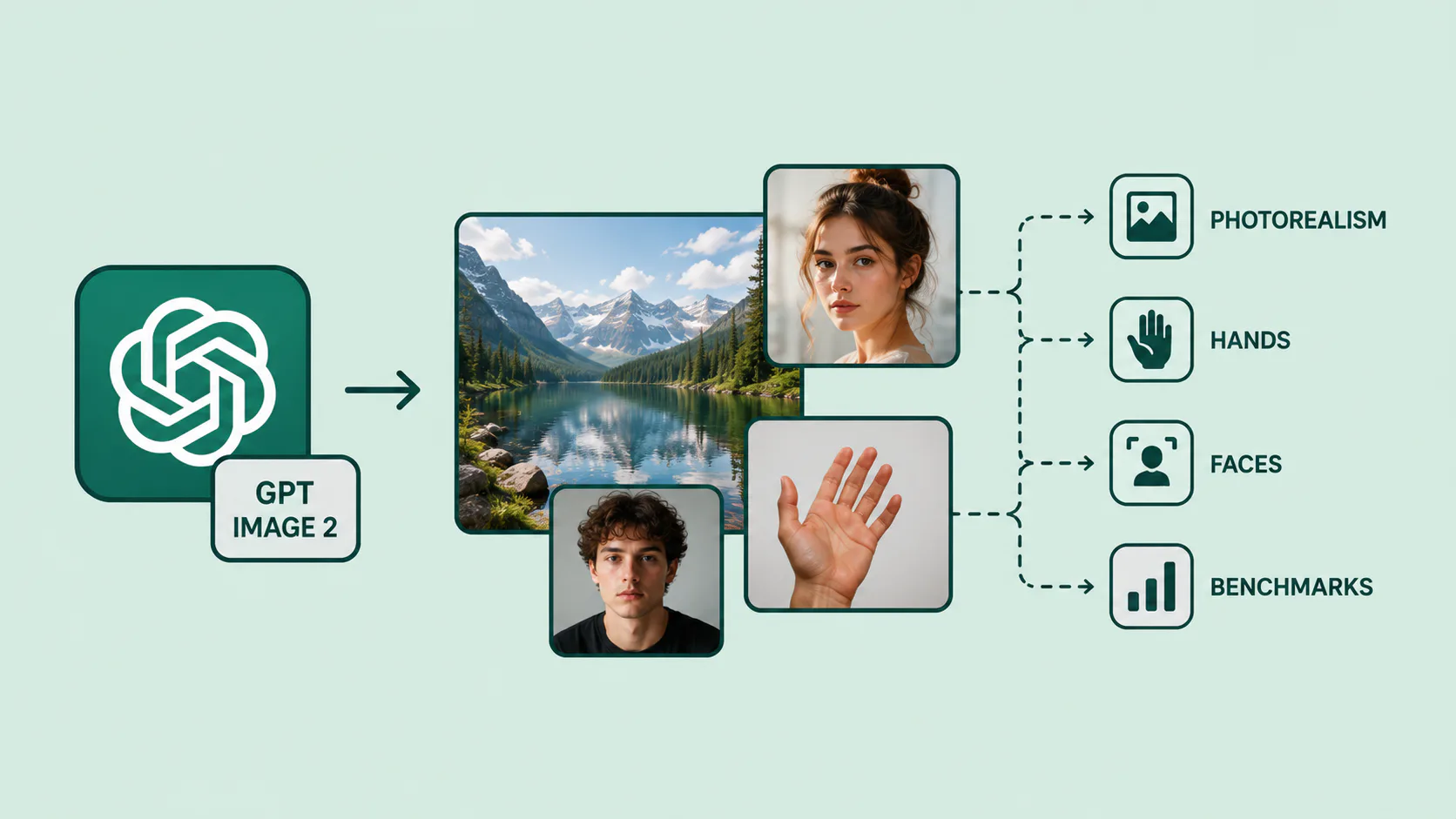
On April 21, 2026, OpenAI dropped a new image model with no press event, no countdown, no keynote. Within days, GPT Image 2 had posted a score of 1,512 Elo on Image Arena. 242 points ahead of the previous leader, the largest gap ever recorded on the leaderboard.
That margin isn't a rounding error. It means blind human evaluators were choosing GPT Image 2 in head-to-head matchups at a rate that makes the scoreboard, in one reviewer's words, "look lopsided." For context: before April 21, GPT Image 1 and Google's Nano Banana were trading the top position within a few dozen points of each other.
The reasons behind the gap are specific and practical: hands that look like hands, faces that hold up under scrutiny, text that renders accurately in eight scripts, and a reasoning layer that changes how you interact with the model entirely. Here's what actually changed and what hasn't.
Migration deadline: DALL-E 2 and DALL-E 3 were retired on May 12, 2026. Any production
code calling those endpoints is already broken. The migration path is gpt-image-2 - same API
key, same base URL, different model string.
The hands and faces question: answered honestly
The three reliable tells for AI-generated imagery have always been: extra fingers, waxy faces, and garbled text. GPT Image 2 attacks all three, but the hands and faces story deserves more precision than most coverage provides.
Hands: The autoregressive architecture is credited for the improvement here. Diffusion models learn what hands statistically look like across billions of images. Autoregressive models generate token-by-token with access to the full GPT backbone's world knowledge, meaning the model understands how hands actually work: joint angles, weight distribution, how fingers bend under grip. The result is that complex multi-subject scenes with interacting hands, historically almost guaranteed to produce AI artifacts are now generating with anatomically plausible results that early testers described as "indistinguishable from real photographs when shown to people without context."
Faces: GPT Image 1.5 had documented weaknesses with multiple faces in one frame and with face consistency across edits. Both are improved in GPT Image 2. Multiple faces in a single scene now hold anatomical consistency, and inpainting no longer breaks facial coherence the way it regularly did before.
The honest caveat: trained eyes can still detect GPT Image 2's outputs, particularly in faces and hands. The gap to zero is not closed. For editorial photography, journalism, or any context where authenticity must withstand professional scrutiny, the residual AI aesthetic remains detectable. C2PA watermarking is baked into every output, which helps with platform-level verification, but it's metadata, not a visible signal to casual viewers.
What the autoregressive architecture actually changes
GPT Image 2 is not a diffusion model. Understanding why that matters requires a brief detour.
DALL-E 2, DALL-E 3, Stable Diffusion, and Midjourney all use diffusion: start with noise, iteratively denoise toward the target. Diffusion models excel at smooth painterly aesthetics. They struggle with spatial logic, text, and precise instruction-following because they work with visual statistics rather than semantic meaning.
GPT Image 2 uses the same autoregressive approach introduced in GPT Image 1 generating images token-by-token, the same way GPT generates text. The generation draws on the full GPT-5.4 backbone, which means the model understands what it's drawing: brand identities, real-world spatial relationships, software interfaces, anatomical structures. It's the difference between a model that knows what hands look like and one that knows how hands work.
The practical downstream effects: superior text rendering, better real-world object accuracy (known logos, UI interfaces, correct architectural details), and instruction-following that is qualitatively more reliable. Where GPT Image 1 "often defaulted to generic aesthetics," GPT Image 2 testers cite what they call "genuine world knowledge" - IKEA storefronts with architectural accuracy, YouTube and Windows interfaces close enough to pass as real screenshots, Minecraft scenes with correct in-game UI.
Text rendering: the commercial unlock
Before GPT Image 2, text accuracy was "the bottleneck that blocked AI-generated assets from reaching clients." A poster with a misspelled headline, a product label with garbled copy, a UI mockup with nonsense button labels. All required manual correction or complete regeneration. At scale, this made AI image generation impractical for commercial production workflows.
GPT Image 2 reports ~99% character-level accuracy across Latin, CJK, Hindi, and Bengali scripts verified independently by third-party reviewers. Multi-word phrases, varied font weights, complex text placement, and brand logos all render reliably on the first try.
For comparison: Midjourney v8 still struggles with complex multilingual text and long strings in non-Latin scripts.
The practical consequence is significant. Production teams are now reporting that GPT Image 2 outputs pass QA checks "without systematic text correction" for the first time in AI image generation. The categories this unlocks: product packaging mockups with accurate label copy, advertisement banners with multi-language headlines, social media assets with accurate overlaid text, and UI mockups with correctly spelled button labels.
Thinking Mode: reasoning before generating
GPT Image 2 introduces a Thinking Mode, a reasoning layer available to ChatGPT Plus subscribers and above where the model reasons through a complex design request before executing it.
The capabilities this enables go further than they might initially sound:
- Web search during generation: The model can pull real-time references mid-generation. Accurate rendering of a specific building's current appearance, a brand's current logo, or a software interface's current design becomes possible without pre-supplying reference images.
- Self-checking: The model evaluates its own generations and retries internally before presenting a result.
- 8-panel batch coherence: Thinking Mode enables generating eight coherent panels from a single prompt with consistent characters, object placement, and brand palette across all panels. Children's book illustration, game studio storyboards, multi-format campaign launches previously these required complex external workflows. As of April 21, they don't.
For developers: Thinking Mode requires a paid ChatGPT subscription to evaluate through the ChatGPT interface, and adds reasoning token overhead with costs that aren't cleanly itemized per prompt, a known friction point flagged by multiple reviewers. The capability itself is accessible via API, but budget planning for Thinking Mode workflows is harder than for standard generation.
The competitive landscape in one table
| Model | Best for | Notable weakness |
|---|---|---|
| GPT Image 2 | Text rendering, instruction-complex prompts, production utility | Midjourney leads on pure aesthetics |
| Midjourney v8.1 Alpha | Artistic quality, editorial, cinematic stills | Weak multilingual text; Discord-first UX |
| Flux 2 Pro | Raw photorealism, open architecture | Weaker text and instruction-following |
| Google Nano Banana Pro | Fastest generation, cheapest frontier pricing, video input | Less consistent run-to-run; trails on text |
| Ideogram 3.0 | Typography and graphic design | Not a general-purpose generator |
| Recraft V4 | Vector/SVG output | Limited photorealism scope |
| DALL-E 3 | Legacy API compatibility | Retired May 12, 2026 |
The competitive story is nuanced. GPT Image 2 wins head-to-head evaluations at scale, but Midjourney v8.1 Alpha (launched March 2026 with native 2K resolution and 5× faster generation) remains the tool of choice for editorial and fine art work where aesthetic quality outweighs production utility. Flux 2 Pro still edges GPT Image 2 on raw photorealism for portrait and product photography specifically.
The professional standard in 2026 is not picking one tool it's routing: GPT Image 2 for text-heavy or instruction-complex tasks, Midjourney for artistic work, Flux 2 Pro for photorealism-first product photography.
API pricing and rate limits: what builders need to know
GPT Image 2 pricing is tiered by quality:
| Quality tier | Price per image |
|---|---|
| Low (1024×1024) | $0.006 |
| Medium | ~$0.053 |
| High (2K) | $0.10–$0.21 |
| Batch API (up to 24hr latency) | 50% discount |
The developer community has broadly validated the "draft cheap, finalize expensive" workflow: low quality at $0.006 for ideation and iteration, high quality only for production outputs. This is described as "actually viable rather than a marketing line" - something earlier AI image pricing structures didn't credibly support.
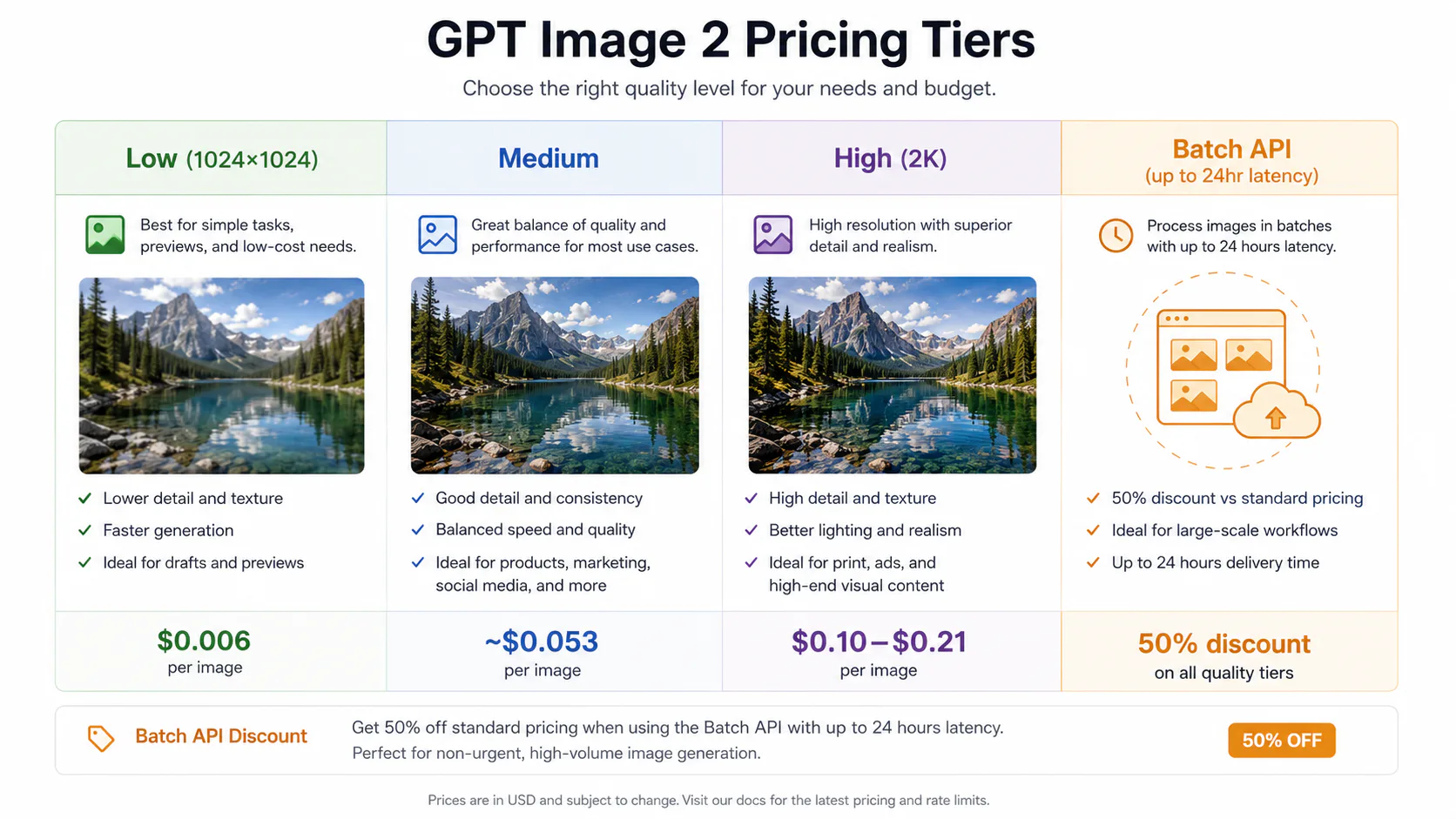
The Batch API's 50% cost reduction for non-real-time workloads is significant for high-volume use cases: catalog photography, content libraries, training data generation. At scale, the economics change meaningfully.
Rate limits are the friction point for production workloads. Tier 1 starts at 5 images per minute, insufficient for any meaningful production pipeline. Tier 5 caps at 250 IPM, which covers most teams but hits during bursty traffic. Consumer products with unpredictable demand peaks and enterprise pipelines with strict SLAs need multi-provider routing or pre-generation strategies.
A hidden cost nobody puts in pricing comparisons: failure rate. A medium-quality image at $0.053 regenerated five times because the first four missed the brief costs $0.265 with one image to show for it. The failure rate improvement in GPT Image 2 reduces this, but it doesn't eliminate it. Budget modeling for AI image generation needs to account for the average number of attempts per successful output.
Organization Verification in the OpenAI developer console is required before API access a one-time setup step, but worth knowing before planning a sprint around GPT Image 2 integration.
The DALL-E 3 migration: what's different
Migrating from DALL-E 3 to gpt-image-2 is straightforward at the API level - same key, same base URL, updated model string. The behavior differences are less straightforward and worth testing before assuming a drop-in replacement:
- Instruction interpretation: GPT Image 2 follows prompts more precisely. Prompts written to work around DALL-E 3's tendency to generalize may produce differently-structured results under the new model.
- Default aesthetics: The autoregressive backbone's world-knowledge-grounded outputs look different from DALL-E 3's diffusion-style outputs. Existing style prompts may need adjustment.
- Aspect ratio handling: GPT Image 2 supports native aspect ratios from 3:1 to 1:3. If your integration was generating square images and cropping post-generation, you can now request the target ratio directly.
The Batch API with its 50% discount is worth evaluating during migration if your integration has any workloads tolerant of up to 24 hours of latency.
What shifts in the market from here
The hands/faces improvement is the development most consequential to the stock photography industry. The three reliable tells that distinguished AI imagery from human photography have been substantially reduced in a single release. C2PA watermarking enables platform-level provenance tracking, but it doesn't create a quality barrier that prevents AI images from competing on visual appeal. The industry response is already moving toward authenticity certification, provenance-verified human photography commanding a premium in contexts where human authorship is genuinely meaningful, while AI generation handles commodity visual needs.
The skill value shift is equally structural. The table one comparative analysis produced tells the story clearly:
| Skillset | Value in 2024 | Value in 2026 |
|---|---|---|
| Keyword/prompt engineering | Very High | Low |
| Art direction / taste | Medium | Very High |
| Post-editing (Photoshop) | High | Medium |
| Workflow automation | Low | Very High |
Prompt engineers who extracted good outputs through clever phrasing are facing a declining market. Art directors who can brief AI systems like creative collaborators and engineers who can build AI-integrated production workflows are in rising demand.
Based on OpenAI's release cadence (GPT Image 1 in March 2025, GPT Image 1.5 in December 2025, GPT Image 2 in April 2026), the next major version is projected for late 2026 to early 2027. The areas with the most room to grow: closing the residual AI aesthetic gap for trained observers, real-time generation for interactive applications, and 3D asset output.
Why it matters now
GPT Image 2 is the first AI image model to simultaneously solve text rendering, hand anatomy, and face consistency at a quality level that passes casual scrutiny and it has the benchmark lead to show it wasn't a fluke. For developers, the urgency is immediate: DALL-E 3 is already retired, migration is mandatory, and the new pricing structure rewards building the right cost tiers into your generation pipeline from the start.
For designers and marketers, the commercial asset production blocker, broken text, garbled copy, anatomically broken humans is substantially removed. The question shifts from "can this work?" to "how do I integrate it into the production workflow?"
If you're building with AI image generation in 2026, this is the new baseline. Our overview of the AI tools landscape covers where GPT Image 2 fits alongside the broader category. For teams evaluating the full AI research and production stack, the NotebookLM 2026 review covers the private document analysis side of the same workflow.
Frequently asked questions
Yes. DALL-E 2 and DALL-E 3 were both retired on May 12, 2026. Any production code calling those
endpoints is now broken. The migration path is gpt-image-2, which uses the same API key and base
URL - only the model string needs updating.
Substantially, yes, but not completely. The autoregressive architecture gives the model genuine spatial understanding of how hands work, not just what they statistically look like. Complex multi-subject scenes with interacting hands now generate with anatomically plausible results that pass casual scrutiny. Trained eyes can still detect the residual AI aesthetic, particularly in hands and faces. The improvement is dramatic; the gap to zero is not yet closed.
Low quality (1024×1024) costs $0.006 per image. Medium quality is approximately $0.053. High quality at 2K resolution runs $0.10–$0.21 per image. The Batch API offers 50% off for workloads that tolerate up to 24 hours of latency. Rate limits start at 5 images per minute on Tier 1 and cap at 250 IPM on Tier 5. Budget planning should also account for regeneration costs, failure rate is a real line item.
It depends on what you need. GPT Image 2 leads on text accuracy, instruction-following, production utility, and API integration. Midjourney v8.1 Alpha still leads for artistic quality, editorial photography, and cinematic stills where aesthetic depth outweighs precision. Most professional teams are now routing between models GPT Image 2 for text-heavy and instruction-complex tasks, Midjourney for artistic work.
Thinking Mode is a reasoning layer that lets GPT Image 2 plan a complex generation request before executing it including web search during generation to verify current brand logos or building appearances, self-checking outputs, and generating coherent 8-image batches from a single prompt. It requires a ChatGPT Plus subscription or above to access via the ChatGPT interface, and adds reasoning token overhead with costs that aren't clearly itemized per prompt. For complex, multi-constraint production workflows, the quality improvement is real. For straightforward single-image generation, the base model is sufficient.