Weekly AI Roundup: Biggest Launches and Funding Rounds
Week of June 15-17, 2026: Claude Fable 5 launched and pulled by the US government, SpaceX IPO'd at $1.77T, Anthropic filed confidentially, and Gemini 3.5 Pro is still not out.


A new frontier model launched, got pulled by the US government, and went fully dark worldwide in under 72 hours. The largest IPO in history priced and started trading. Anthropic quietly filed its own S-1. And Gemini 3.5 Pro remains available any day now, which is exactly what Google said five weeks ago.
This is the week of June 9-17, 2026. Here is what happened and what it means for developers, builders, and anyone trying to plan around AI infrastructure.
Dates in this roundup: Unless noted, "this week" refers to June 9-17, 2026. The Claude Fable 5 launch was June 9; the SpaceX IPO priced June 11 and debuted June 12; Anthropic's confidential S-1 was filed June 1 and confirmed publicly this week.
Claude Fable 5 Launched Tuesday. The US Government Pulled It Friday.
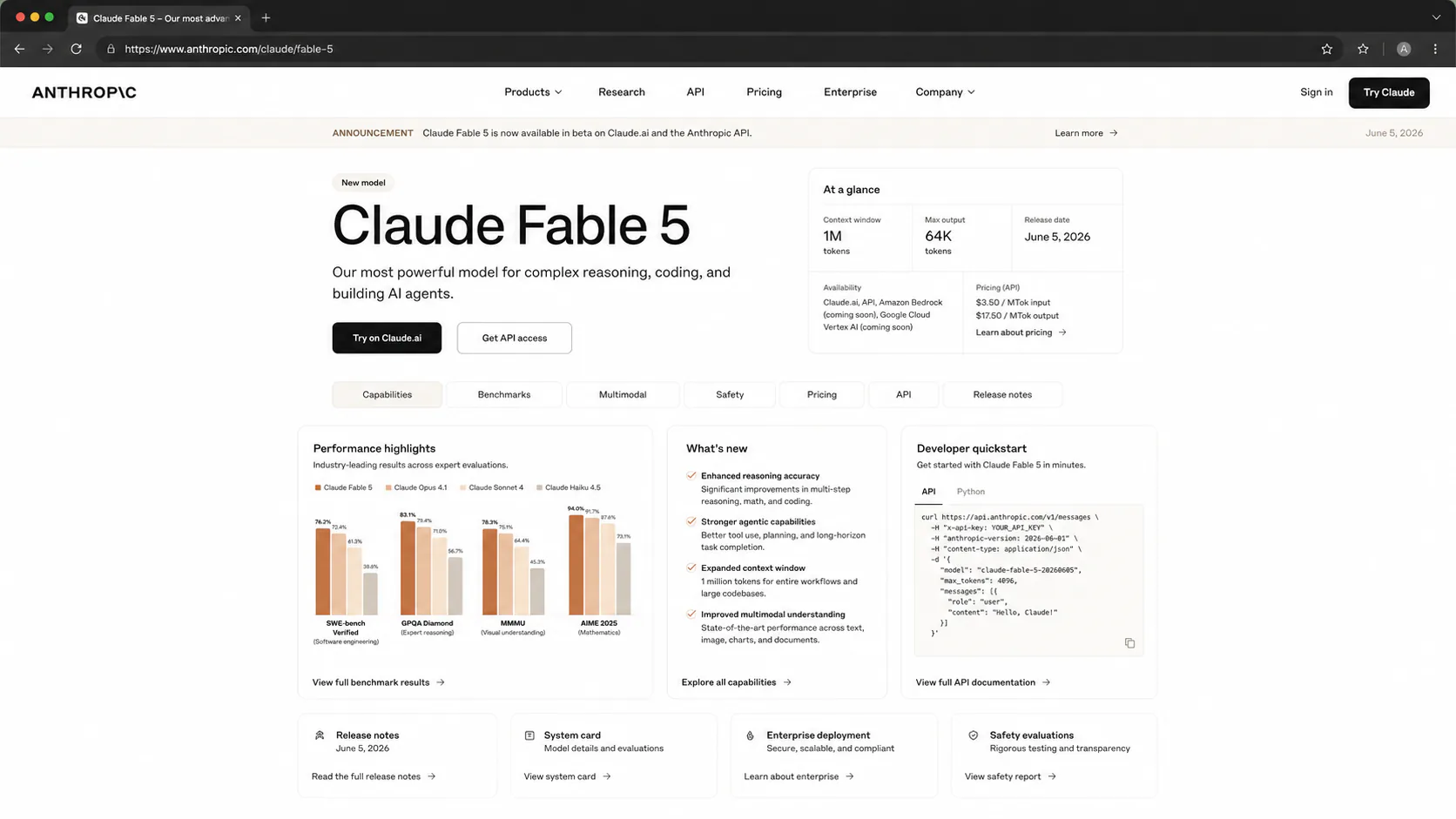
Anthropic launched Claude Fable 5 on June 9, 2026, positioning it as the first publicly available Mythos-class model. It offered a 1-million-token context window, 128K output tokens, and always-on adaptive reasoning. Pricing was set at $10 per million input tokens and $50 per million output tokens.
The model comes with hard safety limits. In high-risk domains (cybersecurity, biology, chemistry, nuclear topics), Fable 5 blocks the request and silently falls back to Claude Opus 4.8. Anthropic had run over 1,000 hours of external bug-bounty testing before launch, with no universal jailbreaks found.
By Friday, June 12 at approximately 5:21 PM Eastern, Fable 5 was offline for every user on the planet. Not rate-limited. Not region-restricted. Completely gone. A US government export-control directive, issued after the launch, required Anthropic to suspend public access to both Fable 5 and the more powerful Claude Mythos 5.
This is the first time a US government export-control order has been used to pull a live, globally deployed commercial AI model. The authority has existed for decades to restrict physical hardware and certain technical data; applying it to software running in production on a commercial API is new territory.
The separate Claude Mythos 5, which lacks Fable 5's safety classifiers and can reportedly discover unknown software vulnerabilities autonomously, remains available only to vetted organizations through Project Glasswing. Current participants include Microsoft, Nvidia, Cisco, Google Cloud, and AWS. Anthropic's launch statement said: "No entity currently has sufficient safeguards for a full public release of Mythos-level models."
Stripe reported that Fable 5 compressed months of engineering work into days and handled a large Ruby codebase migration that would have taken a team over two months. Whether Anthropic restores public access, ships a modified Fable 5 variant compliant with the directive, or leaves the model suspended indefinitely is the most consequential open governance question in AI this month.
What this means in practice: Any production dependency on a specific frontier model now carries a new risk category: sudden regulatory suspension. If you are building on API-tier models from frontier labs, your continuity planning needs a fallback, not just a retry loop.
Gemini 3.5 Pro Is Still Not Out (But Flash Is Already Beating Last Year's Pro)
Google unveiled Gemini 3.5 Pro at I/O on May 19 and told the audience to wait another month. We are now more than three weeks into that month, and Pro has not shipped to general availability.
What has shipped: Gemini 3.5 Flash, released at I/O, is priced at $1.50/$9.00 per million tokens (input/output) and is already outperforming Gemini 3.1 Pro on Terminal-Bench 2.1 (76.2% vs 70.3%), MCP Atlas (83.6% vs 78.2%), and Finance Agent v2 (57.9% vs 43.0%). Flash costs roughly 40% less than Gemini 3.1 Pro while beating it on every benchmark listed above.
Gemini 3.5 Pro is targeting a 2-million-token context window and Deep Think reasoning. Pricing is estimated at around $15/$60 per million tokens based on the typical Flash-to-Pro ratio. If Pro extends the benchmark gaps Flash already established over 3.1 Pro, it will force a real pricing renegotiation against Claude Opus 4.7 and GPT-5.5.
The model deprecation picture around Gemini is also worth flagging. Gemini 2.0 models are already fully shut down, and several 3.1 preview models (including gemini-3.1-flash-image-preview and gemini-3-pro-image-preview) are being deprecated within months of release. If you are building on any Gemini preview endpoint, budget time for a migration before the end of Q3.
SpaceX IPO'd at $1.77 Trillion
SpaceX priced at $135 per share on June 11 and began trading June 12. The offering sold 555.6 million shares for a $75 billion raise, with underwriters holding an option for $11.2 billion more. Elon Musk retains over 82% of voting control after the offering. Investor demand reportedly exceeded $250 billion, roughly 3.5 to 4 times the amount actually offered, with retail investors earmarked for 30% of the float.
The AI connection is buried in the S-1: SpaceX disclosed a deal renting 300 megawatts of compute capacity to Anthropic for $1.25 billion per month through May 2029. This means SpaceX (through the merged xAI entity) is both a compute supplier and AI competitor to Anthropic simultaneously. The S-1 also disclosed that xAI lost $2.4 billion in Q1 2026 alone while spending $7.7 billion on capex.
The SpaceX debut is the opening act. Anthropic has filed its S-1 confidentially (filed June 1, publicly confirmed this week), with a current private valuation of $965 billion after its $65 billion Series H. OpenAI is preparing its own filing for H2 2026. When those two file, AI companies will have public market valuations for the first time, subject to quarterly scrutiny and short-seller attention. That will be a different discipline than private-round pricing.
Anthropic's $65 Billion Series H Pushed It Past OpenAI in Private Valuation
The $65 billion Series H closed in late May and pushed Anthropic's private valuation to $965 billion, overtaking OpenAI for the first time. The round included $15 billion of previously committed hyperscaler investments, with Amazon contributing $5 billion and Micron Technology also participating.
Amazon's total custom silicon business (Graviton, Trainium, Nitro) surpassed a $20 billion annual run rate this week, growing over 100% year-over-year, with major multi-year commitments from OpenAI, Anthropic, Meta, and Uber. The cross-investment pattern, where compute providers directly invest in AI labs rather than transacting purely through commercial contracts, has become structural rather than incidental.
For context on how concentrated this funding cycle is: Q1 2026 produced $297-330 billion in global venture investment (depending on source), with four companies absorbing 63% of the total. The median AI startup is raising seed and Series A in a normal, competitive environment. The headline numbers describe a different market than the one most founders actually navigate.
Microsoft Build 2026: The MAI Models and an 11,000-Model Foundry
Microsoft announced two proprietary AI models at Build 2026: MAI-Code-1-Flash (text-to-code generation, available through Microsoft Foundry) and MAI-Thinking-1 (a reasoning model in private preview). Both are Microsoft's own models, not repackaged OpenAI or Anthropic endpoints.
Microsoft has invested $13 billion in OpenAI and $5 billion in Anthropic, making those models available through Azure. Its own MAI family represents an attempt to own more layers of the AI stack before both major partners pursue public listings and potentially shift their pricing or exclusivity terms.
The more immediately useful announcement for developers is Microsoft Foundry's 11,000-model catalog: frontier closed-weight models from OpenAI, Anthropic, and Google alongside open-source models via Fireworks AI, the MAI family, and specialized small, vision, and multilingual models, all accessible through a single Azure endpoint and one billing relationship. If your team is managing separate vendor relationships for different model workloads, this catalog reduces operational overhead significantly.
Apple WWDC: Gemini Runs Siri Now, Claude Is an iPhone Option
Tim Cook's final WWDC as CEO produced two announcements relevant to AI tool users. First, Apple announced a Gemini-powered Siri, replacing the prior OpenAI-backed integration. Second, a multi-AI Extensions system makes Claude available as a first-party option on iPhone for the first time, with iOS 27 Beta 1 released the same afternoon.
What this means in practice: AI assistant choice on iOS is no longer locked to one provider. For enterprise teams with Claude or Gemini-specific workflows, on-device access through system-level integrations rather than third-party apps is a meaningful distribution shift.
Funding Rounds: Neura Robotics, TensorWave, NinjaOne, Iceye
The week's largest disclosed rounds outside the mega-cap tier:
- Neura Robotics (Germany): $1.4 billion. Physical AI robotics.
- Iceye (Finland): $520 million Series F led by General Atlantic at a $12+ billion valuation. Space-based radar imaging for Earth observation.
- NinjaOne: $400+ million Series C extension at a $12.3 billion valuation. IT operations and endpoint management.
- TensorWave (Las Vegas): $350 million Series B led by Magnetar Capital and AMD Ventures. AMD-based cloud infrastructure for AI training and inference workloads.
- Beren Therapeutics: $300 million in equity and debt. Biotech targeting defective cholesterol trafficking conditions.
TensorWave is the most relevant for developers tracking AI compute alternatives to Nvidia. AMD-based inference infrastructure at scale is now attracting institutional capital at a level that suggests competition with NVIDIA for enterprise AI workloads is no longer theoretical.
London Tech Week: The UK's £1.1 Billion AI Hardware Plan
London Tech Week (June 9-12) included the UK government's AI Hardware Plan, backed by a £1.1 billion package:
- £750 million for a national AI supercomputer at the University of Edinburgh (operational by 2030)
- £150 million through the British Business Bank for SME AI access
- £120 million for the AI Hardware Innovation Programme, including at least £20 million for ARIA's Scaling Inference Lab
- £80 million for skills, including bursaries and a Centre for Doctoral Training in Chip Design
The Edinburgh supercomputer is the headline, but the ARIA Scaling Inference Lab allocation is the most immediately interesting for developers. ARIA (the UK's Advanced Research and Invention Agency) focuses on high-risk, high-reward research; a dedicated inference lab at this funding level signals serious intent to compete on AI infrastructure sovereignty, not just access to US-built frontier models.
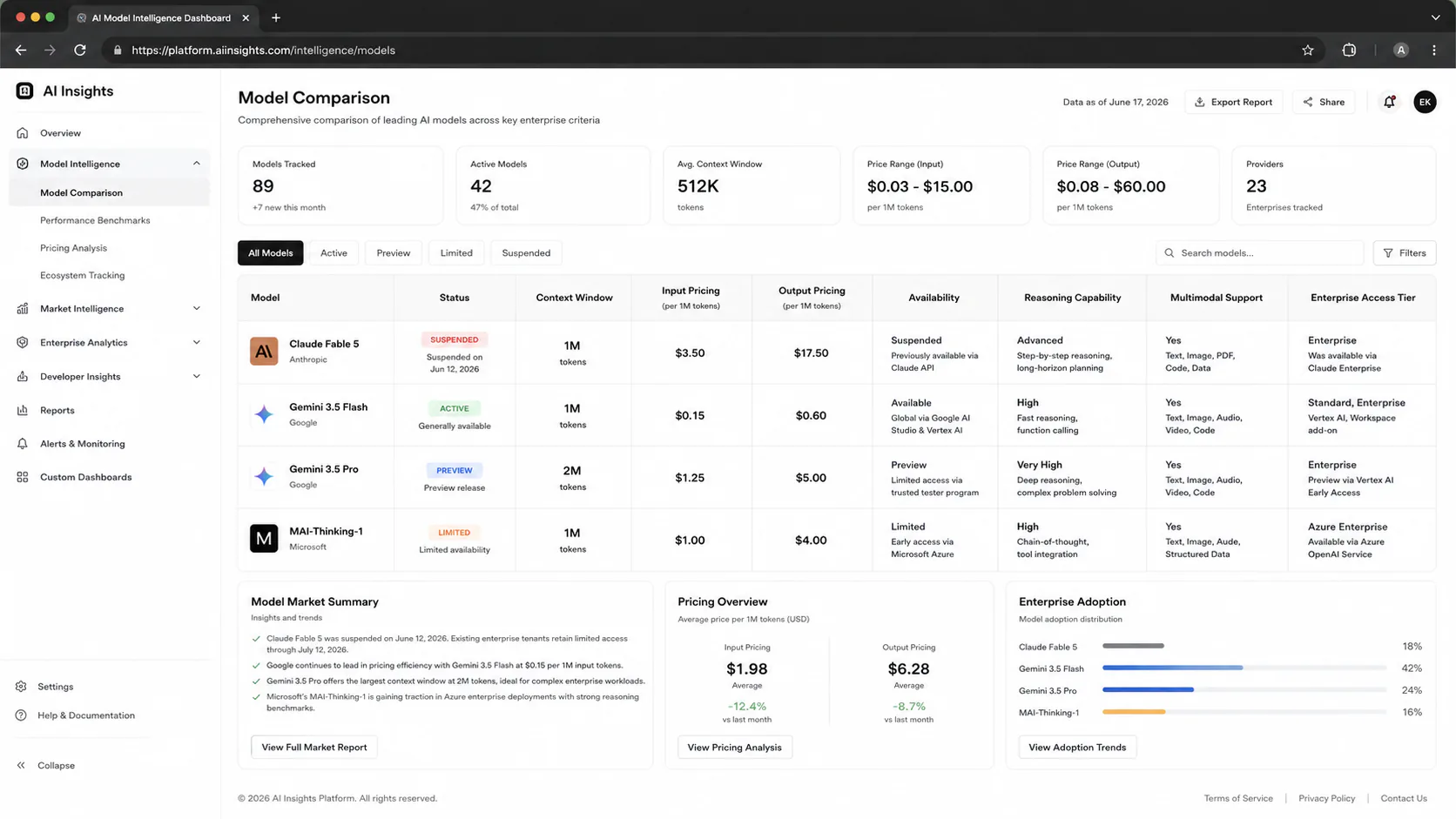
This Week's Model Launches at a Glance
| Model | Status | Context | Price (in / out per 1M) | Key feature |
|---|---|---|---|---|
| Claude Fable 5 | Suspended (export control) | 1M tokens, 128K output | $10 / $50 | Mythos-class with safety fallback to Opus 4.8 |
| Claude Mythos 5 | Project Glasswing only | Same as Fable 5 | Not public | Autonomous vulnerability discovery |
| Gemini 3.5 Flash | GA since May 19 | 1M tokens | $1.50 / $9.00 | Beats prior-gen Pro on coding and agent benchmarks |
| Gemini 3.5 Pro | Pending GA | 2M tokens (target) | Est. $15 / $60 | Deep Think reasoning, frontier multimodal |
| MAI-Code-1-Flash | Available (Foundry) | Not specified | Not specified | Microsoft's first text-to-code model |
| MAI-Thinking-1 | Private preview | Not specified | Not specified | Microsoft's first proprietary reasoning model |
What This Means for Developers
Three things from this week deserve a position in your planning, not just your reading list.
The Fable 5 precedent changes your continuity calculus. Government export-control authority can now reach live, globally deployed API endpoints, not just hardware shipments or source code exports. A model can be running in production on Monday and gone by Friday. Architects building on frontier-tier APIs need a tested fallback model in their stack, not a hypothetical one. Anthropic's automatic fallback to Opus 4.8 inside Fable 5 itself is one design pattern worth studying regardless of whether you use Anthropic.
Gemini 3.5 Flash is worth evaluating now, before Pro ships. At $1.50/$9.00 per million tokens, Flash is already beating last year's flagship-tier models on coding and agentic benchmarks. If your current stack pays Gemini 3.1 Pro pricing for those workloads, you are almost certainly overpaying. Pro will raise the ceiling further, but Flash already changed the floor.
Public listings will change how labs behave, not just how they are valued. Once Anthropic and OpenAI are subject to quarterly earnings, short-seller attention, and analyst ratings, expect tighter release timelines, more conservative capability claims in launch marketing, and faster deprecation of less-profitable model tiers. The chaotic pace of 2025-2026 model releases has partly been a feature of private-market financing; public-market discipline will compress that.
For background on the model families competing this week, our coverage of Meta's Muse Spark launch gives context on how frontier labs have structured tiered releases across the industry. For more on how AI models are being integrated into agentic pipelines that this week's governance news directly affects, the guardian agents in CI/CD tutorial covers how production teams are building resilient model-dependent systems.
Frequently asked questions
Anthropic received a US government export-control directive on or around June 12, 2026 requiring it to suspend public access to Claude Fable 5 and Claude Mythos 5. This is the first time US export-control law has been used to pull a live, globally deployed commercial AI model from public availability. The specific clause of export-control law invoked has not been fully disclosed publicly. As of June 17, 2026, both models remain suspended.
Google committed to a June 2026 general availability window at Google I/O on May 19, but has not confirmed a specific date. As of June 17, 2026, Gemini 3.5 Pro is still not publicly available. Gemini 3.5 Flash shipped at I/O and is available through the Gemini API at $1.50/$9.00 per million tokens. Pro is expected to target a 2-million-token context window with Deep Think reasoning, priced in the estimated $15/$60 per million token range based on the historical Flash-to-Pro pricing ratio.
Project Glasswing is a US government-coordinated access program developed by Anthropic that gives vetted organizations access to Claude Mythos 5, the more capable and less safety-restricted version of Anthropic's frontier model. Current confirmed participants include Microsoft, Nvidia, Cisco, Google Cloud, and AWS. Mythos 5 can reportedly discover unknown software vulnerabilities autonomously. Anthropic has stated that no entity currently has sufficient safeguards for a full public release of Mythos-class capability.