Yann LeCun Raises $1.03B for AMI Labs: World Models Explained
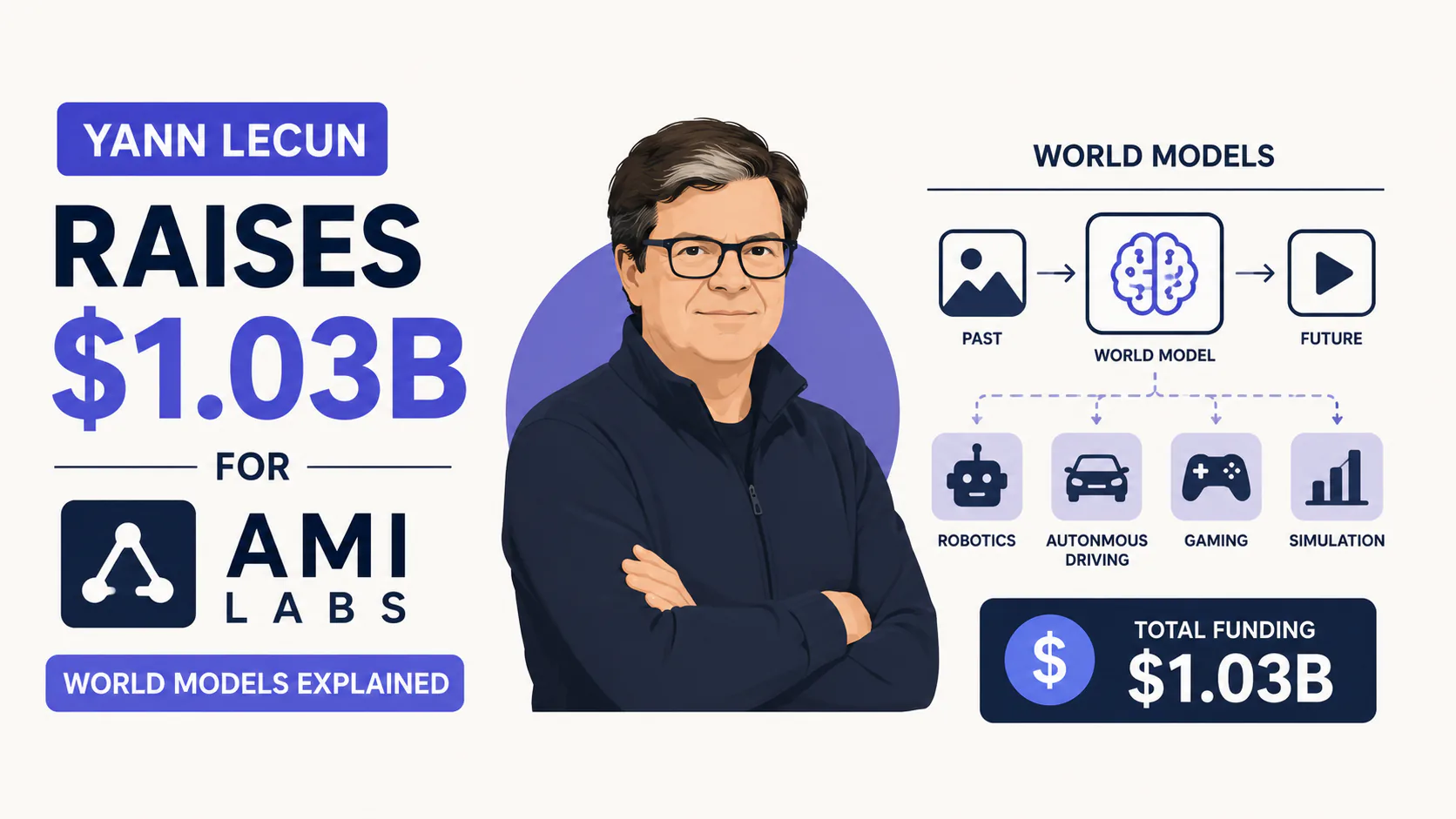
AMI Labs raised $1.03B betting that JEPA world models, not LLMs, are the path to human-level AI. The architecture, the funding, and the fight explained.

In November 2025, Yann LeCun walked into Mark Zuckerberg's office after twelve years as Meta's chief AI scientist and resigned. His reported explanation: "I told him I can do this faster, cheaper, and better outside of Meta."
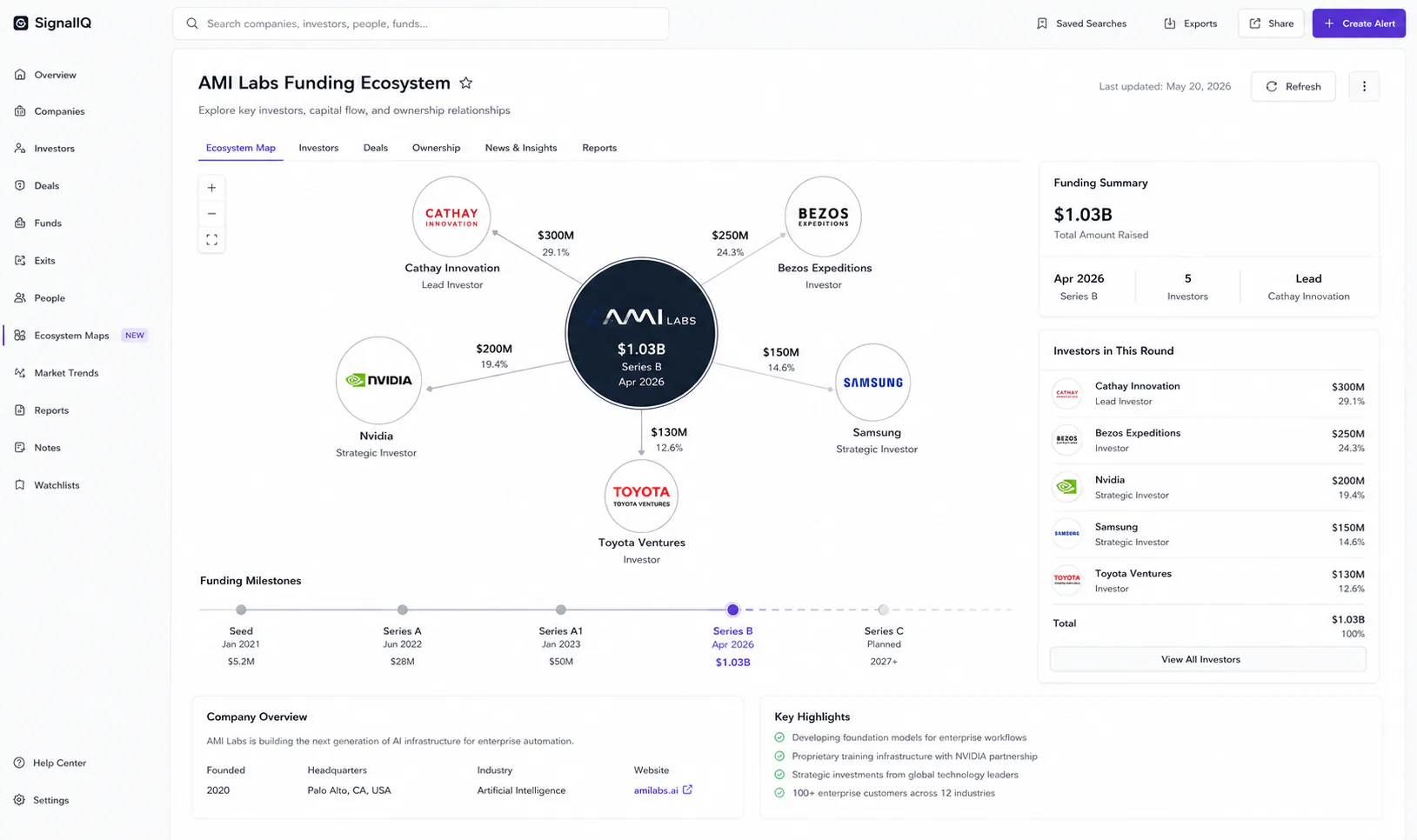
Four months later, the company he built on that statement closed the largest seed round in European AI history. AMI Labs raised $1.03 billion at a $3.5 billion valuation, backed by Nvidia, Samsung, Toyota Ventures, Jeff Bezos, and Eric Schmidt, for a research lab with twelve employees and no shipped product. The bet is that large language models, the technology behind ChatGPT, Claude, and Gemini, are fundamentally incapable of reaching human-level intelligence, and that the real path runs through something called world models.
That's a real disagreement with billions of dollars behind it, made by one of the three researchers most credited with inventing the deep learning techniques the entire current AI industry runs on. Here's what AMI Labs is actually betting on, what the technology does differently, and where the cracks in the thesis are already showing.
TL;DR: AMI Labs raised $1.03B (not the often-cited $500M, which was an early fundraising target) to build JEPA, a non-generative architecture that predicts abstract representations of reality instead of predicting text or pixels. The bet: LLMs can't reason about physical causality because nothing on the internet states it explicitly. LeCun's own May 2026 research shows the theory works under narrow conditions and current models are brittle outside them.
What AMI Labs actually is
The headline figure that circulated widely, "€500 million," was AMI Labs' initial fundraising target reported in December 2025, not what the company actually raised. The closed round, announced March 9-10, 2026, was $1.03 billion (approximately €890 million), nearly double the original target, at a $3.5 billion pre-money valuation.
The investor roster is notable for its breadth: Cathay Innovation, Greycroft, Hiro Capital, and HV Capital co-led, with Bezos Expeditions, Nvidia, Samsung, Toyota Ventures, and Eric Schmidt also participating. Nvidia's presence is worth pausing on. Nvidia operates its own competing world-model platform, Cosmos, which means the company is positioned to profit regardless of which underlying architecture wins. That's the same hedge-the-field strategy infrastructure providers played throughout the LLM boom.
LeCun serves as executive chairman, setting scientific direction. CEO duties went to Alexandre LeBrun, founder of French health-tech startup Nabla, who previously worked as a research engineer under LeCun at Meta's FAIR lab in Paris. The company is headquartered in Paris with stated plans for a global research organization, "particularly in Europe." Meta is providing technical and research partnership but explicitly no financial investment.
LeBrun has been refreshingly direct about what AMI Labs is not: "It's not your typical applied AI startup that can release a product in three months, have revenue in six months, and make $10 million in [annual recurring revenue] in 12 months... it could take years for world models to go from theory to commercial applications." Investors deployed over a billion dollars anyway, pricing the round almost entirely on LeCun's scientific reputation and the strength of the underlying thesis rather than any demonstrated product.
The architecture: what a world model actually predicts
A world model, in LeCun's framing, is an abstract digital twin of reality that an AI uses to understand the world, predict the consequences of actions, and plan accordingly. The distinction that matters: a chatbot predicts the next word in a sentence. A world model predicts the next state of a physical environment. What happens if a robot arm pushes a cup. What happens if a car turns a corner. What happens if a drone enters a wind gust.
The technical backbone is JEPA, Joint Embedding Predictive Architecture, which LeCun first proposed in his 2022 paper "A Path Towards Autonomous Machine Intelligence," three years before the rest of the field paid attention to it. The core insight is a deliberate rejection of how generative models work.
A generative model (think Sora or Veo) tries to predict raw data: the next pixel, the next video frame. JEPA instead trains a model to predict the abstract representation, the embedding, of missing information. It has three components:
Context encoder: Converts an observation (part of a video, for example) into a compressed latent representation.
Target encoder: Converts the answer (the masked or future part of the observation) into its own latent representation.
Predictor: Learns to predict the target encoder's output using only the context encoder's output and an action.
The critical design choice is what JEPA doesn't have: a decoder. It never tries to reconstruct raw pixels. LeCun's argument is that predicting every pixel of, say, wind moving leaves in the background of a video wastes enormous model capacity on irrelevant detail and produces only a "blurry average" rather than genuine understanding. By predicting only in representation space, object permanence, physics, causal structure, the model spends its compute on what's actually useful for planning, not on details nobody needs.
Generative Model (Sora, Veo)
┌──────────────────────────────────────────────┐
│  Input → Encoder → Decoder                   │
│                        ↓                     │
│             Full pixel reconstruction        │
│             (every leaf, every pixel)        │
└──────────────────────────────────────────────┘

JEPA (AMI Labs) — no decoder
┌──────────────────────────────────────────────────────────┐
│ │
│ Context Encoder │
│ ↓ │
│ latent rep. of context ──────────→ Predictor │
│ ↓ │
│ Target Encoder predicts latent │
│ ↓ rep. of target │
│ latent rep. of target ──────────→ (ground truth) │
│ │
│ [no decoder, ever] │
└──────────────────────────────────────────────────────────┘
The architecture has already produced a published family of variants: I-JEPA (2023, image-based, predicting masked regions in a still image), V-JEPA and V-JEPA 2 (2024-2025, video-based, predicting masked spatiotemporal regions and demonstrating zero-shot robotic planning with minimal action data), MC-JEPA (joint motion and content learning), and LeJEPA, a 2026 from-scratch end-to-end implementation using Gaussian regularization for training stability, the most direct technical product of AMI Labs' own early research.
Why LeCun says LLMs are a dead end
This isn't a new position LeCun adopted to justify a funding round. In April 2024 he called LLMs "basically an off-ramp, a distraction, a dead end" for reaching human-level intelligence. At a lecture at IIT Madras later that year, he told students bluntly: "If you are interested in human-level intelligence, do not work on LLMs."
His core technical argument rests on a thought experiment that's become widely cited: even a hypothetical, vastly scaled future LLM trained only on text could never independently deduce that pushing a table moves a book sitting on it, because no text on the internet explicitly states that physical fact, and LLMs have no grounded experience of physical causality from which to derive it. Speaking at an event in Brooklyn, LeCun put the stakes in plainer terms: "LLMs are great, they're useful, we should invest in them. They are not a path to human-level intelligence. They're just not. Right now, they are sucking the air out of the room anywhere they go, and so there's basically no resources left for anything else."
That last point is really the commercial argument underneath the technical one. LeCun isn't only claiming LLMs have a capability ceiling. He's claiming the entire industry's capital and talent allocation toward LLM scaling is starving a more promising approach of the resources it needs.
Fei-Fei Li, the Stanford computer vision pioneer and founder of competing startup World Labs, has articulated a closely related but distinct framing she calls "spatial intelligence": the idea that LLMs are "eloquent, but lack experience" and cannot truly understand the world without grounded spatial and visual reasoning. World Labs published a taxonomy in June 2026 splitting "world model" into three technical categories (simulation-focused, generation-focused, and "linchpin" systems meant to anchor agent reasoning), an attempt to bring some definitional order to a term that's already getting overloaded.
AMI Labs enters an already crowded field
AMI Labs is not alone in this bet, and it's not even the most commercially advanced player making it. Within the same few months of AMI Labs' launch, Fei-Fei Li's World Labs shipped its first commercial product (Marble, a 3D environment generator for VR, gaming, and film VFX) and entered talks to raise $500 million at a $5 billion valuation. Google DeepMind released Genie 3, a real-time interactive 3D world generator. NVIDIA's Cosmos platform surpassed 2 million downloads. Collectively, world model startups attracted over $1.3 billion in funding in early 2026 alone.
| Company | Architecture Approach | Funding / Valuation | Product Status |
|---|---|---|---|
| AMI Labs | JEPA, non-generative latent prediction | $1.03B raised, $3.5B valuation | Pre-product, research-stage |
| World Labs | Generative spatial/3D generation | In talks for $500M at $5B (Apr 2026) | Shipped: Marble (free-$95/mo) |
| Google DeepMind (Genie 3) | Fully generative real-time 3D rendering | Internal (Alphabet-funded) | Shipped: real-time, 24fps |
| NVIDIA Cosmos | Generative physics-aware simulation | Internal + Cosmos Coalition | Shipped: 2M+ downloads |
| Wayve (GAIA-2) | Generative, driving-specialized | Independently funded (UK) | Shipped, active AV testing |
| OpenAI (Sora) | Generative video diffusion | Internal (OpenAI-funded) | Shipped |
The most important technical split in this table isn't company versus company; it's JEPA's non-generative approach versus everyone else's generative approach. JEPA is more compute-efficient (no decoder, no pixel reconstruction) but produces output that's hard to directly inspect, since there's no image or video to visually sanity-check. Generative approaches produce output you can look at and judge, but cost more to run at the same fidelity. V-JEPA showed 1.5 to 6 times improvement in training and sample efficiency over comparable generative video models, and I-JEPA achieved state-of-the-art low-shot ImageNet classification using only 12 labeled examples per class while training in under 72 hours on 16 GPUs, a fraction of the compute competing methods required.
The most direct rivalry in the field is AMI Labs versus World Labs: two startups founded by towering, equivalent-prestige researchers, raising comparable nine-figure-to-billion-dollar sums within months of each other, both explicitly positioned against the LLM-dominant paradigm. The practical difference is go-to-market philosophy. World Labs shipped a product and is generating real usage signal. AMI Labs chose a longer, more fundamental-research path with no product timeline at all.
The cracks already showing in the thesis
What makes this story unusually interesting, rather than just another big funding number, is that LeCun's own research group has already published the strongest case against its own near-term readiness.
In late May 2026, the team released two arXiv preprints within days of each other. The first is a formal theorem proving that LeJEPA can achieve "linear identifiability," meaning it can provably recover real-world structure from data, but only under specific mathematical conditions: the underlying latent variables must be Gaussian and evolve under stable, predictable dynamics. As one analysis from CryptoBriefing put it, "the Gaussian assumption is both the paper's greatest strength and its most obvious vulnerability. Real-world latent dynamics are often non-Gaussian. Financial markets have fat tails. Physical systems have phase transitions."
The second preprint, published the same week, is a paired stress-test benchmark showing that current JEPA-based world models collapse under minor visual perturbations. Tech Times described the pair as "the most substantive response yet to a field watching his thesis with skepticism and $1.03 billion in investor capital."
That's an unusual level of public transparency for a three-month-old, billion-dollar-backed startup: publishing both the supportive theoretical result and the unflattering empirical counter-evidence in the same week. Whether that posture survives once commercial pressure mounts is worth watching.
LeCun also has direct, public pushback from the field's most prominent leaders, not just internal research caveats. At Davos in January 2026, Anthropic CEO Dario Amodei clashed publicly with LeCun, predicting that current-architecture AI models would replace the work of all software developers within a year and reach "Nobel-level" scientific research within two, a direct rebuttal of LeCun's "dead end" framing. Independent commentator Adam Holter summarized the skeptical camp's position bluntly: "His thesis: LLMs are a dead end, and the real path to intelligence is through systems that learn by watching and interacting with the world, not just reading about it. I think he's wrong. And I think his track record on LLM predictions backs me up."
There's also a definitional problem that LeBrun himself acknowledges. "World model" already applies to JEPA's non-generative latent prediction, Genie 3's fully generative real-time 3D rendering, Cosmos's physics-simulation infrastructure, and retroactively even to Sora. LeBrun's own prediction: "My prediction is that 'world models' will be the next buzzword. In six months, every company will call itself a world model to raise funding." He argues AMI Labs is different because its goal is genuinely to understand reality rather than adopt fashionable branding, but he's also conceding that telling the difference from the outside will get harder, not easier.
What this means for the AI industry
The practical stakes aren't abstract. LeCun's argument is that LLMs hallucinate because they're pattern-matching machines, not reasoning machines, and that this is tolerable in casual chatbot use but unacceptable in domains where physical grounding and reliability matter more than fluency: robotics, autonomous vehicles and drones, and safety-critical agentic systems in healthcare.
That's why AMI Labs' first announced commercial application targets exactly that highest-stakes domain. Nabla, the digital health company LeBrun previously led and still chairs, gets "first access" to AMI's world model technologies, with the explicit goal of becoming the first company to bring FDA-certifiable agentic AI systems to healthcare. It's a deliberate choice: prove the architecture works somewhere mistakes are genuinely costly, then carry that credibility into robotics and autonomous vehicles.
For developers and AI practitioners, the realistic near-term takeaway is that nothing changes immediately. AMI Labs has no product, a multi-year horizon by its own CEO's admission, and a published benchmark showing its current models are brittle. The architectural debate between JEPA's representation-only prediction and the generative approach used by Genie 3, Cosmos, and Sora most likely resolves toward domain-specific answers rather than one paradigm replacing the other: generative models for content generation and synthetic training data, where visual fidelity and human inspection matter, and JEPA-style models for long-horizon robotic planning, where compute efficiency and action-grounded abstraction matter more.
The deeper signal is what the size of the bet says about how the field is currently pricing risk. A research lab with twelve employees and zero shipped product raised more capital than most Series C companies, priced almost entirely on one researcher's reputation and an unresolved theoretical thesis. If JEPA-based world models clear the brittleness problems documented in AMI's own recent benchmark, that's a genuinely significant alternative path for the field. If they don't, it joins a long history of well-credentialed contrarian research programs that failed to outpace the scaling curve of the mainstream approach. For a deeper look at how a competing world-model platform is already being deployed commercially, see our explainer on Nvidia Cosmos 2.5 for robotics and autonomous vehicles.
Frequently asked questions
AMI Labs raised $1.03 billion (approximately €890 million) in a round announced March 9-10, 2026, at a $3.5 billion pre-money valuation. The often-cited "€500 million" figure was the company's initial fundraising target reported in December 2025, not the final amount raised; the actual round nearly doubled that target.
JEPA (Joint Embedding Predictive Architecture) is a self-supervised learning framework Yann LeCun proposed in 2022. Unlike generative models that predict raw pixels or text, JEPA trains a model to predict the abstract latent representation of missing information using a context encoder, target encoder, and predictor, with no decoder. The goal is to focus model capacity on predictable, useful structure like physics and causality rather than wasting it on irrelevant fine-grained detail.
LeCun argues LLMs are pattern-matching systems trained only on text, with no grounded experience of physical causality. His core example: an LLM could never independently deduce that pushing a table moves a book on it, because no text on the internet explicitly states that fact. He's held this position publicly since at least April 2024, predating AMI Labs' founding by over a year.
No, they're separate companies pursuing different technical approaches under the broad "world models" umbrella. AMI Labs uses JEPA's non-generative, latent-only prediction. World Labs (Fei-Fei Li's company) and Nvidia Cosmos both use generative approaches that produce full visual or 3D output. World Labs has already shipped a commercial product (Marble); AMI Labs has not and isn't expected to for years.
No. As of June 2026, AMI Labs remains pre-product with roughly a dozen employees. CEO Alexandre LeBrun has stated explicitly that the company is not a typical applied AI startup that can ship a product in months, and that commercial applications of world models could take years to mature. The first announced commercial partnership is with Nabla, targeting FDA-certifiable agentic healthcare AI, with no public timeline yet.