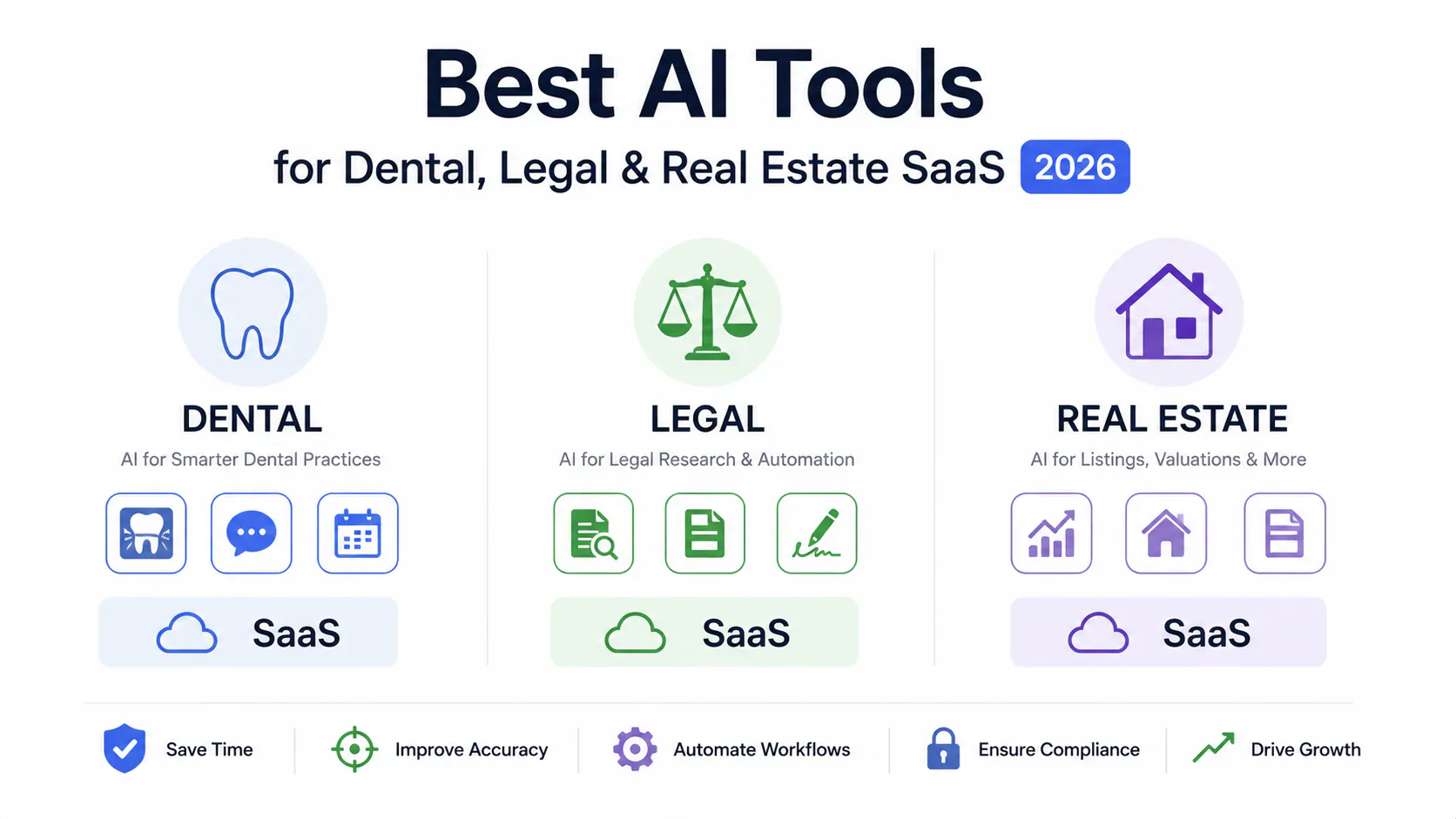
Best AI Tools for Dental, Legal & Real Estate SaaS (2026)
Best vertical AI tools for dental, legal, and real estate in 2026: Pearl, Overjet, Harvey, Clio, Follow Up Boss, and Ylopo with ROI data and pricing.

Bytewaves Score Card
The most important thing to know about vertical AI SaaS in 2026 is that the tools winning enterprise contracts are not the ones with the longest feature lists. They are the ones with FDA clearances, SOC 2 Type II certifications, and verified citation grounding. In regulated industries, compliance documentation is the competitive moat, and it explains why Harvey ($190M ARR, $11B valuation) and Pearl (9,000+ practices) are growing faster than the general AI tools trying to serve these markets.
This guide covers the best AI tools across three verticals where purpose-built platforms are generating measurable, documented ROI: dental, legal, and real estate. For each vertical, the tools are organized by use case category, because a dental practice choosing between Pearl and Overjet is solving a different problem than one choosing between Weave and Zentist, and conflating them leads to bad procurement decisions.
Scope: This covers AI-native and AI-first tools in each vertical, not general AI tools (ChatGPT, Claude, Copilot) adapted for professional use. The case for using general AI for professional work is real, but the risks (hallucinated legal citations, non-HIPAA-compliant data handling, no domain-specific training) are the reason purpose-built platforms exist. That trade-off is covered in the legal section.
Why vertical AI beats horizontal AI
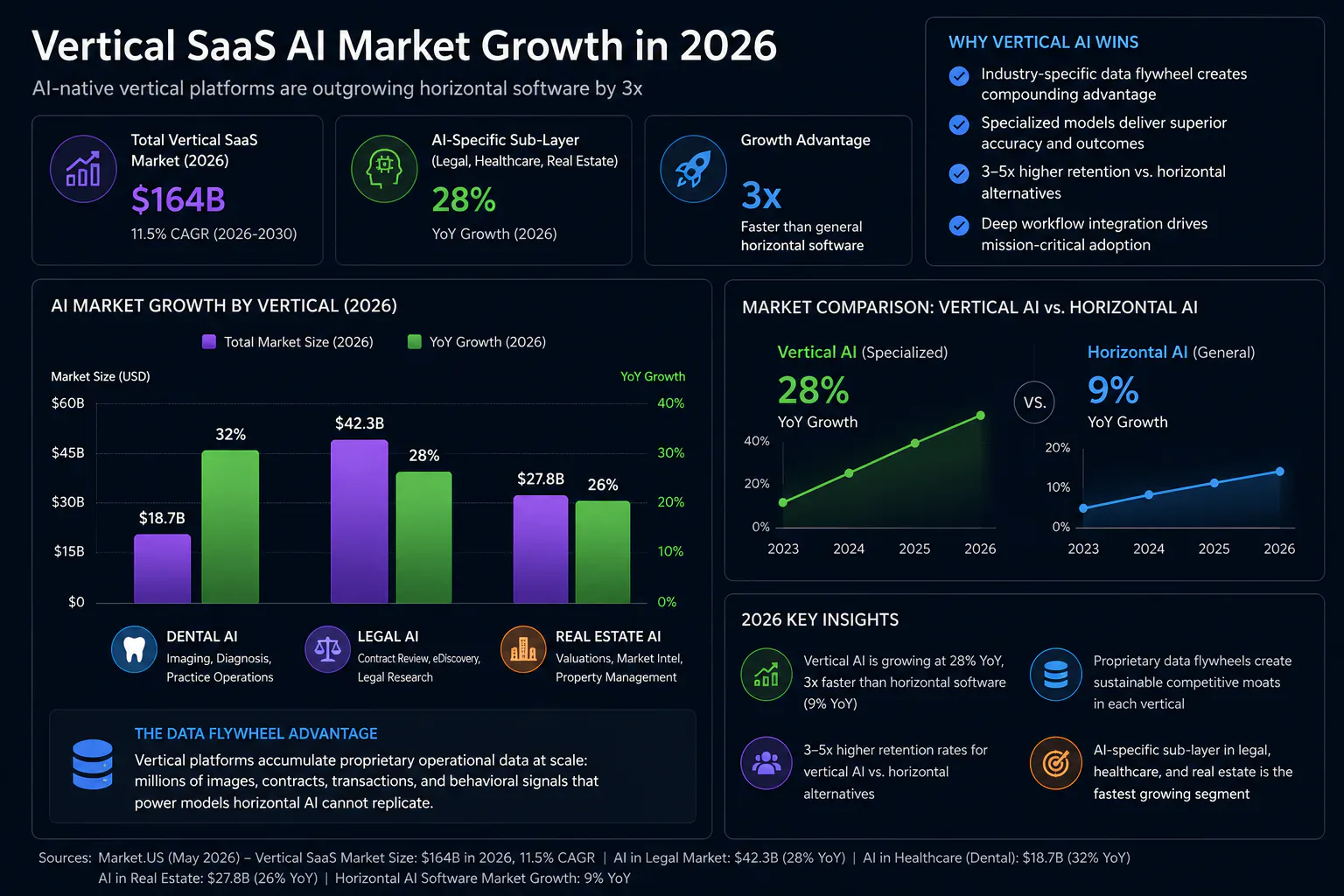
A general-purpose "summarize any PDF" tool is a wrapper. A tool that reads commercial real estate lease agreements, extracts the specific data points property managers need, and pushes flagged items into their matter management system is a vertical AI agent. That distinction explains a documented 3 to 5 times higher retention rate for specialized vertical AI versus horizontal alternatives.
The structural reason is the data flywheel. Vertical SaaS platforms accumulate industry-specific operational data at scale: millions of dental radiographs, hundreds of thousands of contract review cycles, billions of real estate behavioral signals. Models trained on this data produce predictions that no horizontal tool can replicate. A dental platform trained on real clinical imaging from thousands of practices detects pathology with a precision that a general vision model never achieves.
The vertical software market sits at $164 billion in 2026, growing at 11.5% CAGR. The AI-specific sub-layer in legal, healthcare, and real estate is growing at 28% year over year, roughly 3x the rate of general horizontal software. The tools covered below are the current leaders in each segment.
Dental AI tools
The U.S. dental market sits at a structural inflection point. DSOs now manage 15%+ of U.S. clinics in a market valued at $37.9 billion, growing at 17.9% CAGR. More than half of U.S. dentists say shrinking reimbursements are their top concern. Around 15% of claims get denied. And 10-15% of patient appointments end in no-shows.
The AI tools addressing these pain points fall into three distinct categories with different ROI profiles: clinical imaging AI, patient communication platforms, and revenue cycle management. Evaluate them separately.
Clinical imaging AI: Pearl vs. Overjet
These two platforms dominate the dental imaging AI market and are the most frequently compared tools in the segment. The right choice depends on your practice's specific clinical needs and enterprise footprint.
Pearl (Second Opinion)
Pearl is the broadest clinical imaging AI suite available, anchored by its Second Opinion platform for 2D radiograph analysis. Its regulatory clearances extend to 3D CBCT segmentation, panoramic analysis, and caries detection, bone level measurement, periapical radiolucency, margins, and bridge evaluation.
The 3D CBCT capability is Pearl's primary differentiator over Overjet. Pearl's automated 3D segmentation (Dice coefficients ranging from 0.76 to 0.97 in peer-reviewed research) is directly relevant for implant planning, orthodontics, and oral surgery. Overjet's public FDA clearances are focused on 2D workflows.
Beyond imaging, Pearl ships Practice Intelligence for business analytics, Precheck for insurance pre-authorization, and Claimcheck for claim validation. The platform integrates natively with Open Dental, Dentrix, Eaglesoft, Carestack, Oryx, Curve, Denticon, and Software of Excellence EXACT: the broadest PMS compatibility list of the three major imaging AI providers.
Pearl is deployed in 9,000+ practices. Chief Clinical Officer Dr. Greg Kerbel described the impact: "Pearl helps us deliver consistency, coaching, and clarity across every office. It helps young doctors become confident providers. It helps seasoned clinicians work more safely."
Best for: DSOs with multi-location deployments needing consistent imaging AI across mixed PMS environments; practices with 3D CBCT workflows; international operations (Pearl offers EU data storage options for GDPR compliance).
Overjet
Overjet emphasizes predictive analytics and insurance automation alongside imaging. Its Vision AI Annotations display color-coded findings and measurements directly on the radiograph in real time, which is the feature most directly associated with its documented case acceptance improvement: practices report a 25% increase when patients see AI-annotated radiographs alongside the clinical explanation.
The Chart Audit feature is worth specific attention for DSOs. It analyzes 12 months of historical patient radiographs using FDA-cleared AI to identify conditions that were found but never scheduled, surfacing missed revenue that existing practices have already generated but not collected.
Overjet Voice, released globally in January 2026, adds automated dental documentation at the operatory, reducing charting time without requiring clinicians to change their workflow. The platform's image-level sensitivity is 89.8% with specificity of 84.2% on its radiographic analysis.
Overjet's enterprise footprint is significant: Imagen Dental Partners (120+ locations) selected Overjet as its exclusive AI partner, and its partnership with mydentist represents the largest dental AI rollout in UK dentistry history.
Best for: Large DSO implementations with high insurance claim volumes; practices prioritizing case acceptance conversion over 3D workflows.
Pearl vs. Overjet: which to choose
| Dimension | Pearl | Overjet |
|---|---|---|
| 2D radiographic analysis | FDA-cleared | FDA-cleared |
| 3D CBCT segmentation | Yes (unique) | No |
| PMS integrations | 8 native (broadest) | Major systems |
| Voice documentation | No | Yes (Jan 2026) |
| Chart audit / missed revenue | Via Practice Intelligence | Yes (direct feature) |
| Case acceptance data | Not published | 25% improvement reported |
| Enterprise deployments | 9,000+ practices | Imagen (120+), mydentist UK |
| Best for | 3D workflows, international DSOs | Insurance automation, large DSOs |
The one piece of advice from DSO operators that appears consistently: "Clinical AI evaluations that do not use real practice X-rays are almost always misleading. Ask each vendor to run a demo on your actual cases." Vendor-reported sensitivity and specificity numbers are useful for shortlisting; practice-specific demos are required before purchase.
Patient communication and front-desk AI: Weave, Adit, Peerlogic
These platforms address a gap that imaging AI doesn't touch. For DSOs, 38% of revenue flows through the phone: new patient acquisition, case acceptance, hygiene utilization, and reactivation. Missed calls and poor follow-up are where that revenue leaks.
Weave is the most widely deployed of the three: an all-in-one communications platform with AI-powered phone analytics, automated reminders, review management, and payments. Deployed across DSOs primarily for no-show reduction and patient responsiveness improvement.
Adit takes a more comprehensive approach, consolidating communications, scheduling, payments, analytics, and reminders in a single platform. Its AI Call Intelligence feature listens to calls, recovers missed bookings, automates follow-ups, flags unhappy patients, and tracks performance across the front desk. Adit is the better choice for practices that want to replace multiple point solutions with one system.
Peerlogic focuses specifically on call analytics and conversational AI. It is the most purpose-built of the three for understanding what is happening on dental phone calls: useful for DSOs doing systematic coaching and performance analysis of front-desk staff.
The practical decision: Weave for communication automation and patient responsiveness; Adit for replacing a fragmented software stack; Peerlogic for systematic call analytics and coaching.
Revenue cycle management AI: Zentist
Zentist is the clearest ROI case in dental AI. Its Remit AI automates EOB parsing, payment posting, and claim follow-up, directly reducing the manual workload that the 2026 RCM industry report described as the "efficiency paradox": strong collection rates sustained by unsustainable manual effort.
The documented performance at Dental Group of Chicago is concrete: within 30 days of adoption, the system processed 73.53% of all transactions automatically, with peak days reaching 87% automation. The RCM team tripled its productivity. This is the fastest, most measurable ROI in dental AI, and it comes with the lowest change management burden: Remit AI runs on existing workflows rather than requiring clinical behavior change.
Dental AI quick picks:
- DSO clinical consistency across locations: Pearl
- Insurance automation + case acceptance: Overjet
- Patient communication and no-show reduction: Weave
- Full front-desk platform consolidation: Adit
- Revenue cycle automation (fastest ROI): Zentist
Legal AI tools
Legal technology funding surpassed $2.4 billion in 2025. Harvey hit $190 million ARR in January 2026 and raised $200 million at an $11 billion valuation in March. The market is past the experimentation phase.
The essential context before evaluating any legal AI tool: in 2023, a lawyer submitted AI-generated case citations to federal court in the Mata v. Avianca case. The citations were fabricated. The sanctions that followed established the professional risk standard for the entire industry. Every legal AI platform evaluated here exists partly because that case demonstrated what happens when general LLMs are used for legal work without verified citation grounding.
Harvey: legal infrastructure for enterprise
Harvey is the platform most directly positioned as legal infrastructure rather than a legal productivity tool. The distinction is meaningful: at 100,000+ lawyers across 1,300 organizations in 60 countries, with a majority of the Am Law 100 as customers, Harvey operates at a scale that creates network effects no newer entrant can match.
The platform handles legal research, contract analysis, due diligence, compliance, litigation support, drafting, document review, and workflow automation. More than 25,000 custom agents operate on the platform, and Harvey's model of embedding legal engineering teams directly within client organizations accelerates time-to-value significantly compared to self-serve deployment.
Enterprise clients include NBCUniversal, HSBC, DLA Piper International, and McCann Fitzgerald. Harvey's CEO Winston Weinberg describes the positioning directly: "AI isn't just assisting lawyers. It's becoming the system through which legal work gets done."
Harvey is not priced for small firms. This is not a criticism: it reflects a deliberate enterprise focus. For Am Law 100 firms and Global 2000 in-house teams, the embedded engineering model and platform breadth justify the cost. For solo practitioners or firms under 20 attorneys, Clio is the more appropriate starting point.
Best for: Am Law 100 firms, Global 2000 in-house legal teams, asset management legal departments.
Clio: from solo to enterprise via practice management
Clio is the dominant cloud-based legal practice management platform, and its October 2025 launch of the Intelligent Legal Work Platform and vLex merger created a combination that no competitor currently matches: practice management (billing, case management, calendaring, client intake) plus AI-powered legal research backed by a verified legal database.
The product breakdown matters here:
Clio Manage ($49-89/user/month) covers case management, billing, client intake, calendaring, and analytics with AI-powered insights that flag risks and surface anomalies. The AI-powered automatic calendar capture from court documents alone represents meaningful administrative time savings for litigation practices.
Clio Work (AI workspace for legal research, analysis, and strategy) was the fastest-adopted product in Clio's history at launch in October 2025. It became available as a standalone product in April 2026, opening it to solo practitioners and smaller firms for the first time. The vLex legal database integration is what separates Clio Work from general-purpose AI for legal research: outputs are grounded in verified, citable case law, not generated from a general model.
Clio's 250+ integrations, including Diligen (contract review) and Supio (personal injury), make it the most connected legal platform in the mid-market.
Best for: Solo practitioners, small and mid-size firms, and enterprise teams that want a single platform connecting practice management to verified AI-powered legal research.
Contract review AI: LegalOn, Spellbook, Luminance
Contract review is the highest-volume, most immediately ROI-positive use case in legal AI. LEGALFLY reports AI contract review tools help in-house teams complete reviews 7x faster. The pattern is consistent: AI handles repetitive checking against playbooks and approved positions; lawyers spend time on judgment calls.
LegalOn ships the most complete contract review suite: seven integrated products (Review, Assistant, Matter Management, Knowledge Core, Agents, Translate, and a Word add-in) with 50+ AI playbooks for NDAs, MSAs, and other standard agreements. Five new AI agents shipped in February 2026. Pricing starts around $550/user/year at the individual tier. Best for contract review at enterprise scale.
Spellbook is the right choice for in-house teams and firms that want AI contract review without leaving Microsoft Word. Lawyers review and redline agreements directly in their existing environment, which eliminates the platform-switching friction that slows adoption. The tightest integration into existing workflows of any contract review tool.
Luminance is the strongest option for large-volume document analysis. Its Legal-Grade AI platform is widely deployed for M&A due diligence and compliance review where the document set is too large for manual review at any realistic cost.
ContractPodAi (Leah) is worth evaluating for teams that need AI review inside a broader contract lifecycle management system rather than a standalone review tool.
Legal research AI: Lexis+ AI and Westlaw Precision
Both platforms have converged on the same foundational requirement: zero hallucination on citations. The Mata v. Avianca case established what happens when that standard is not met.
Lexis+ AI offers real-time Shepard's validation (confirming whether a cited case is still good law), conversational search, and predictive insights. It is widely cited as the most advanced legal research AI platform currently available.
Westlaw Precision (Thomson Reuters) integrates AI into its research database with Strong Document functionality connecting research to related materials and automating research workflow construction.
The practical distinction for buyers: Lexis+ AI is stronger on conversational interface and predictive research features; Westlaw Precision is stronger for teams already embedded in the Thomson Reuters ecosystem. Either platform is categorically safer than general-purpose AI for any research going to a client or court.
General AI vs. legal-native: the honest trade-off
| Legal-native platforms | General AI (ChatGPT, Claude, Copilot) | |
|---|---|---|
| Citation accuracy | Verified, database-grounded | Hallucination risk |
| Data security | SOC 2, zero-retention options | Varies; data may train models |
| Legal database access | Integrated (Westlaw, vLex) | None |
| Compliance | Bar-rule aware | General purpose |
| Cost | $550-$89/user/month | $0-$20/month |
| Right for | Client deliverables, court filings | Drafting, brainstorming, internal use |
The consensus in the legal tech community is direct: general AI is appropriate for internal drafting and brainstorming. Legal-native AI is required for any work product going to a client or court. The cost difference is real; the professional risk difference is bigger.
Legal AI quick picks:
- Am Law 100, Global 2000 in-house: Harvey
- Solo to mid-size firms, full practice management: Clio (Manage + Work)
- Enterprise contract review at scale: LegalOn
- Contract review inside Word: Spellbook
- Large-volume M&A due diligence: Luminance
- Legal research with citation verification: Lexis+ AI or Westlaw Precision
Real estate AI tools
McKinsey estimates generative AI could generate $110-180 billion in additional value for real estate, with the largest share coming from automated client engagement and lead qualification. The conversational AI market powering real estate tools is projected to reach $17.97 billion in 2026.
The gap between ambition and execution is real: 92% of commercial real estate firms have started AI pilots, but only 5% have achieved their AI program goals. The practitioners who have closed that gap share consistent advice: automate a single high-impact workflow before attempting full-scale transformation. Speed-to-lead is almost always the right starting point.
AI-enhanced CRM: Follow Up Boss
Follow Up Boss (acquired by Zillow) is one of the three dominant AI-powered CRM platforms for real estate agencies alongside Lofty and Sierra Interactive. Its approach is CRM-first with AI layered on: lead behavioral analysis, AI-generated personalized outreach, automated call summaries, and task suggestions based on lead activity.
The behavioral AI engine analyzes website visits, listing views, and email opens to surface prioritized "hot" leads every morning. For high-volume teams managing hundreds of active leads simultaneously, this triage function has a direct impact on which opportunities get followed up on and which decay.
AI-generated email and text responses are built from each agent's own historical communication data, producing outreach that matches their established style rather than generic templates. Automated call summaries extract key conversation points without manual note-taking.
Pricing: Grow Plan $58-69/user/month; Pro Plan $416/month for 10 users.
Best for: Teams that have outgrown spreadsheet lead management and want a CRM-first tool with AI assistance built in.
AI lead generation and nurturing: Ylopo
Ylopo is purpose-built around the lead nurturing problem: maintaining consistent engagement with a lead database over 12+ months without requiring ongoing manual agent involvement. Its Raiya AI has handled over 25 million conversations with a 48% response rate.
The AI Voice system calls leads 14 times over 90 days with a 45% answer rate using scripts optimized for each contact scenario. This is the "speed-to-lead" execution that Salesforce research documents as producing a 50% increase in conversion rates compared to manual follow-up: AI initiates contact within seconds of a lead registering, runs through qualification, and alerts the assigned agent only when the lead is engaged and ready for a real conversation.
The DyVA (Dynamic Video Ads) feature takes MLS listing photos and generates AI-powered 3D video tours. Documented performance: triple the click-through rate and double lead generation compared to static ads.
Pricing: From $299.95/month.
Best for: Residential-focused agents and teams wanting automated lead nurturing that runs without manual input across a 12-month window.
AI-first brokerage platforms: Lofty and Sierra Interactive
Lofty (formerly Chime) and Sierra Interactive take a different architectural approach from Follow Up Boss: they are AI-first platforms with CRM built in, rather than CRMs with AI added.
Lofty provides a full brokerage platform combining AI-powered IDX website, lead generation, CRM, and marketing automation in one system. AI lead scoring, behavioral triggers, and automated follow-up sequences are native to the platform architecture, not layered on.
Sierra Interactive is designed specifically for teams and brokerages with advanced AI-powered lead routing: behavioral scoring feeds an intelligent matching system that connects incoming leads to the right agent based on expertise, availability, and historical conversion patterns. 250+ lead source integrations make it suitable for high-volume multi-channel lead operations.
Performance data from AI-powered CRM deployments: agencies report up to 300% increases in lead volume handled and approximately 40% gains in conversion rates compared to non-AI workflows. Structurely (a conversational AI layer used by CINC and others) documented a 233% conversion lift in its deployments.
Choose Follow Up Boss if you have existing lead generation infrastructure and want AI-enhanced follow-up without rebuilding your stack. Choose Lofty or Sierra if you are rebuilding your entire tech stack around AI-native workflows from scratch.
Conversational AI for lead qualification: Structurely and EliseAI
Structurely provides 24/7 AI conversation that qualifies leads, handles objections, and routes warm prospects to agents. The core value is the speed-to-lead interval reduction: from a documented industry average of 15 hours for human first contact to under 30 seconds for AI-initiated contact.
EliseAI specializes in conversational AI for property management rather than lead generation: handling tenant inquiries, maintenance requests, and payment processing via text, email, and chat. For multifamily property management operations, EliseAI solves a fundamentally different problem than agent-side lead nurturing tools.
Predictive analytics and commercial real estate: SmartZip and Buildout
SmartZip analyzes over one billion data points to identify homeowners likely to sell in the next 12 months, before they list. For agents running geographic farm strategies, predictive seller identification compresses prospecting timelines by finding high-probability sellers before competitors know they exist.
Buildout serves commercial real estate specifically, combining CRM with marketing automation and deal management. AI-assisted contact enrichment, automated property marketing, and intelligent property-to-investor matching make it the strongest AI tool for commercial brokers: a segment that most residential AI CRM tools explicitly do not serve well.
Real estate AI quick picks:
- CRM-first with AI behavioral analysis: Follow Up Boss
- Automated lead nurturing at scale: Ylopo
- Full AI-native brokerage stack: Lofty or Sierra Interactive
- Speed-to-lead for high-volume teams: Structurely
- Multifamily property management: EliseAI
- Predictive seller identification: SmartZip
- Commercial real estate operations: Buildout
What to watch: three trends shaping all three verticals
AI agents are replacing feature comparisons
The unit of competition in 2026 is moving from features to outcomes. Harvey doesn't sell a contract analysis feature: it deploys agents that complete M&A due diligence. Overjet doesn't sell an X-ray feature: it sells diagnostic consistency metrics across locations. Follow Up Boss doesn't sell a CRM: it sells conversion rates.
This shift toward outcome-based value framing is still early but will reshape procurement conversations significantly. When buyers start asking "what outcomes does this produce?" instead of "what features does this have?", vendor selection criteria change fundamentally. The tools that can answer the outcomes question with documented data (Zentist's 87% automation peak days, Overjet's 25% case acceptance lift, Structurely's 233% conversion improvement) have a durable advantage.
Compliance certification is the real competitive moat
Across all three verticals, the vendors winning enterprise procurement are not always the technically superior tools. They are the tools with FDA clearances, SOC 2 Type II certifications, HIPAA BAAs, and bar-compliant citation grounding. One CISO described the procurement reality directly: "The tool was running perfectly in the sandbox, but procurement killed it because SOC 2 Type II compliance couldn't be verified."
The compliance investment creates a bifurcation: enterprise-grade tools (Pearl, Overjet, Harvey, Clio) versus SMB-accessible tools (Adit, Spellbook, Follow Up Boss) that trade compliance depth for accessibility and price. The right tier depends on your organization's procurement requirements: but if you are in healthcare, legal, or regulated real estate, understand that compliance documentation is not a procurement formality. It is the actual barrier to adoption.
The execution gap is the real problem
The statistics tell the same story across all three verticals: 58% of dental practices have adopted or plan to adopt AI: but only 11% have embedded it in clinical workflows in a measurable way. 92% of commercial real estate firms have started AI pilots: but only 5% have achieved their goals.
The gap is not tool quality. It is change management, training, and the underestimated cost of integrating new systems into existing workflows. The vendors who are closing this gap are those investing in implementation support, embedded deployment teams (Harvey's legal engineering model being the most sophisticated example), and time-to-value guarantees that shift risk from buyer to vendor.
The practical implication for buyers: evaluate implementation support and time-to-value commitments as rigorously as you evaluate features. A tool with 80% of the features and a dedicated onboarding team will deliver better ROI than a technically superior tool with self-serve documentation.
Limitations and honest caveats
Dental imaging performance claims require independent validation. Clinical performance metrics from Pearl, Overjet, and VideaHealth are largely vendor-reported. Independent clinical evaluations using practice-specific X-rays regularly produce different results than vendor benchmarks. The 25% case acceptance improvement from Overjet, for example, is practice-reported rather than independently audited. Use vendor data for shortlisting; always run demos on your actual cases before signing.
PMS compatibility lists are not uniform. A tool listed as compatible with Dentrix may have deep bidirectional integration; another tool with the same listing may have read-only data access. Verify integration depth specifically for your PMS before committing.
Harvey's pricing is not public and is not accessible to small firms. The embedded legal engineering model that makes Harvey effective at scale is also what makes it impractical for firms under 50 attorneys. Clio Work is the correct entry point for small and mid-size firms.
Real estate AI over-automation is a real risk. Autonomous AI lead follow-up that feels persistent to the point of harassment damages brand more than it helps conversion. Human review of AI-generated communications is best practice, particularly for longer-term nurture sequences.
Non-English legal AI performs differently in civil law jurisdictions. Legal AI trained primarily on U.S. common law has documented quality gaps in civil law systems. International firms need to evaluate language and jurisdiction coverage carefully before deploying legal-native platforms across multiple markets.
Bottom line by vertical
Dental: Start with revenue cycle automation (Zentist) for the fastest measurable ROI, then layer in clinical imaging AI (Pearl for 3D/international, Overjet for insurance automation and case acceptance). Add front-desk AI (Adit for full consolidation, Weave for communication automation) when the foundational clinical and RCM systems are stable.
Legal: Match the tool to the firm size. Harvey for Am Law 100 and Global 2000 in-house. Clio for solo to mid-size. LegalOn or Spellbook for contract-heavy practices at any size. Lexis+ AI or Westlaw Precision for research-intensive work. Do not use general-purpose AI for any work product going to a client or court.
Real estate: Start with speed-to-lead (Structurely or Ylopo's AI Text). Layer in CRM-side behavioral AI (Follow Up Boss or Sierra Interactive) once lead qualification is automated. Add predictive seller identification (SmartZip) for agents running geographic farm strategies. Commercial operators should evaluate Buildout separately from residential agent tools.
For broader coverage of AI tools by category, see SaaS productivity tools on Bytewaves and the AI model and platform reviews.
Frequently asked questions
Both offer FDA-cleared 2D radiographic analysis, but they diverge on key capabilities. Pearl extends to 3D CBCT segmentation (relevant for implant planning and oral surgery), has the broadest PMS compatibility list (8 native integrations), and offers EU data storage for international practices. Overjet focuses more on insurance automation, has a Chart Audit feature for identifying missed revenue from historical radiographs, and ships Overjet Voice for automated documentation at the operatory. Pearl is the stronger choice for 3D clinical workflows and DSOs with mixed PMS environments. Overjet is stronger for practices with high insurance claim volumes and documented case acceptance improvement goals.
Harvey is priced and structured for Am Law 100 firms and Global 2000 in-house teams. Its embedded legal engineering model is what creates value at scale, but that model is not practical for firms under 50 attorneys. For solo practitioners and small to mid-size firms, Clio (Manage plus Clio Work) is the more appropriate platform: it combines practice management with AI-powered legal research backed by the vLex database, at a pricing structure that works at smaller firm sizes. Clio Work became available as a standalone product in April 2026, opening it to solo practitioners for the first time.
It depends on your current infrastructure. Follow Up Boss (Zillow) is the strongest choice for teams that already have lead generation in place and want AI-enhanced follow-up, behavioral lead scoring, and AI-drafted communications built on top of an established CRM. Lofty and Sierra Interactive are better for teams rebuilding their entire brokerage tech stack around AI-native workflows: they are AI-first platforms with CRM built in, rather than CRMs with AI added. Ylopo is the best choice specifically for automated long-term lead nurturing: its Raiya AI has handled over 25 million conversations and maintains 12-month drip follow-up without human involvement.
For internal drafting, brainstorming, and document summarization: yes, with appropriate caution. For any work product going to a client or court: no. The 2023 Mata v. Avianca case: in which a lawyer submitted AI-generated case citations to federal court that did not exist: established the professional risk standard. General-purpose LLMs hallucinate citations without warning. Legal-native platforms (Harvey, Clio Work, Lexis+ AI, Westlaw Precision) solve this by grounding outputs in verified legal databases with inline citations linking to real, retrievable sources. The cost difference is real; the professional liability difference is larger.
Revenue cycle management automation. Zentist's Remit AI documented tripled RCM team productivity within 30 days at Dental Group of Chicago, with 87% automation on peak payment posting days. Clinical imaging AI (Pearl, Overjet) produces meaningful ROI through case acceptance improvement and diagnostic consistency, but the change management timeline is longer and the results are more dependent on clinician adoption. For a DSO that needs to demonstrate ROI quickly, start with RCM automation, then layer in clinical AI once the financial operations are stable.