MCP vs A2A Protocol: Which AI Agent Standard Does Your Stack Need?
MCP vs A2A protocol compared: what each one does, where they overlap, when to use both, and which to implement first for your AI agent stack in 2026.

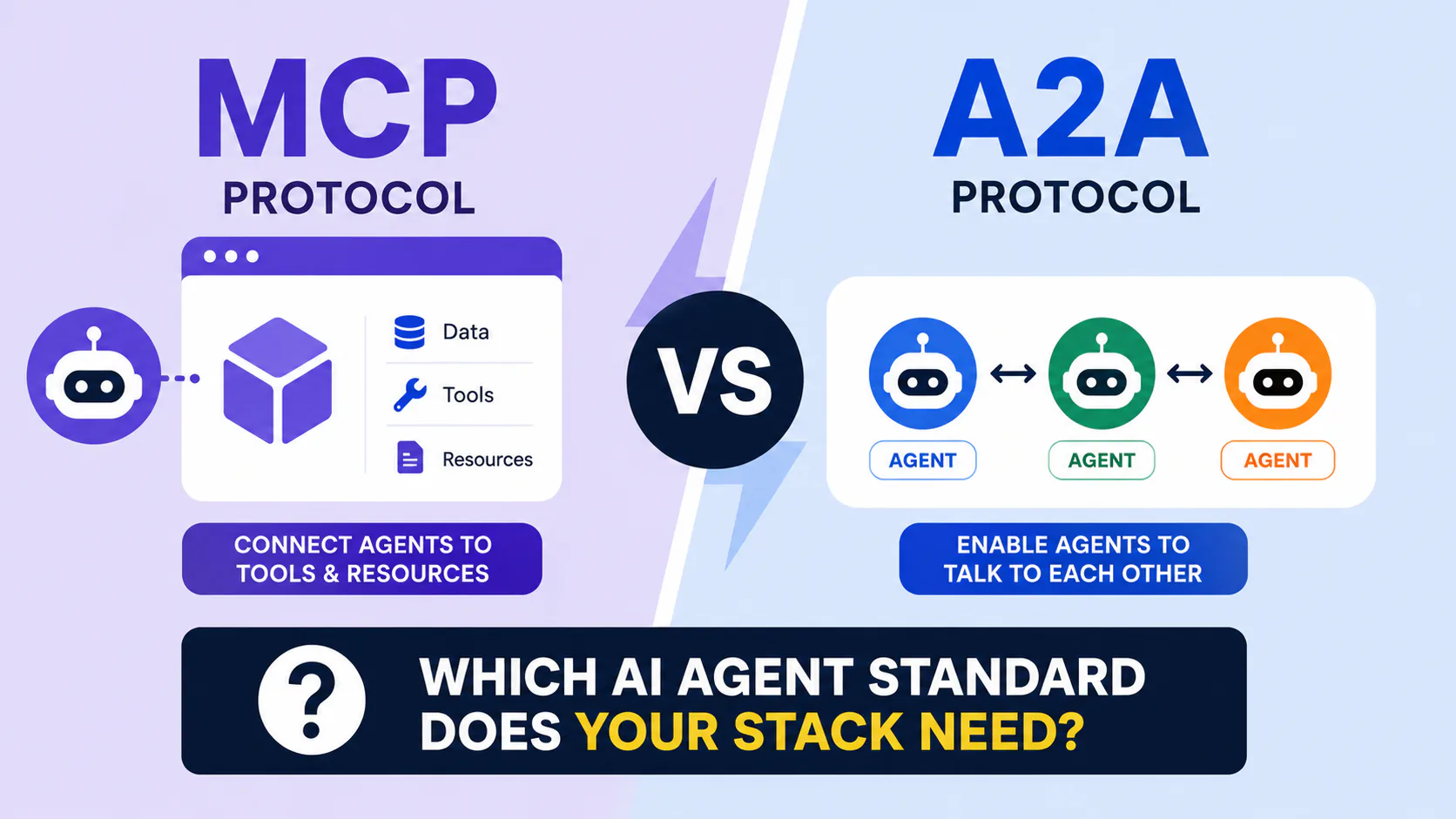
If you're architecting an AI agent system in 2026, you've almost certainly hit two protocol names: MCP and A2A. Both are open standards. Both live in the Linux Foundation. Both are backed by every major AI vendor. And they are frequently compared as if you have to pick one.
You don't. They solve different problems at different layers of the same stack.
The question that actually matters is: which one does your project need first, and how do you design a system that can use both? This breakdown covers exactly that, from first principles through real production examples.
TL;DR: MCP connects agents to tools and data. A2A connects agents to other agents. If you're building a single agent that needs to read databases, call APIs, or access files, start with MCP. If you're building a multi-agent system where agents need to discover and delegate tasks to each other, you need A2A. Most production systems at scale will need both.
Quick verdict: what each protocol actually is
Before comparing them, it helps to understand what problem each one was built to solve, because the names alone don't tell you much.
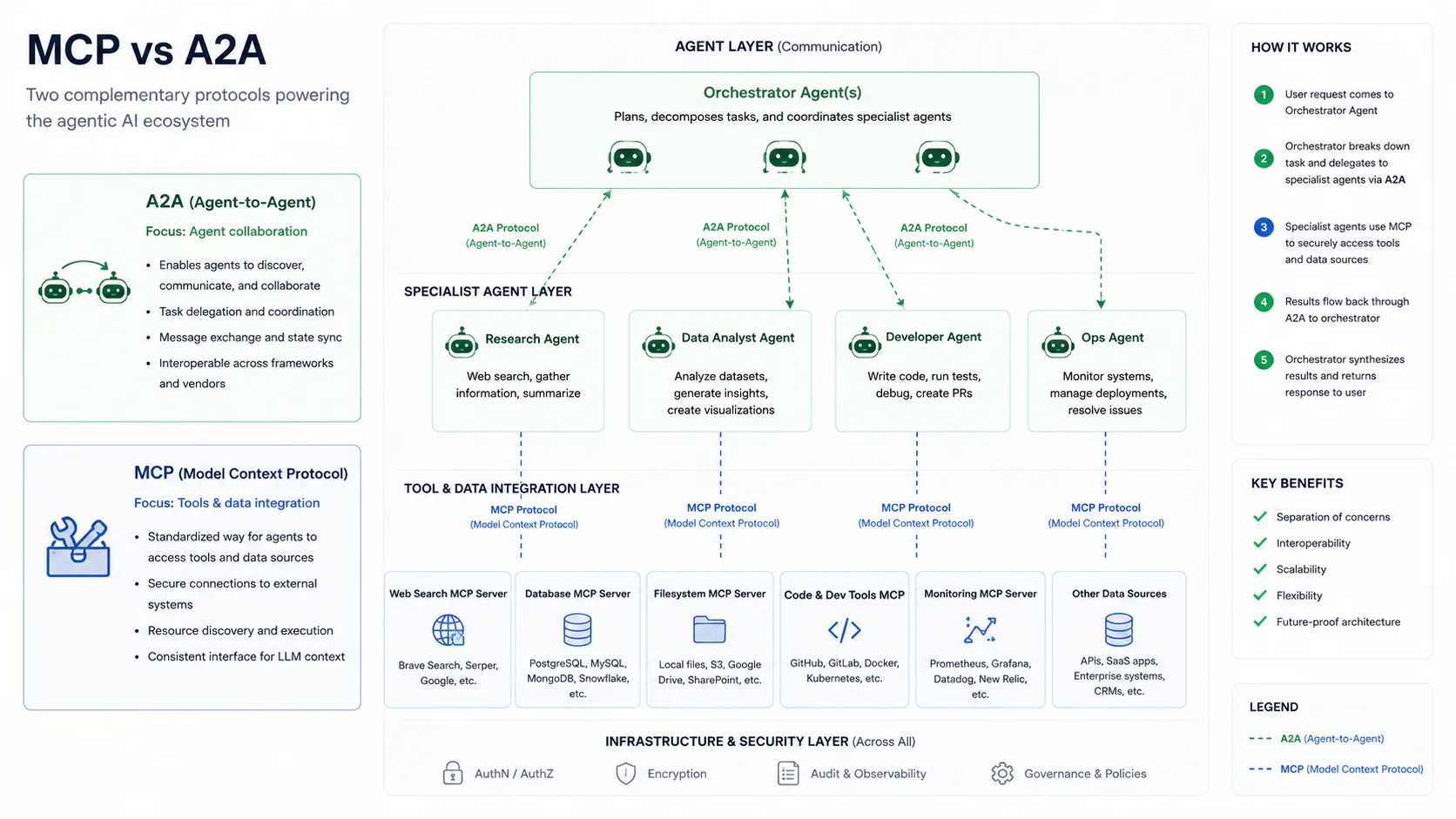
MCP (Model Context Protocol) was launched by Anthropic in November 2024. Its job is vertical integration: connecting an AI agent downward to external tools, APIs, databases, and file systems. Think of it as the standardized socket that lets any AI agent plug into any tool without custom glue code per combination. Before MCP, connecting a LangChain agent to Salesforce, then to Snowflake, then to Slack required three separate custom integrations. With MCP, you write one server per tool, reusable across every MCP-compatible agent.
A2A (Agent-to-Agent Protocol) was announced by Google Cloud in April 2025. Its job is horizontal coordination: connecting agents laterally to other agents, regardless of which vendor or framework built them. A2A defines how agents discover each other's capabilities, delegate tasks, track task state, and return structured results. Before A2A, a LangGraph orchestrator handing off work to a Semantic Kernel agent required bespoke inter-framework glue that had to be rebuilt per pair.
The most widely cited analogy holds up: MCP is USB-C for AI. A2A is HTTP for AI agents. One standardizes how a device connects to peripherals. The other defines how devices communicate across a network.
How MCP works: agent-to-tool connectivity
MCP uses a three-part architecture: a host (the AI application or agent runtime, such as Claude Code, Cursor, or a custom LangGraph agent), an MCP server (a lightweight adapter that exposes a specific tool or data source), and a client layer inside the host that manages server connections and routes calls.
Communication uses JSON-RPC 2.0. Local servers connect over stdio; remote servers use HTTP with Server-Sent Events (updated to Streamable HTTP in the March 2025 spec revision). Each MCP server exposes three resource types:
- Tools: callable functions the agent can invoke (query a database, create a Jira ticket, send a Slack message)
- Resources: data or content the agent can read (files, records, knowledge bases)
- Prompts: pre-defined instruction templates the agent can use without constructing them from scratch
The key insight is what MCP eliminates: the N*M problem. If you have five agents and 10 tools, the pre-MCP world required up to 50 custom integrations. With MCP, you write 10 servers. Every agent that speaks MCP connects to all of them. Block (Square) deployed MCP servers connecting to Snowflake, GitHub, Jira, Slack, Google Drive, and internal APIs, replacing six separate tool integrations with a single standardized interface layer for every agent in their stack.
By May 2026, the MCP ecosystem counts over 97 million monthly SDK downloads and more than 9,600 servers in the official registry, with nearly 16,000 GitHub repositories tagged mcp-server. OpenAI, Microsoft, AWS, Salesforce, and ServiceNow all expose tools via MCP.
AI Agent (Host)
     │
MCP Client
     │
┌────┴────┬──────────┬────────────┐
│         │          │            │
GitHub    Postgres  Salesforce  File System
MCP Server MCP Server MCP Server  MCP Server
How A2A works: agent-to-agent coordination
A2A's architecture centers on four primitives:
Agent Card: A JSON document published at /.well-known/agent.json (following RFC 8615). It describes the agent's name, capabilities, accepted input formats, authentication requirements, and endpoint. Think of it as a machine-readable business card that any other agent can read to understand what tasks this agent can accept. In A2A v1.0 (released early 2026), Agent Cards can be cryptographically signed using JWS for verified identity, which matters when you're delegating to agents across organizational boundaries.
Task: A structured unit of work with a defined lifecycle: submitted -> working -> input-required -> completed / failed / canceled / rejected. Tasks carry structured payloads including text, files, and data objects.
Message: A communication object exchanged between entities, attributed to either a user or agent role. Messages support multi-turn interactions for tasks that require clarification or intermediate input.
Artifact: The structured output produced when a task completes. This is what the downstream agent or orchestrator receives as the result.
A2A uses HTTP/HTTPS, JSON-RPC 2.0, and SSE for transport. These were chosen deliberately: they require no new protocol stack, which means A2A integrates with existing enterprise security infrastructure, load balancers, and monitoring tools without modifications. Authentication supports OAuth 2.0, API keys, and mTLS.
Orchestrator Agent
      │
   A2A Tasks
 ┌───┴────────┬────────────┐
 │            │            │
Billing     Inventory   Support
Agent       Agent       Agent
(LangGraph) (AutoGen)   (Semantic Kernel)
 │            │
MCP          MCP
 │            │
Stripe DB   ERP System
By April 2026, A2A had surpassed 150 supporting organizations, including AWS, Cisco, Google, IBM, Microsoft, Salesforce, SAP, and ServiceNow. The GitHub repository crossed 22,000 stars, and production deployments are confirmed in supply chain, financial services, insurance, and IT operations.
The stack they form together
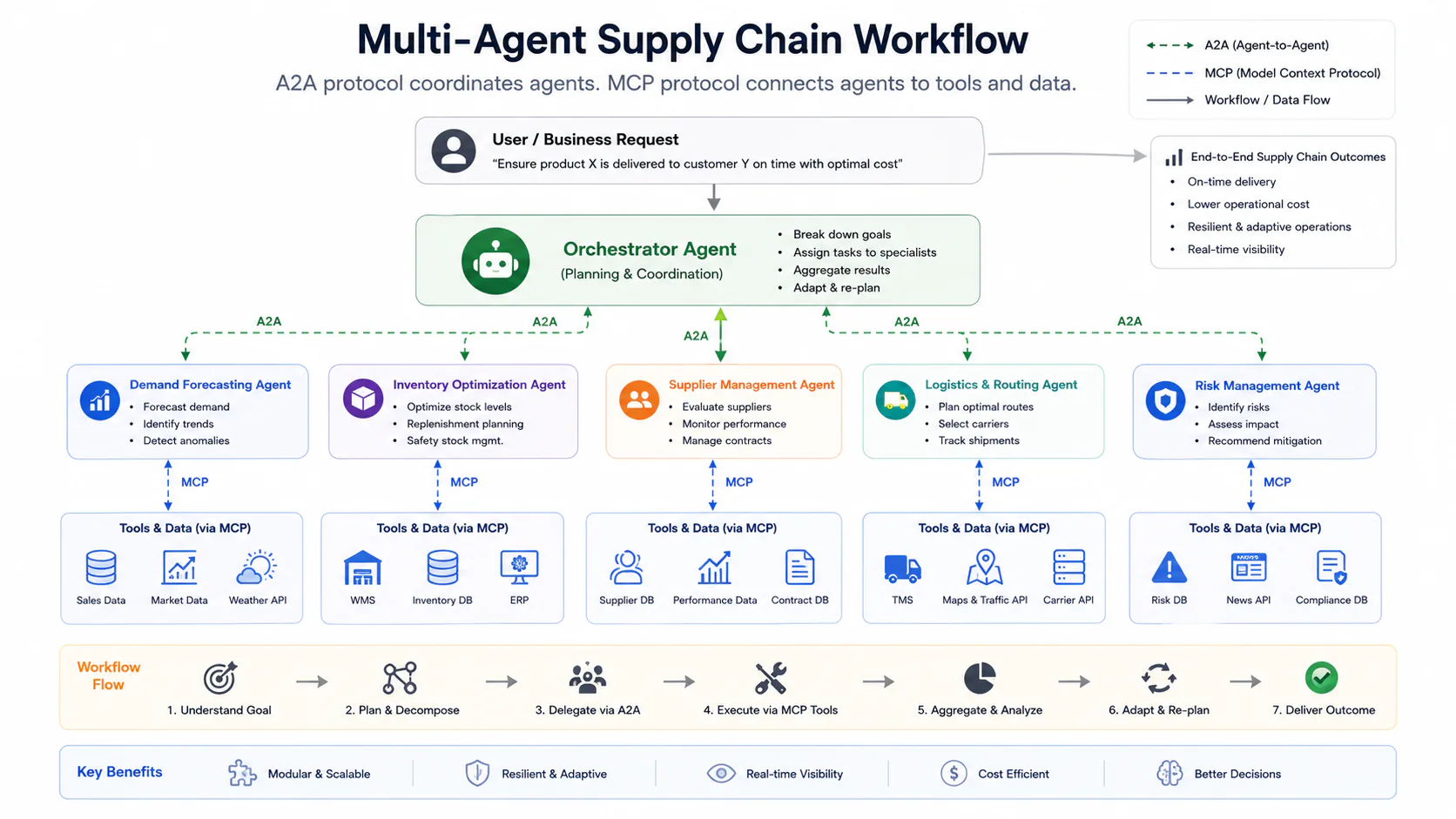
The distinction becomes clearest when you look at a real multi-agent workflow. Here's a supply chain example from actual 2026 production patterns:
An orchestrator agent manages customer order fulfillment. Via A2A, it delegates availability checking to a supplier agent (built by a third-party vendor on a different framework). That supplier agent uses MCP internally to query its own inventory database. A2A handles inter-organizational coordination. MCP handles each agent's tool access. Neither protocol alone would support this workflow.
This is why the framing of "MCP vs A2A" is wrong. The actual stack is:
User / Application
      │
ORCHESTRATOR AGENT (A2A client)
      │
      ├──A2A──► Specialist Agent A (billing)
      │                │ MCP
      │           Stripe + DB
      │
      ├──A2A──► Specialist Agent B (inventory)
      │                │ MCP
      │           ERP + Warehouse API
      │
      └──A2A──► Specialist Agent C (support, 3rd party)
                       │ MCP
                  Ticketing + CRM
A2A handles the conversations between agents. MCP handles each agent's conversations with tools and data. A complete production multi-agent system typically needs both.
Head-to-head: MCP vs A2A on the dimensions that matter
| Dimension | MCP | A2A |
|---|---|---|
| Purpose | Agent connects to tools and data | Agent coordinates with other agents |
| Layer | Vertical (downward to capabilities) | Horizontal (lateral to peers) |
| Transport | stdio / HTTP + SSE | HTTP + SSE + JSON-RPC 2.0 |
| Discovery | Manual configuration or registry | Agent Card at /.well-known/agent.json |
| Auth | Token-based, optional DID (2026 spec) | OAuth 2.0, API keys, mTLS, JWS signing |
| State | Stateless tool calls | Stateful task lifecycle |
| Ecosystem | 10,000+ servers, 97M monthly downloads | 150+ org supporters, 22K GitHub stars |
| Enterprise readiness | High (with security hardening) | Moderate-High (growing rapidly) |
| Launched | November 2024 | April 2025 |
| Governed by | Linux Foundation / AAIF | Linux Foundation |
| Best for | Single agent, multiple tools | Multi-agent orchestration |
MCP's real limitations you need to know
MCP's rapid growth created a security gap that the enterprise community is still closing. Between January and February 2026, researchers filed 30 CVEs against MCP infrastructure. The NSA issued an advisory warning that MCP poses enterprise security risks, specifically flagging that deployment outpaced governance. The Cisco State of AI Security 2026 report found that only 29% of organizations feel prepared to secure agentic AI applications.
The documented attack vectors are worth understanding before you deploy:
- Prompt injection: malicious inputs manipulate the model into executing hidden commands via tool calls
- Tool poisoning: manipulated tool definitions pass into agent context, triggering unauthorized execution
- Over-privileged access: agents running with credentials broader than the task requires (documented in the Supabase incident)
- Supply chain attacks: compromised MCP packages cascading into developer environments (CVE-2025-6514)
- Memory poisoning: malicious inputs injected across multiple interactions that gradually shift agent behavior
The 2026 MCP spec update introduces incremental scope consent, meaning agents request only the minimum necessary access per operation rather than broad credentials upfront. This is a step forward, but enterprise deployments should treat MCP security hardening as a first-class engineering task, not an afterthought.
The cost dimension is also real. A basic MCP server connecting one agent to two or three tools takes four to eight weeks to design, build, and deploy with proper security hardening. Custom MCP servers run an estimated $50K-$150K per integration per year. Context window bloat from MCP resource retrieval also increases latency and inference costs, particularly on complex reasoning tasks.
A2A's real limitations you need to know
A2A is earlier in its maturity curve. While production deployments exist, the most substantiated production implementation from a major platform is Microsoft's Semantic Kernel integration. Most vendors are still building out their A2A support.
Agent Card maintenance adds operational overhead that's easy to underestimate. When an agent's capabilities evolve, its card must be updated. Stale or inaccurate cards cause misrouted task delegation, and in a multi-agent system those failures can cascade.
Long-running distributed tasks that span multiple agents across organizational boundaries add coordination complexity that A2A's task lifecycle model handles well in principle but requires careful error recovery design in practice. Monitoring and observability tooling for A2A workloads is still maturing.
The cross-organizational trust question is also real. Signed Agent Cards in v1.0 address identity verification partially, but enterprise-grade agent authorization frameworks for inter-organizational scenarios are still being developed.
Where to use MCP, where to use A2A
Start with MCP if:
- You're building a single agent that needs to connect to external tools, APIs, databases, or file systems
- You want your agent to work with tools that already have MCP servers (Salesforce Headless 360, ServiceNow Action Fabric, GitHub, Postgres, and thousands more)
- Your primary problem is eliminating custom integration code between agents and tools
- You're in a framework like Claude Code, Cursor, or Copilot Studio that already handles MCP client implementation
Add A2A when:
- You need agents to delegate tasks to other agents, especially across frameworks or organizational boundaries
- You're building an orchestrator that coordinates specialist sub-agents
- Your use case involves stateful, multi-step tasks where progress tracking and failure recovery matter
- Your enterprise stack includes SAP, where A2A via Joule is the only supported path for external agent integration
Build both when:
- You're deploying a production multi-agent system where specialists each need tool access and the orchestrator needs to coordinate them
- You're building cross-organizational agent workflows (supply chain, financial services, insurance)
- You need your agent architecture to scale beyond a single framework or vendor
The SAP decision is worth a separate note. SAP announced during Sapphire 2026 that A2A via Joule is the only supported path for third-party AI agent integration. This isn't an architectural preference, it's a vendor constraint. If SAP is in your stack, A2A is not optional.
The four-protocol landscape (brief)
MCP and A2A are the two protocols your production stack almost certainly needs. Two others are in development and worth knowing:
ACP (Agent Communication Protocol): developed by IBM/BeeAI, adopted by the Zed editor. Handles the editor-to-agent relationship via stdin/stdout. Complementary to MCP and A2A, not competitive. Limited to same-machine execution.
ANP (Agent Network Protocol): a decentralized, peer-to-peer protocol using Decentralized Identifiers. Positioned for open-web agent networks with no central authority. Still early-stage with limited production adoption.
Neither displaces MCP or A2A for enterprise workloads in 2026. They address different architectural contexts.
What this means for your implementation timeline
A full MCP plus A2A multi-agent system with role-based access, schema validation, and orchestration logic typically takes 12-20 weeks of engineering work. That's the realistic baseline for a production deployment, not a weekend prototype.
The practical sequencing for most teams: implement MCP first for tool connectivity, validate the agent-to-tool layer, then add A2A for multi-agent coordination once your specialist agents are functional. Trying to build both layers simultaneously before either works reliably is a common architecture mistake.
Monitoring is currently a gap in both protocols. Neither mandates how usage, errors, or costs should be logged. A misconfigured MCP prompt can reportedly spike daily AI costs from $100 to $17,000 overnight. Budget for FinOps-style observability as a first-class component, not a nice-to-have.
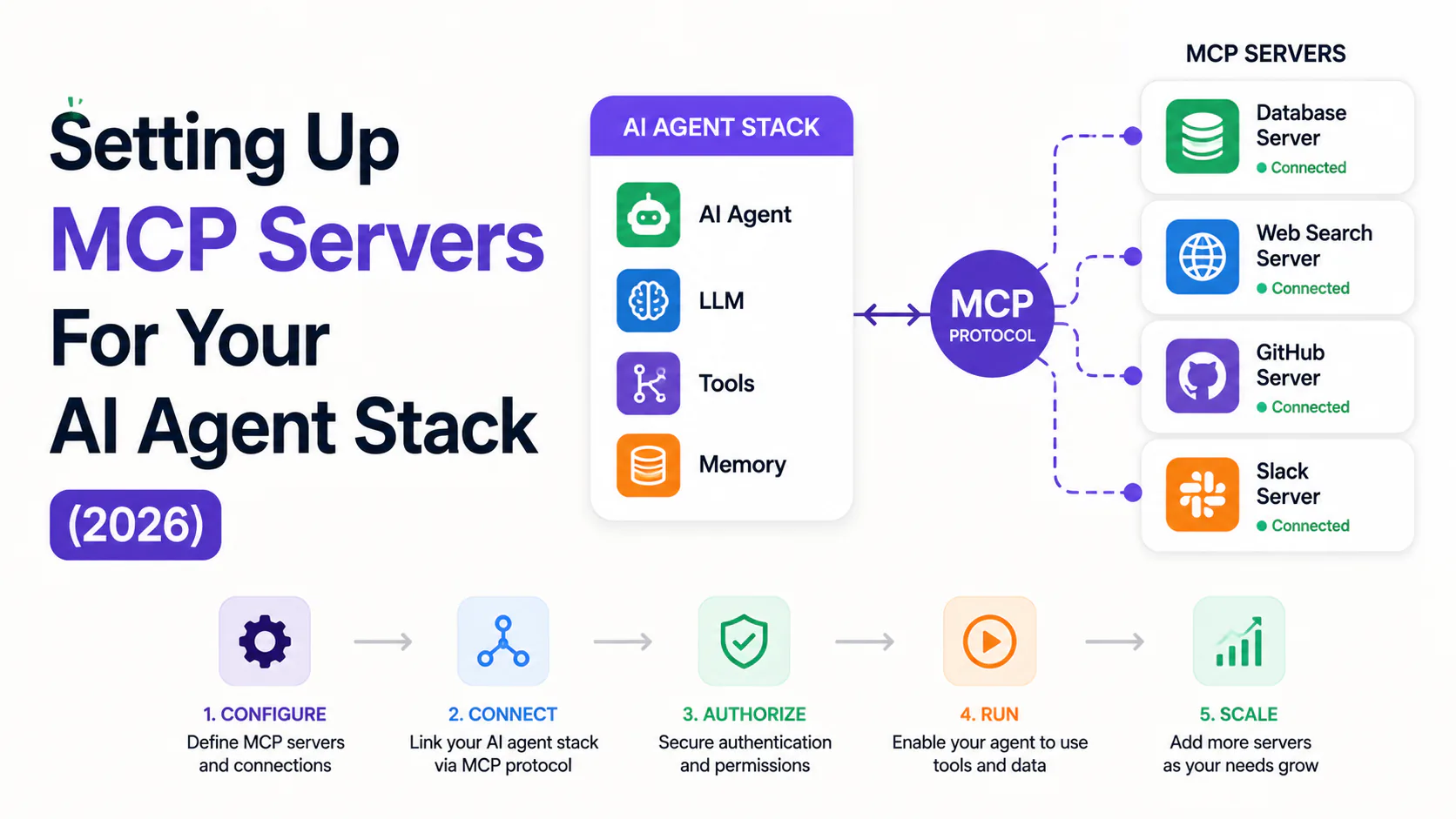
For more on configuring MCP in practice, the MCP server setup guide for AI agent stacks covers transport types, mcp.json configuration, and security hardening in detail.
Final recommendation
MCP and A2A are not competing standards. They are complementary layers of the same infrastructure, and the enterprise AI ecosystem has effectively decided that both will be part of the canonical stack.
If you're building a single agent that needs tools: MCP first. If you're building an orchestrator that coordinates other agents: A2A. If you're building anything at production scale that needs both tool access and agent coordination (most serious systems do), you'll implement both.
The governance question is settled. Both protocols now sit under the Linux Foundation alongside Kubernetes and PyTorch. The "will either survive?" risk is gone. The work now is in the security hardening, observability, and operational maturity that enterprise deployments require.
If your stack includes SAP, A2A is not a choice. For everyone else, start with whichever layer represents your current bottleneck: agent-to-tool connectivity or agent-to-agent coordination.
Frequently asked questions
MCP (Model Context Protocol) is an open standard that defines how AI agents connect to external tools, APIs, and data sources. It uses a client-server architecture where each tool (GitHub, a database, Salesforce) exposes an MCP server, and any MCP-compatible agent can connect to all of them without custom integration code per pair. Launched by Anthropic in November 2024, it now has 97 million monthly SDK downloads and 10,000+ public servers.
A2A (Agent-to-Agent Protocol) is an open standard for how AI agents discover and coordinate with other AI agents, regardless of which framework or vendor built them. It defines Agent Cards (machine-readable capability descriptors), a stateful task lifecycle, and message formats for inter-agent communication. Announced by Google in April 2025 and transferred to the Linux Foundation in June 2025, it now has 150+ supporting organizations including AWS, Microsoft, Salesforce, SAP, and ServiceNow.
Most single-agent setups only need MCP. If your agent needs to call tools, read databases, or access APIs, MCP covers that. You need A2A when you're building multi-agent systems where agents need to delegate tasks to other agents, particularly across frameworks or organizational boundaries. Production systems at scale typically need both: MCP for each agent's tool access, A2A for coordination between agents.
They serve different purposes, so the question depends on your use case. MCP has a larger ecosystem and more production deployments, but has documented security risks that require active hardening. A2A has stronger built-in auth (OAuth 2.0, mTLS, Signed Agent Cards) and is the only supported path for third-party AI agents in SAP via Joule. For most enterprises, the right answer is a phased implementation of both.
An Agent Card is a JSON document published at /.well-known/agent.json that describes an agent's
name, capabilities, accepted input formats, authentication requirements, and endpoint. It
functions like a service descriptor in microservice architecture, enabling other agents to
programmatically discover and evaluate whether this agent can handle a given task. In A2A v1.0,
Agent Cards can be cryptographically signed using JWS for verified identity.