SaaS Pricing Models in 2026: Per-Seat vs Usage-Based vs Outcome
Per-seat SaaS is losing to usage- and outcome-based pricing in 2026. What the data shows, which model fits your product, and lessons from GitHub Copilot.

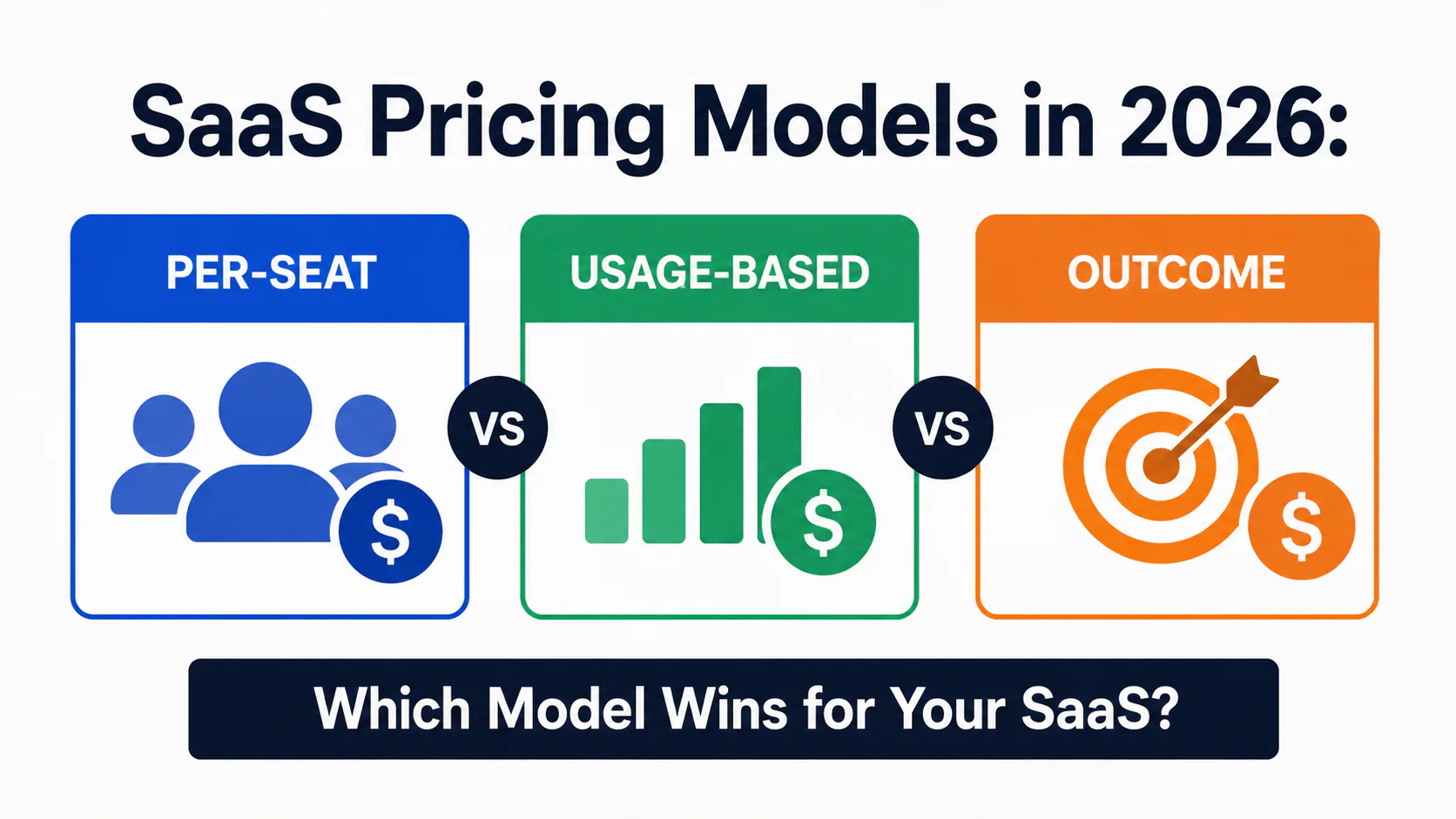
Per-seat SaaS pricing made sense when software was used by humans. One user, one license, predictable revenue. That logic has been coming apart since AI agents arrived.
In early 2026, roughly $2 trillion in market cap evaporated from software companies over 30 days. Atlassian's enterprise seat count declined for the first time in company history. Analysts named it the "SaaSpocalypse." The proximate cause: buyers started asking why they should pay for 100 seats when 10 AI agents could do the same work.
This comparison covers the four pricing archetypes that matter in 2026, the data on which ones grow faster, and the real-world execution stories that show what each model looks like when it works and when it breaks.
TL;DR: Hybrid pricing (per-seat base plus usage-metered AI features) is the dominant model for AI-powered SaaS in 2026. Pure per-seat is structurally vulnerable to agent adoption. Outcome-based pricing is the high-ceiling option but requires measurement infrastructure most teams underestimate. Usage-based pricing grows revenue faster but requires spend cap design from day one.
Quick verdict
Hybrid wins the middle ground for most products right now. Usage-based is the right foundation for API-first or infrastructure products. Outcome-based is the most aligned model for AI automation tools, but only 9% of companies have fully implemented it. Per-seat is not dead, but it only makes sense for specific product categories.
The model you choose is not a billing decision. It shapes your product architecture, what your engineering team optimizes for, and which customers you can serve.
The four pricing archetypes of 2026
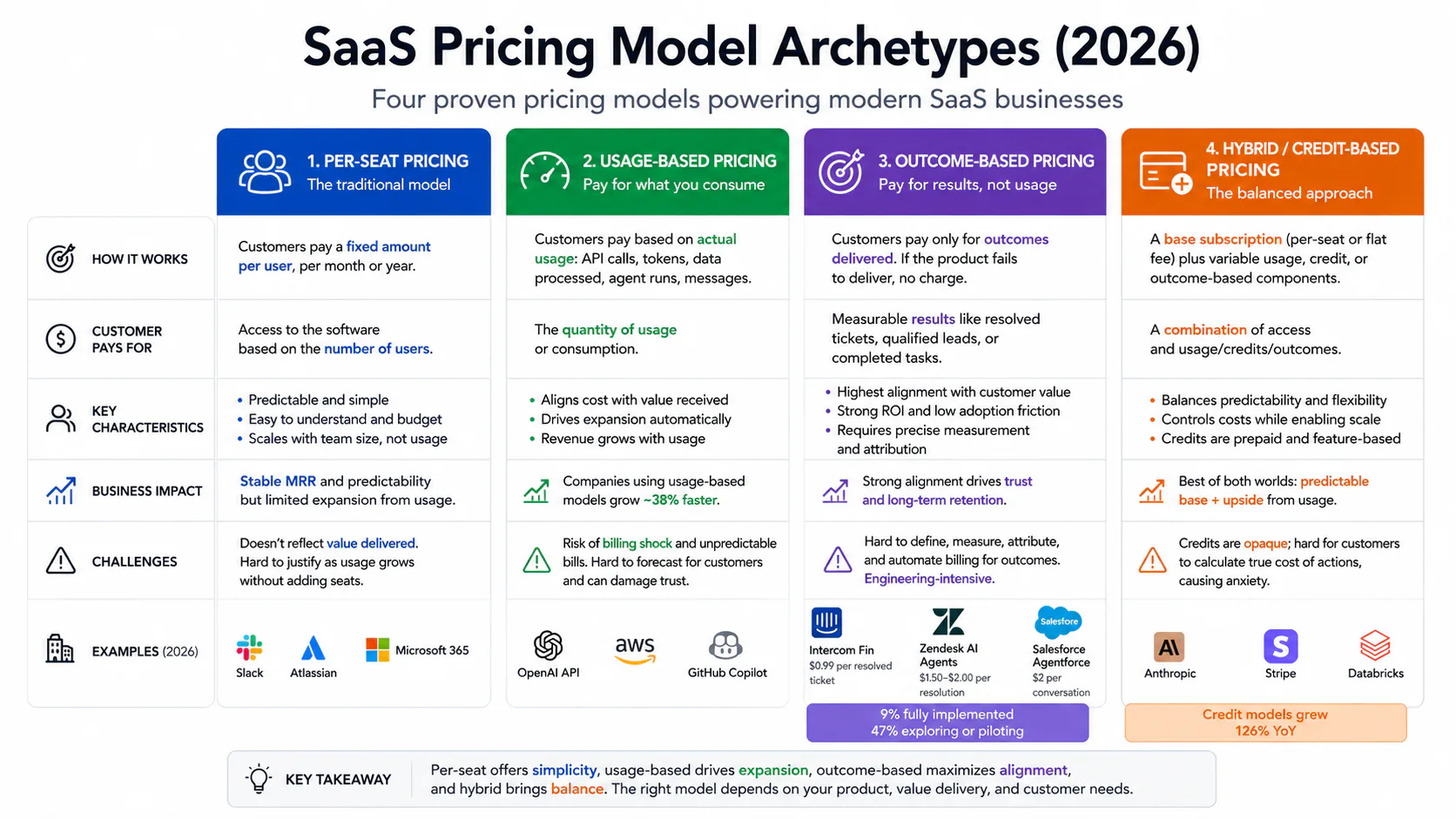
SaaS pricing in 2026 has converged on four distinct models. Vendor marketing blurs them. Here is what each one actually is.
Per-seat (user-based) pricing
A fixed monthly or annual fee per human user. Budget-predictable. Easy to sell. Low operational overhead: no metering infrastructure, no billing anomaly investigations.
The problem is structural. When AI features are bundled into a flat seat price, heavy AI users cost the vendor significantly more than light users while paying the same fee. Worse, if the AI works well and reduces headcount, seat count goes down. The vendor is penalized for delivering value.
The shelfware problem compounds this: enterprise buyers paying for 500 seats when 80 people actively use the product build resentment at every renewal cycle. That resentment is now a tailwind driving procurement teams toward consumption-based alternatives.
Usage-based pricing (UBP / consumption-based)
Customers pay for what they consume: API calls, tokens, data processed, agent runs, messages sent. Revenue tracks directly with product usage.
Companies using usage-based models grow approximately 38% faster than per-seat peers, and the best-performing recent IPOs (seven out of nine, by one measure) had usage-based models. The mechanism is simple: usage-based pricing turns customer success into automatic expansion revenue without a new sales motion.
The operational risk is equally simple to describe and surprisingly hard to solve: billing shock. The GitHub Copilot case study below is the canonical 2026 example. A pricing model that generates five-figure invoices in 24 hours without warning is a design failure, not a customer education problem.
Outcome-based pricing
Customers pay for results delivered, not for software access or consumption. Resolved support tickets. Qualified leads. Completed tasks. If the product fails, no charge.
This is the most aligned model theoretically and the hardest to execute. You need to define outcomes precisely, measure them automatically, attribute them correctly to the product, and surface that data in a billing system. Most teams underestimate the engineering work required for all four.
Live implementations as of 2026: Intercom Fin charges $0.99 per resolved support ticket; Zendesk AI Agents charge $1.50 to $2.00 per automated resolution; Salesforce Agentforce charges $2 per conversation. Currently only 9% of companies have fully implemented outcome-based models, but 47% are actively exploring or piloting them.
Hybrid / credit-based pricing
A base subscription (per-seat or flat fee) combined with variable components (usage-based, credit-based, or outcome-based) metered on top. Credits are a common implementation: customers buy prepaid credits consumed at different rates by different features.
This is where most AI-powered SaaS is landing in 2026. Pure per-seat is unsustainable with variable AI COGS. Pure usage-based is too unpredictable for enterprise procurement. Hybrid threads both needles.
Credit models have grown 126% year-over-year. The practical criticism: credits are opaque. Customers cannot easily calculate the real cost of an action, which creates anxiety about unexpected bills. Most practitioners consider credits a bridge, not a long-term architecture.
Why the economics of AI broke per-seat pricing
Traditional SaaS products, a CRM, a project management tool, a document editor, have near-zero marginal cost per additional user. AI inference does not.
LLM inference is now a variable cost-of-goods item. When AI features are bundled into a flat seat price, vendors absorb that variability. The result is margin compression: AI-feature gross margins run 50 to 60%, compared to 80 to 90% for traditional SaaS. That is 30 points of compression, and it is not recoverable by operational efficiency.
The SaaS CFO community captured the structural risk plainly: "For decades, SaaS expansion revenue was driven by headcount growth. AI introduces the possibility of the opposite: a customer can stay on your platform but quietly shrink their seat count as agents replace the employees who used to need licenses."
This is why pricing model choice in 2026 is a strategic decision, not a billing one. A vendor that successfully automates customer workflows under per-seat pricing is incentivized to cap AI usage, which undermines the product. The model creates the wrong incentive at the exact moment the product is working.
What the data actually shows
| Model | Revenue Growth vs Per-Seat | Median NRR | Customer Satisfaction |
|---|---|---|---|
| Per-seat | Baseline | 100-110% | Moderate |
| Usage-based | +38% | 110-140% | 80% prefer it |
| Outcome-based | High (when executed) | Very high | +31% retention |
| Hybrid (sub + usage) | +21% median | High | High |
| Credit-based | Varies | Varies | Mixed |
A few numbers worth anchoring:
Expansion revenue now drives 38% of new ARR for companies above $25M ARR, up from 27% in 2022. Usage-based pricing is the primary driver of this shift. Pure per-seat models with flat tiers make NRR above 120% structurally difficult to achieve.
Market structure has already shifted. Pure per-seat represents 28% of public SaaS companies today, down from 51% in 2021. Subscription-plus-usage tiers now represent 51%, up from 27% four years ago.
Long range: Bloomberg estimates subscription-based pricing could decline from 60% to 30% of software models over the next decade, while outcome-based pricing grows from 10% to 60%. Gartner forecasts at least 40% of enterprise SaaS spend will shift to usage-, agent-, or outcome-based models by 2030.
Where per-seat still makes sense
Per-seat is not universally wrong. It remains the right model for specific product categories.
Use per-seat when:
- Individual user activity is the primary value driver (calendar tools, communication platforms, document editors)
- AI features are minimal or bounded and do not create variable COGS exposure
- Enterprise buyers prioritize budget predictability over consumption alignment
- The product is a collaboration or workflow tool where the number of humans actively using it is the direct proxy for value delivered
- You are early-stage and have not yet validated the right value metric
The worst outcome is staying on per-seat after clear structural signals: churn driven by shelfware, NRR below 100%, customers optimizing around license counts rather than getting value. At that point, the model is working against the product.
The GitHub Copilot migration: what not to do
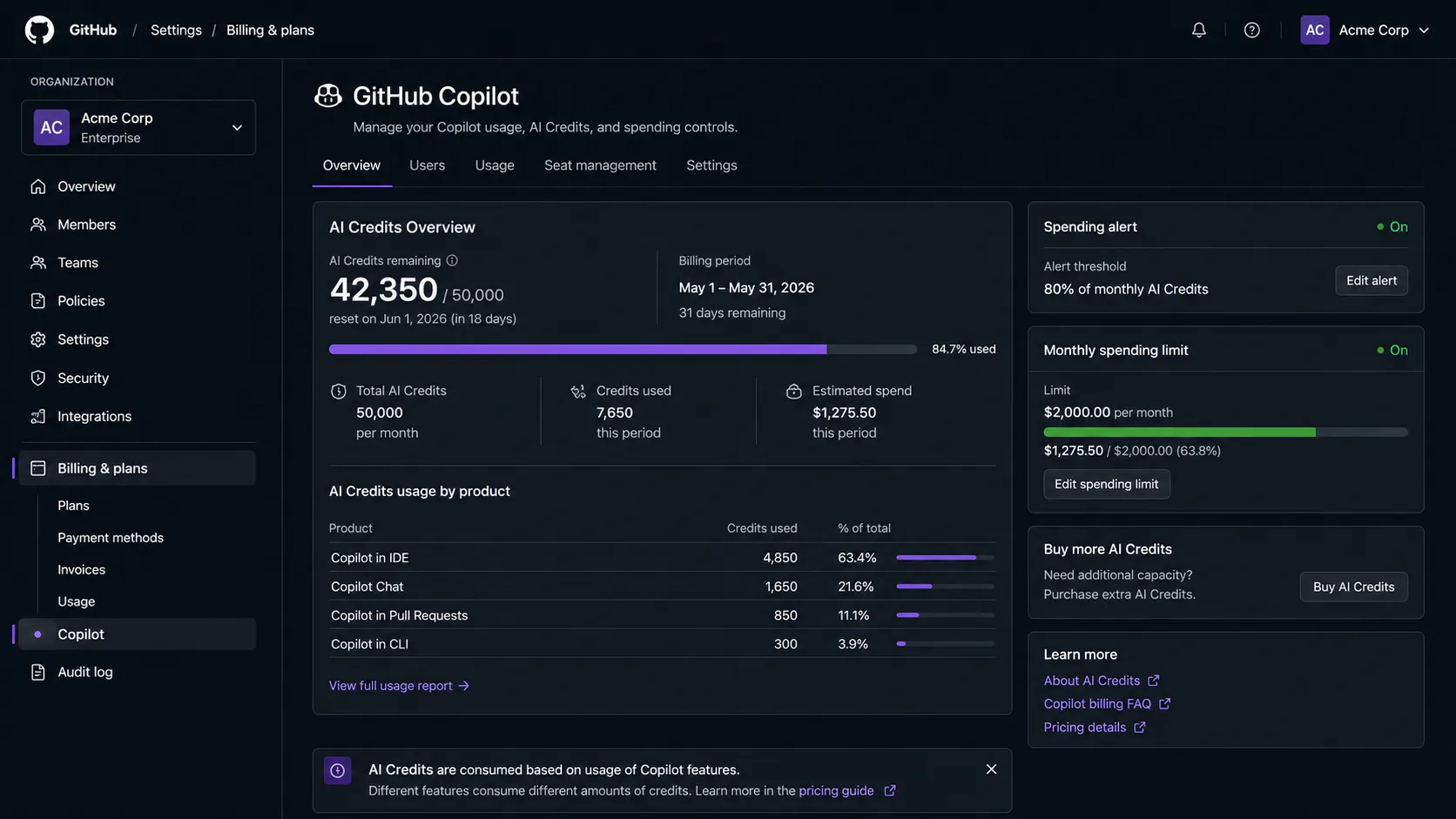
On June 1, 2026, GitHub transitioned all Copilot plans to usage-based billing. Instead of counting premium requests, plans now include a monthly allotment of GitHub AI Credits, with additional usage billed per token at each model's rate.
The community response was immediate and negative. Reports of costs jumping from $29 to $750 per month, and from $50 to $3,000, spread across Reddit, X, and GitHub's own discussion forums. The core problem: no spending ceiling existed by default. Heavy agentic users discovered there was no safety net unless they manually configured spending limits they did not know existed.
The reason GitHub made the change was legitimate: Copilot had evolved from autocomplete into an agentic coding assistant, and the internal cost structure no longer fit flat billing. Internal documents cited by journalists noted that week-over-week running costs had nearly doubled since January 2026. The transition was cost-driven, not strategically planned.
The design lesson that every SaaS team planning a UBP migration has taken from this: usage-based pricing requires four architectural components that seat-based pricing does not:
- Spend caps (hard limits on per-user, per-team, or per-billing-period usage)
- Real-time usage dashboards accessible to the buyer
- Alerting systems that fire before limits are hit, not after
- Granular audit trails so bills can be explained line by line
Absent these four, billing shock is not an edge case. It is the predictable outcome for any power user in an agentic workflow.
The Intercom Fin story: outcome-based at scale
Intercom Fin is the most studied outcome-based pricing implementation of 2026. The case is instructive because of what they tried first and rejected.
The team initially considered per-conversation pricing and a percentage-of-revenue model. Per-conversation charged for every interaction regardless of whether the customer's problem was solved. Revenue-based attribution broke down because too many variables between Fin's work and a closed deal sat outside Fin's control.
The solution: $0.99 per resolved conversation, with no charge for failures. Annual resolution buckets. Non-punitive overages. Pay-as-you-go options for teams not ready to commit annually.
Intercom CTO Darragh Curran described the core tension: "A surprising challenge has been predictability getting in the way of usage." Customers who could not forecast costs were cautious about usage, which is the opposite of what an outcome-based model should produce. The resolution bucket and overage structure directly addressed this.
Result: Fin rapidly scaled to an eight-figure ARR business at 393% annualized growth. Zendesk followed at $1.50 to $2.00 per automated resolution. Salesforce launched Agentforce at $2 per conversation. Outcome-based pricing is now the industry template for AI customer service tools.
The precondition that every implementation assumes but few teams pre-build: robust measurement infrastructure. Before you can charge per outcome, you need automated, auditable detection of whether the outcome occurred. Intercom spent significant engineering time on resolution detection before pricing could go live. That work is not optional.
When each model wins: a decision guide
Per-seat wins when individual user activity is the primary value driver; AI features are minimal or bounded; buyers prioritize budget predictability; the product is a collaboration or communication tool.
Usage-based wins when COGS is variable and scales with use; customers want to start small and grow; developer or technical buyers are the primary audience; the product is API-first infrastructure.
Outcome-based wins when AI automation is the core product; the outcome is measurable and attributable; the market has trust deficits to overcome; the vendor has the engineering capacity to build measurement infrastructure.
Hybrid wins when the vendor has an established per-seat base that cannot be disrupted overnight; AI features need separate monetization; enterprise buyers need a predictable floor with usage upside.
The test that cuts through most analysis: what is the unit of value your customer receives? Pricing architecture flows from the answer to that question. Twilio initially charged per API call and found per-message pricing better aligned value. Snowflake tested multiple approaches before settling on compute credits. Getting the value metric right matters more than which archetype you choose.
The FinOps implication for buyers
The buyer side response to variable AI billing has generated a new discipline: SaaS FinOps. Enterprise procurement teams now treat usage monitoring, spend caps, governance dashboards, and real-time metering as procurement requirements for any tool with variable AI billing, not nice-to-haves.
Even as token prices have fallen 80% year-over-year, total AI spending has grown 320%. The tools category has matured accordingly: BetterCloud, Zylo, and Torii have expanded to include token-level visibility into AI usage. Any vendor deploying usage-based pricing into enterprise accounts without a governance story is solving a problem for their billing team while creating a problem for their procurement team.
The CFO perspective is consistently underrepresented in pricing discussions focused on vendor growth metrics. The best pricing model is the one a buyer can explain to their CFO in one sentence. Hybrid pricing earns its complexity only when each layer maps to value the buyer already understands.
Which one should you choose?
If you are a founder or product leader evaluating this now:
Start with the simplest model that captures your value metric. Add complexity only when you have data justifying it. Per-seat is not wrong for an early-stage company that has not yet validated its value metric. The mistake is staying there after the signals change.
If you are an established SaaS vendor with AI features: the margin math on AI inference under flat pricing will eventually force a model change. Building metering infrastructure now is cheaper than an emergency transition under cost pressure. GitHub Copilot's June 2026 migration is the cautionary example of what a cost-driven, under-prepared transition looks like.
If you are evaluating AI-native tools as a buyer: insist on spend cap configuration, real-time usage dashboards, and auditable billing before signing any contract with variable AI billing. These are now table-stakes features, not differentiators.
For a deeper look at how specific AI tools price agentic features, see our Cursor Background Agents tutorial (usage-based billing in practice), the AI tools category hub, and SaaS productivity coverage.
Frequently asked questions
Not dying, but declining. Pure per-seat represented 51% of public SaaS companies in 2021 and 28% in 2026. It remains the right model for collaboration tools, communication platforms, and any product where individual user activity directly drives value. For AI-powered products where inference costs are variable, it creates margin problems that compound over time.
Usage-based pricing means customers pay based on measurable consumption: API calls, tokens, data processed, agent runs, or messages sent. Revenue scales with how much value the product delivers rather than how many seats are licensed. Companies on usage-based models grow approximately 38% faster than per-seat peers, but the model requires spend cap design and real-time billing dashboards to avoid billing shock.
Outcome-based pricing charges for results delivered rather than software access or usage. Live examples in 2026: Intercom Fin at $0.99 per resolved support ticket, Zendesk AI Agents at $1.50 to $2.00 per automated resolution, and Salesforce Agentforce at $2 per conversation. Only 9% of SaaS companies have fully implemented this model, primarily because it requires significant measurement and attribution infrastructure before billing can go live.
GitHub Copilot switched to usage-based billing on June 1, 2026, transitioning plans from request-based counting to token consumption. The immediate problem: no spending ceiling existed by default. Heavy agentic users saw costs jump from $29 to $750 per month or more without warning. The root cause was a design failure: the architecture allowed five-figure invoices without any alerting system intervening. Usage-based pricing requires spend caps, real-time dashboards, and alerts to be safe to deploy at scale.
Hybrid pricing (a per-seat or platform base with AI features metered separately) is where most AI-powered SaaS companies are landing. It gives enterprise buyers a predictable floor, aligns AI inference costs to revenue, and avoids the full complexity of outcome-based measurement infrastructure. Pure usage-based works best for API-first and infrastructure products. Outcome-based is the highest-ceiling option for AI automation tools once the measurement infrastructure is in place.