Best Project Management Tools with Embedded AI (2026)
ClickUp Brain2, monday.com, Wrike, Atlassian Rovo, Asana, and Notion compared on embedded AI agents, pricing, data governance, and real workflow ROI in 2026.

Bytewaves Score Card
Project management software crossed a structural line in 2026. The category is no longer dividing along features - Gantt charts, board views, dependency tracking. It is dividing along AI philosophy: who has agents, how deeply they are embedded in real workflows, and whether AI can act on the work or just describe it.
The market numbers confirm the shift. The AI in project management segment grew from $5.32 billion in 2025 to $6.39 billion in 2026, with a 22% annual growth rate forecast through 2032. More practically: 88% of organizations now use AI in at least one business function, and 44% of teams report relying on AI-assisted project management features. But knowledge workers still spend 60% of their time on "work about work" - status updates, progress reports, searching for context across tools, preparing for meetings. That gap is exactly what the best platforms in 2026 are targeting.
This review covers the six platforms with the most substantive embedded AI in 2026: ClickUp (Brain2 + Super Agents), monday.com (AI Work Platform relaunch), Wrike (AI Agents GA), Atlassian (Rovo + Teamwork Graph), Asana (AI Teammates + AI Studio), and Notion (Agents 3.0+). Each is assessed on what their AI actually does, where it falls short, and which team type gets the most value.
Quick verdict: ClickUp Brain2 is the most comprehensive AI layer for all-in-one teams. monday.com is the easiest for non-technical teams building custom agents. Wrike has the strongest documented enterprise ROI and governance controls. Atlassian Rovo is the only platform with 20+ years of accumulated organizational context powering its AI. Asana is best-in-class for goal-aligned project tracking. Notion is the right pick for knowledge-first teams who want documents and projects in one AI-aware workspace.
What "embedded AI" actually means in 2026
The most important distinction to establish before comparing platforms: the difference between reactive AI assistants and agentic AI.
A reactive assistant responds when you ask: click the "summarize" button, it drafts the status update. Useful, but still requires you to initiate every action. Every platform in this review had reactive AI by 2024. That is no longer the differentiator.
Agentic AI acts on behalf of the work without being asked. It monitors a project, notices it is drifting off schedule, and posts the risk flag. It watches a ticket queue, triages incoming requests by priority, and routes them to the right team member. It runs the weekly standup by pulling each person's task history and posting the formatted summary before you arrive at the meeting. That is the shift that happened in 2026 across all six platforms in this review.
The second concept worth understanding: workspace-aware context. A standalone Claude or ChatGPT session has no idea what your project looks like. Embedded AI reads your live workspace: task assignments, due dates, status history, comments, linked documents, overdue items. When you ask "what did the design team ship last week?" the answer comes from actual task records, not a hallucinated estimate. That native context is the competitive advantage embedded AI holds over generic tools - and the reason data hygiene matters so much (more on that later).
A third layer emerging in 2026 is Model Context Protocol (MCP), introduced by Anthropic. Both ClickUp and monday.com now publish MCP servers, and Atlassian opened its Teamwork Graph via MCP at Team '26. This inverts the traditional integration model: instead of your PM tool connecting to AI, your AI tool (Claude, ChatGPT) connects directly to your PM workspace as a data source and action surface. That architecture is early but significant.
ClickUp: Brain2 and Super Agents
Best for: All-in-one teams wanting the deepest AI layer across tasks, documents, meetings, and goals in a single workspace.
ClickUp's AI offering has historically been called "the most comprehensive AI layer in any PM platform" by independent reviewers, and Brain2 - shipped in May 2026 - substantiates that claim with a meaningful architectural upgrade.
What Brain2 adds
Brain2's core change: AI models now get direct contextual access to everything stored in the ClickUp workspace, not just the task they're currently open on. Ask about Q1 delivery status across five teams and the answer draws from tasks, docs, comments, and linked items simultaneously. The knowledge retrieval becomes genuinely useful instead of isolated to whatever page you happen to have open.
Multi-model routing is built in. Brain2 automatically distributes work across GPT-4o, GPT-5, Claude Opus, o3, and o1-mini based on what the task actually requires. Cheap, fast models handle boilerplate and summaries. Expensive reasoning models handle architectural or strategic questions. The routing is not configurable per task - it is automatic and invisible, which keeps it simple but removes control.
The capability that has no equivalent in competing platforms: Brain2 can generate polished slide presentations, interactive dashboards, websites, and executable code directly from a natural-language prompt inside the workspace. "Create a Q2 board review deck from the current project status" returns a formatted presentation, not a draft outline.
Super Agents: AI coworkers in the workspace
Super Agents are ClickUp's most significant differentiation. These are AI "coworkers" that exist as real users in the workspace - they appear in the Members list, can be @mentioned in comments, put on task assignments, and scheduled to run on a cadence. Each agent has a defined skill set (500+ fine-tuned skills) and a scope: which spaces it can touch, what actions it can take.
Autopilot Agents cover the highest-volume routine work: weekly standups, status update compilation, ticket triage, onboarding task creation. The agent runs on schedule, pulls current task data, formats the output, and posts it to the right channel or Assignee without any human trigger. A product team at a mid-size tech company uses ClickUp's Knowledge Manager agent to answer onboarding questions like "where is the deployment runbook?" - eliminating what previously amounted to a 20-minute cross-tool search for every new hire.
MCP integration means Claude and ChatGPT can connect to a ClickUp workspace directly - creating tasks, pulling reports, updating items from outside the app. For teams that use external AI tools alongside ClickUp, this is the path to combining workspace context with frontier model capabilities.
Pricing: ClickUp plans are separate from Brain pricing. Brain AI is $9/user/month as an add-on. Everything AI (the full tier) is $28/user/month on top of base ClickUp cost. AI is not included in base plans.
Honest limitation: Feature depth creates real onboarding friction. If your team barely fills out task descriptions now, Brain2 will not fix that - it will surface AI outputs based on whatever sparse data exists. The platform's AI quality scales directly with existing data hygiene. ClickUp 3.0 was deprecated in March 2026 partly due to performance complaints; ClickUp 4.0 achieved approximately 40% faster load times, which is a real improvement over the prior version's reputation.
monday.com: The AI Work Platform relaunch
Best for: Business teams wanting agents that execute end-to-end workflows without a technical background; non-engineers who need to build and configure custom automations.
In May 2026, monday.com announced what its leadership called "the most significant change in the company's history" - a repositioning from work management platform to AI Work Platform. The relaunch centers on three features that work differently from anything else in the category.
monday Sidekick
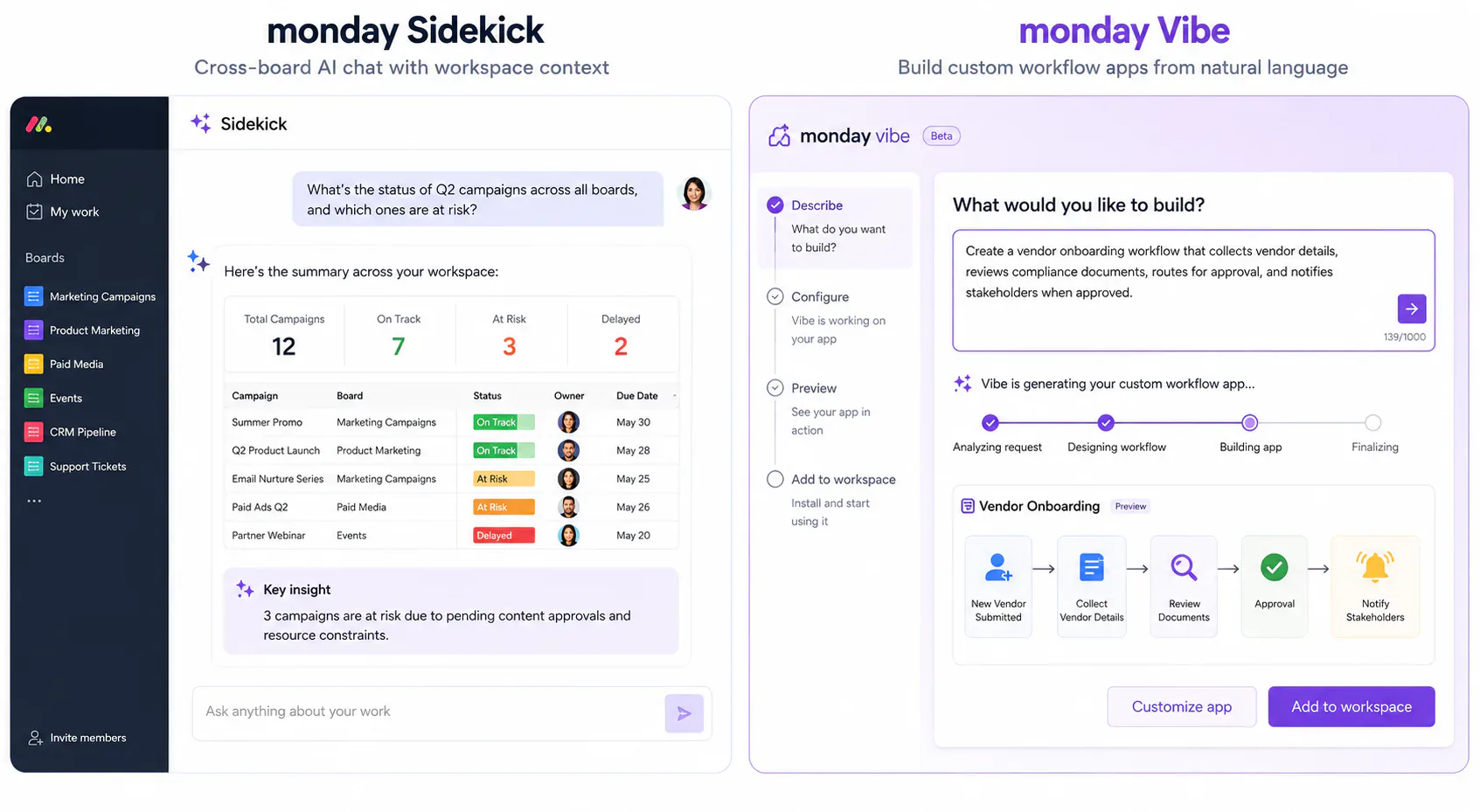
Out of beta since January 2026, Sidekick is the central AI entry point. It works across boards, docs, and people with full workspace context - unlike most AI chat interfaces that only see the current page. Ask Sidekick "what's the status of the ACME deal across all departments?" and it synthesizes from the relevant boards, surfaces the relevant owners, and returns a coherent answer without requiring you to specify which boards to search. For operations teams running multiple cross-functional processes, the cross-context awareness is the feature that earns daily use.
monday vibe
This is monday.com's answer to the "vibe coding" pattern. Describe in plain language what workflow or tool you need - "a client onboarding tracker that automatically sends welcome emails and creates a task checklist based on the service tier" - and Vibe generates custom views, dashboards, and mini-apps directly inside the platform. No code, no API configuration. Building and testing is free; publishing apps is billed separately.
The practical application: content agencies use Vibe to build intake forms that automatically structure themselves as boards with the right columns based on a natural-language description of the project type. Sales operations teams build lead routing workflows. This reduces the need for custom internal tooling that would otherwise require an engineer.
monday AI Agents
Native agents execute work end-to-end: routing, updating, notifying, triaging, and preparing context for handoffs. CRM agents classify leads by intent and route them to the right representative. Support agents triage incoming tickets and prepare context before a human review. The agent creation interface is the most accessible of any platform in this review - non-technical team members can configure and deploy agents through a guided interface.
MCP infrastructure, introduced in March 2026, allows external AI agents to authenticate and operate within monday.com as active participants - not just passive integrations that pull data.
Pricing: monday.com switched to a credit-based model in 2026. AI actions consume credits at $0.01 per credit, with an initial trial balance of 6,000 to 12,000 credits on first use, then packages starting at $960/year. Many features remain free: Formula Builder, Docs Assistant, Deal Insights. The credit system adds cost unpredictability for high-volume AI workflows, which is the most common community complaint.
Wrike: AI Agents with enterprise governance
Best for: Enterprise teams where agent accountability, auditability, and security posture are prerequisites, not afterthoughts.
Wrike launched AI Agents into general availability on February 5, 2026 with an unusually specific ROI claim: six days of output in a five-day work week. The adoption data from the GA announcement is the most concrete evidence for agentic AI's enterprise impact of any platform in this review.
What the adoption data shows
These figures come from Wrike's GA announcement and early-adopter reporting:
- Early adopters report savings of up to 520 hours per employee annually (approximately 10 hours per week)
- AI penetration in enabled accounts grew from 1% to 53% after agents became available - the activation event drives nearly universal adoption
- In January 2026 alone, AI actions nearly equaled all of 2025's combined AI actions
- Weekly active AI users increased by 4,900% during the preview phase
- Agents now represent 23% of all AI traffic within Wrike
The intake agent use case is the most documented: a marketing team's intake review process dropped from 3.5 hours per idea to a fraction of that. The agent pre-reviews submissions so human reviewers receive pre-screened, structured requests with context already filled in.
What Wrike AI Agents do
Wrike Copilot is the always-on AI assistant: answer questions, summarize work, surface relevant context. The Copilot layer is most analogous to what other platforms call their base AI assistant.
AI Agents are purpose-built for specific workflow categories: triage (classify and route incoming requests), intake (structure and prepare submissions before human review), and risk (monitor projects for drift and flag issues before they become deadline misses). Multi-Actions capability, requested by 72% of early adopters, allows a single agent to execute several workflow steps in sequence without human hand-off between each step.
The Agent Builder Dashboard gives administrators visibility over agent activity, active locations, recent updates, and execution counts across the organization. This governance layer is what makes enterprise procurement of agentic AI possible: you can see what agents are doing, when, and on what.
Security posture: Wrike runs on Microsoft Azure OpenAI Service with stringent security standards. It does not use customer data to train generative AI models. Gartner named Wrike a Leader for the third time in the 2025 Magic Quadrant for Collaborative Work Management. For organizations where data sovereignty and compliance are purchase requirements, this documentation is available and current.
Pricing: Not publicly listed. Requires a sales conversation. Primarily an enterprise tool; less accessible for small teams or individual buyers.
Atlassian (Jira + Confluence + Rovo): The Teamwork Graph
Best for: Software engineering organizations, DevOps teams, and large enterprises where 20+ years of organizational work data creates AI context that no other platform can replicate.
Atlassian's AI strategy is built on a data asset no competitor can acquire quickly: the Teamwork Graph, a living map of how work flows across teams, tools, goals, and decisions, built over two decades of enterprise use with over 150 billion connections. When Rovo answers "which services still use the outdated UI pattern and who owns the migration plan?" it draws from actual historical project data, not inference from the current task list.
What Team '26 shipped (May 6, 2026)
The announcements at Team '26 represent the most significant Atlassian AI expansion since Rovo launched:
Agents in Jira (GA): Teams can assign work items directly to AI agents, @mention them in comments, and embed them in Jira workflows with full audit trails. An agent that handles IT, finance, and sales ops intake applies the same pattern across all three: triage incoming requests, score by priority, document context, deflect duplicates, and pass qualified items to human reviewers.
Teamwork Graph opened to third-party agents: Third-party AI agents can now search, reason, and act securely across Atlassian tools. This is live for 90% of Atlassian enterprise cloud customers. A Claude or custom enterprise AI agent can connect to the Teamwork Graph via the new MCP Server and CLI tools, accessing 150 billion connections of organizational context from outside the Atlassian UI.
Max mode in Rovo Chat (early access): Hands off complex, multi-step work to Rovo, which breaks it into an action plan and coordinates autonomously across Atlassian and connected SaaS apps.
Strategic Intelligence in Focus (open beta, June 2026): Rovo agents reason over the Teamwork Graph to surface what is on track, what is at risk, and what decisions need to be made today - proactively, without requiring a query.
The scale of current usage: in the month before the Team '26 announcement, Atlassian customers performed more than 14 million Rovo-assisted actions. Agentic automations were up 7x in the preceding six months. Williams Racing uses Rovo agents to surface relevant information from trusted sources across their Atlassian setup, improving decision speed in a high-pressure performance environment.
Pricing: Rovo is included at Premium and Enterprise tiers of Atlassian cloud products. AI credits are consumed per action; exact pricing varies by plan. Full agentic capabilities require Premium or Enterprise.
Honest limitation: Jira's learning curve is steep, particularly for non-engineering users. The platform's complexity is its strength for the teams it is built for, and a genuine barrier for everyone else. If your team is not already in the Atlassian ecosystem, the switching cost is substantial.
Asana: AI Teammates and structured work graphs
Best for: Organizations where connecting daily work to strategic goals is the primary project management challenge; teams that already run structured, consistent Asana workflows and want AI layered on top.
Asana's AI expansion is built on its Work Graph data model - the structured representation of how work flows through an organization. The platform's AI features are most valuable where that structure already exists: if your team runs disciplined, consistent Asana workflows, the AI amplifies that. If your team's Asana usage is inconsistent, the AI output will reflect the inconsistency.
Key AI features
AI Teammates directly support task execution, content creation, and workflow progression rather than acting as passive assistants. They are most analogous to monday.com's Agents, but Asana's implementation is more constrained in scope and more predictable in behavior.
Smart Status is the feature with the most documented day-to-day value: AI drafts project status updates by analyzing live project data, highlighting what is on track, what is behind, and what needs attention. Reviewers consistently note that the drafts are a solid starting point rather than a finished product, but the time saved on manual status compilation is real. A weekly 30-minute status update process becomes a 5-minute review-and-edit.
Smart Fields suggest field values and auto-populate fields based on task context when creating custom fields. Smart Summaries generate AI-compiled overviews of recent project or task activity - useful for catching up after time away. AI Studio provides a no-code interface for building intelligent automation rules within Asana.
Asana's Goals feature remains best-in-class for connecting daily task work to strategic objectives. Most PM platforms treat goal tracking as a secondary feature; Asana built it as a core part of the work graph. The AI integration makes goal progress more visible: when tasks update, goal progress updates automatically, and AI can surface which goals are at risk based on current task velocity.
A March 2026 update introduced a single admin toggle to enable AI features across an entire organization from the Admin console, reducing the deployment overhead that previously required per-team configuration.
Pricing: AI features are included in the Starter plan and above. Starter begins at $10.99/user/month, making Asana's AI the most accessible from a pricing standpoint among the enterprise-oriented platforms. The Advanced plan at $24.99/user/month is where the full AI feature set is available.
Honest limitation: "Asana's AI is solid, not groundbreaking" is the recurring community assessment, and it is fair. Relative to ClickUp's and monday.com's AI investment pace in 2026, Asana has moved more conservatively. The platform's opinionated data model is a strength for teams whose work fits the model and a friction point for teams whose workflows don't.
Notion: Agents and autonomous execution
Best for: Knowledge workers, product teams, and individuals who want documents, wikis, project databases, and AI in a single flexible workspace rather than a dedicated PM tool.
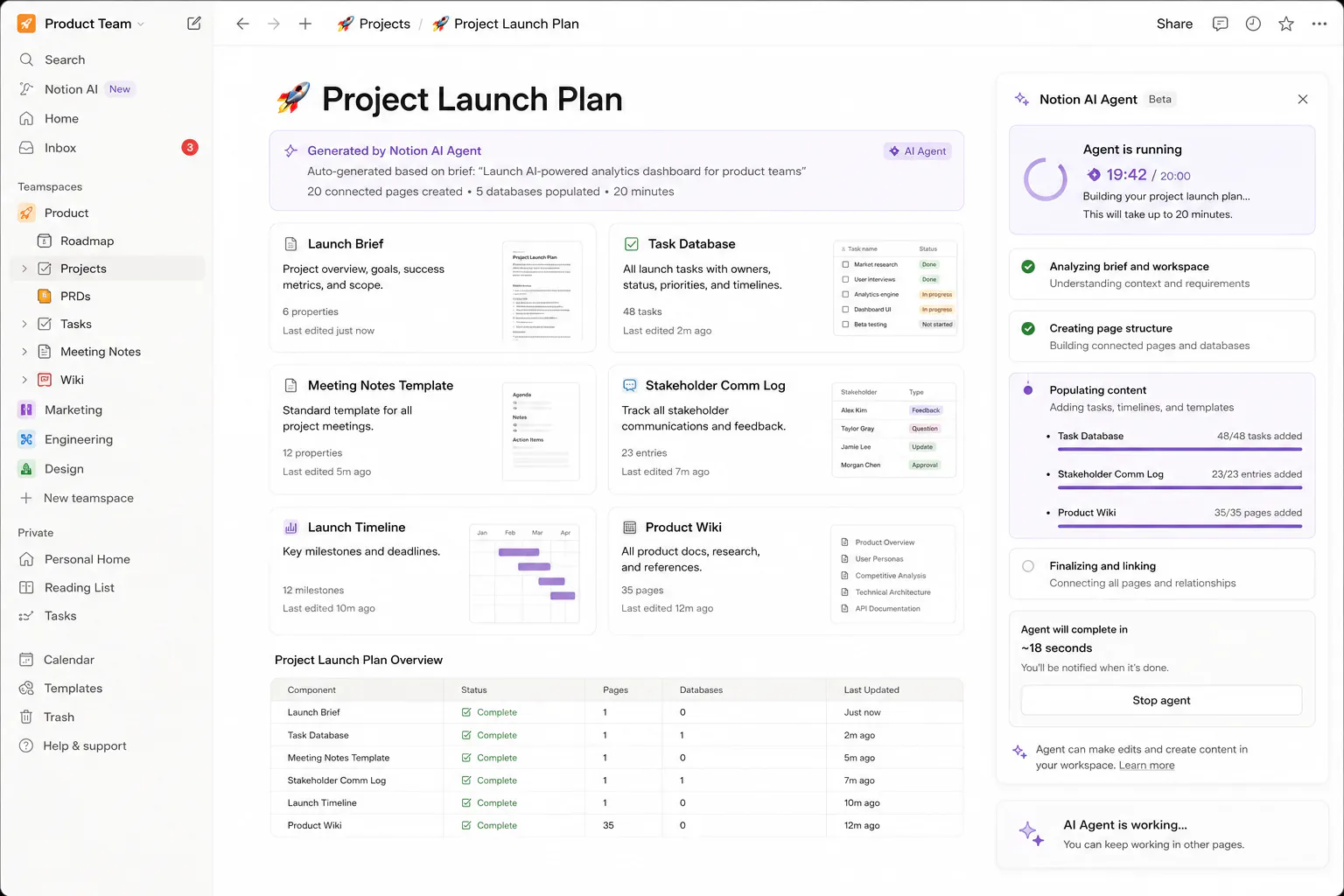
Notion crossed from "AI that suggests" to "AI that executes" with Notion 3.0 in September 2025. Notion Agents can work autonomously for up to 20 minutes, running multi-step tasks across hundreds of pages simultaneously. Notion 3.2 in January 2026 brought agents to mobile and added access to frontier models: GPT-5.2, Claude Opus 4.5, and Gemini 3 with intelligent auto-model selection.
What Notion Agents do
Agents build comprehensive project launch plans from brief descriptions. They compile user feedback from multiple sources into structured Notion databases. They draft reports and update database entries at scale. They create interconnected page structures across a workspace - a new product launch plan that auto-generates the brief, the task database, the meeting notes template, and the stakeholder communication log simultaneously.
A practical workflow documented by a product manager on DEV Community: Monday standup prep from last week's auto-summarized task progress; sprint retrospective summaries; PRD drafts from bullet-point notes; routing and summarizing stakeholder feedback threads. The agent handles the mechanical assembly; the PM handles the judgment.
Key January 2026 updates: The context window expanded from 20 to 50 pages, meaning a project wiki with 35 pages can be fully summarized in a single prompt. AI blocks now resolve one level of links, so a dashboard page linking to five sprint pages automatically pulls all five sprints when generating output. Voice input on macOS and Windows turns a 30-second typed prompt into a 5-second spoken one.
MCP improvements let you track MCP activity in audit logs, query multiple databases, and control which external AI tools can connect to your Notion workspace.
Honest limitations: Notion is a better all-in-one workspace than a dedicated PM tool. Complex projects requiring Gantt charts, resource management, or portfolio-level tracking require workarounds that a purpose-built PM tool handles natively. Data sync with connected apps (GitHub, Jira, Slack, Google Drive) flows in but not out - a PR status update in Notion does not sync back to GitHub. The 20-minute autonomous execution limit means Agents are not designed for indefinite background workflows.
Community verdict from r/Notion: the AI genuinely saves hours per week for people already living in Notion. The $16/user/month Business plan requirement for AI access draws scrutiny from users who do not maximize the features. The ROI framing holds for full Notion users: eliminate a separate ChatGPT subscription (save $240/user/year), reduce documentation tool costs, potentially consolidate a separate PM tool. The total potential savings of $400 to $520/user/year make the Business plan cost reasonable for teams that commit to the platform.
Pricing: Free plan available. AI requires the Business plan at $16/user/month.
Platform comparison
| Platform | AI tier | Agentic | MCP support | Audit trail | AI pricing | Best fit |
|---|---|---|---|---|---|---|
| ClickUp Brain2 | Super Agents | Full | Yes | Limited | +$9–28/user/mo | All-in-one teams |
| monday.com | Sidekick + Vibe + Agents | Full | Yes (March 2026) | Yes | Credit-based (+$960+/yr) | Non-technical teams |
| Wrike | Work Intelligence + Agents | Full | No | Full (enterprise) | Sales only | Enterprise governance |
| Atlassian Rovo | Teamwork Graph + Agents | Full | Yes (MCP Server) | Full | Premium/Enterprise tier | Engineering orgs |
| Asana AI Teammates | Work Graph + AI Studio | Partial | No | Admin console | Included in Starter+ | Goal-aligned teams |
| Notion Agents | 3.0+ autonomous agents | Full (20 min limit) | Yes | Audit logs | Business plan ($16/u/mo) | Knowledge-first teams |
Decision guide by team type
| Team type | Best pick | Why |
|---|---|---|
| Enterprise software engineering | Atlassian (Jira + Rovo) | Teamwork Graph depth, agents in dev workflows, full audit trails |
| Enterprise cross-functional | Wrike | Best governance, agent accountability, enterprise security posture |
| Business teams, non-technical | monday.com | Sidekick + Vibe for no-code agents; most accessible agent creation |
| All-in-one teams | ClickUp Brain2 | Most comprehensive AI across tasks, docs, goals, meetings |
| Goal-driven organizations | Asana | Best goal tracking; structured AI on a mature work graph |
| Knowledge-first teams | Notion | Best for docs + projects + AI in one flexible workspace |
| Individuals and small teams | Motion or Morgen | AI-native scheduling without enterprise platform complexity |
| Microsoft 365 shops | Microsoft Planner + Copilot | Zero incremental cost if already paying for M365 Copilot |
The limitations nobody advertises
Data hygiene dependency
Every platform's AI quality scales directly with how well teams actually use the platform. ClickUp's #1 Solutions Partner (ZenPilot) put it plainly: "If your team barely fills out task descriptions, Brain won't magically create intelligence from nothing." This applies equally to every platform in this review. AI surfaces what is in the workspace. If status fields are blank, descriptions are empty, and comments are sparse, the AI has nothing to synthesize. Deploying these tools requires a data discipline conversation before an AI configuration conversation.
AI on top of base plan costs compounds fast
ClickUp Brain at $9 to $28/user/month in addition to base ClickUp pricing. Notion AI requiring the $16/user/month Business plan. monday.com's credit packages starting at $960/year. For a 50-person team, the AI add-on alone can reach $8,000 to $16,800 per year before the base platform cost. The ROI argument holds when AI genuinely eliminates manual reporting overhead at scale. It does not hold when AI is used intermittently for occasional summaries.
The cross-tool boundary problem
All embedded PM AI excels inside its own platform and weakens at the boundaries. Notion's connected app data flows in but not back out. ClickUp Brain knows the ClickUp workspace but not the CRM. Atlassian Rovo reasons over Jira and Confluence but requires MCP integration to reach Salesforce or Hubspot. The winning pattern in 2026 - using MCP to connect a frontier AI tool (Claude, ChatGPT) to your PM platform's data - is real but requires setup that is not yet turnkey.
Hallucination on external facts
Embedded PM AI is excellent at synthesizing workspace data and unreliable at external factual claims. A PM on DEV Community documented testing Notion AI: it "will confidently tell you [made-up facts about competitors]. Use Perplexity Pro for any factual research about competitors; Notion AI doesn't browse and doesn't have a current knowledge cutoff worth relying on." This limitation applies across every platform in this review. Use embedded PM AI for workspace-aware tasks; use dedicated research tools for external fact-finding.
The "shadow AI" problem these tools actually solve
80% of employees use AI on their own because their employer offers no official solution - pulling sensitive project context into personal ChatGPT sessions, sharing work data with tools the IT department has not reviewed. Wrike, Atlassian, and monday.com Enterprise explicitly position their AI as the governance-compliant alternative to shadow AI: auditable, access-controlled, with data residency options. For enterprises where this is a real compliance concern, the embedded platform AI is not just a productivity tool - it is the governed alternative to ungoverned usage.
What to watch in the next 12 months
MCP will reshape PM tool integrations. As Claude, ChatGPT, and custom enterprise agents connect to PM platforms via MCP, the differentiation shifts from "which platform has the best AI" to "which platform has the richest accessible workspace context." Atlassian's 150 billion connection Teamwork Graph is the most significant data moat in the category.
Agents will own entire workflow categories. Today's agents handle intake triage, status updates, and standup compilation. Tomorrow's will own the full marketing campaign intake process from submission to briefed-and-assigned, without a human touch point in between. Platforms that ship these end-to-end workflow agents first will deepen lock-in significantly.
Pricing models will face pressure. The per-seat AI surcharge model will face competition from platforms bundling AI into base plans and from BYOK (bring your own key) PM tools targeting cost-conscious buyers. The credit-based models (monday.com) introduce unpredictability that enterprises dislike.
Predictive intelligence is the next frontier. Current AI describes the present and executes present-state actions. The next step is AI that monitors project velocity, team capacity, and historical patterns to surface specific risk signals weeks before a deadline is missed - not a generic "this project is at risk" indicator, but a specific analysis of which dependency is blocking which team member and what it will cost if unaddressed. Early versions exist but have not yet broken through to mainstream PM AI adoption.
Verdict
The platform you should use depends on what your team's primary constraint actually is.
ClickUp Brain2 is the right choice if you want the maximum AI surface area in a single workspace and your team is willing to invest in setup and data discipline to get there. The Super Agents, multi-model routing, and MCP integration are the most complete package for all-in-one teams.
monday.com is the right choice if your team is non-technical and you need agents that can be configured and deployed without engineering support. The Sidekick, Vibe, and native agent combination is the most accessible in the category for business teams.
Wrike is the right choice if your procurement requires documented governance controls, agent audit trails, and enterprise-grade security. The 520-hours-per-employee ROI claim is the most substantiated in the category.
Atlassian Rovo is the right choice for software engineering organizations already in the Atlassian ecosystem. No other platform has 20+ years of organizational work data to reason over. The Teamwork Graph is a structural advantage that cannot be replicated in the short term.
Asana is the right choice if goal tracking and structured work management are your primary needs and you want AI that amplifies an already disciplined workflow rather than compensating for an undisciplined one.
Notion is the right choice if documents and knowledge are as important as task tracking in your workflow, and you want one AI-aware workspace rather than a PM tool plus a separate documentation system.
The honest summary: the tools have converged on capabilities but diverged on philosophy. Every platform in this review has agents. The question is whose data model, governance posture, and team fit aligns with how your organization actually works.
For related reading: browse our SaaS productivity hub, see our AI browser research tools comparison for external research workflows, and our open-source AI coding tools review for how engineering teams build agentic tooling outside the PM platform layer.
Frequently asked questions
No. ClickUp Brain is a paid add-on on top of base ClickUp plans. Brain AI costs $9/user/month; the Everything AI tier costs $28/user/month. If you are evaluating ClickUp for its AI features, add both the base plan cost and the Brain add-on to your per-seat calculation. ClickUp does not use customer data to train its AI models.
Wrike has the strongest documented governance posture: Microsoft Azure OpenAI Service infrastructure, no use of customer data for model training, an Agent Builder Dashboard for monitoring agent activity across the organization, and three consecutive Gartner Magic Quadrant Leader placements. Atlassian Rovo provides full audit trails for agent actions in Jira at Premium and Enterprise tiers. Both are materially stronger on governance than ClickUp, Notion, or monday.com for regulated enterprise environments.
The Teamwork Graph is Atlassian's structured, proprietary data layer built from 20+ years of enterprise use across Jira, Confluence, Loom, Slack, and connected SaaS apps, with over 150 billion connections. It means Rovo can answer questions like "which services still use the outdated UI pattern and who owns the migration plan?" with real organizational history, not inference. No competitor can replicate this context depth without the same 20 years of accumulated usage data. Atlassian opened the Teamwork Graph to third-party AI agents via MCP at Team '26 in May 2026.
Yes, for some platforms. ClickUp and monday.com both publish MCP servers, allowing external AI tools like Claude and ChatGPT to connect directly to your workspace, create tasks, read project status, and update items from outside the app. Atlassian opened the Teamwork Graph to third-party agents via MCP at Team '26. Asana and Notion have MCP improvements underway but more limited external agent access as of mid-2026. The combination of a frontier AI model with workspace-native PM context via MCP is the most capable pattern currently available.
Every embedded PM AI reads from the workspace data: task descriptions, status fields, comments, documents, and linked items. If your team leaves task descriptions empty, never updates statuses, and does not document decisions in the platform, the AI has sparse, low-quality inputs to work with. The output reflects the input quality. ClickUp's top Solutions Partner describes it directly: "Brain won't magically create intelligence from nothing." Deploying AI in a PM tool is the second step; the first step is establishing consistent data discipline across the team.