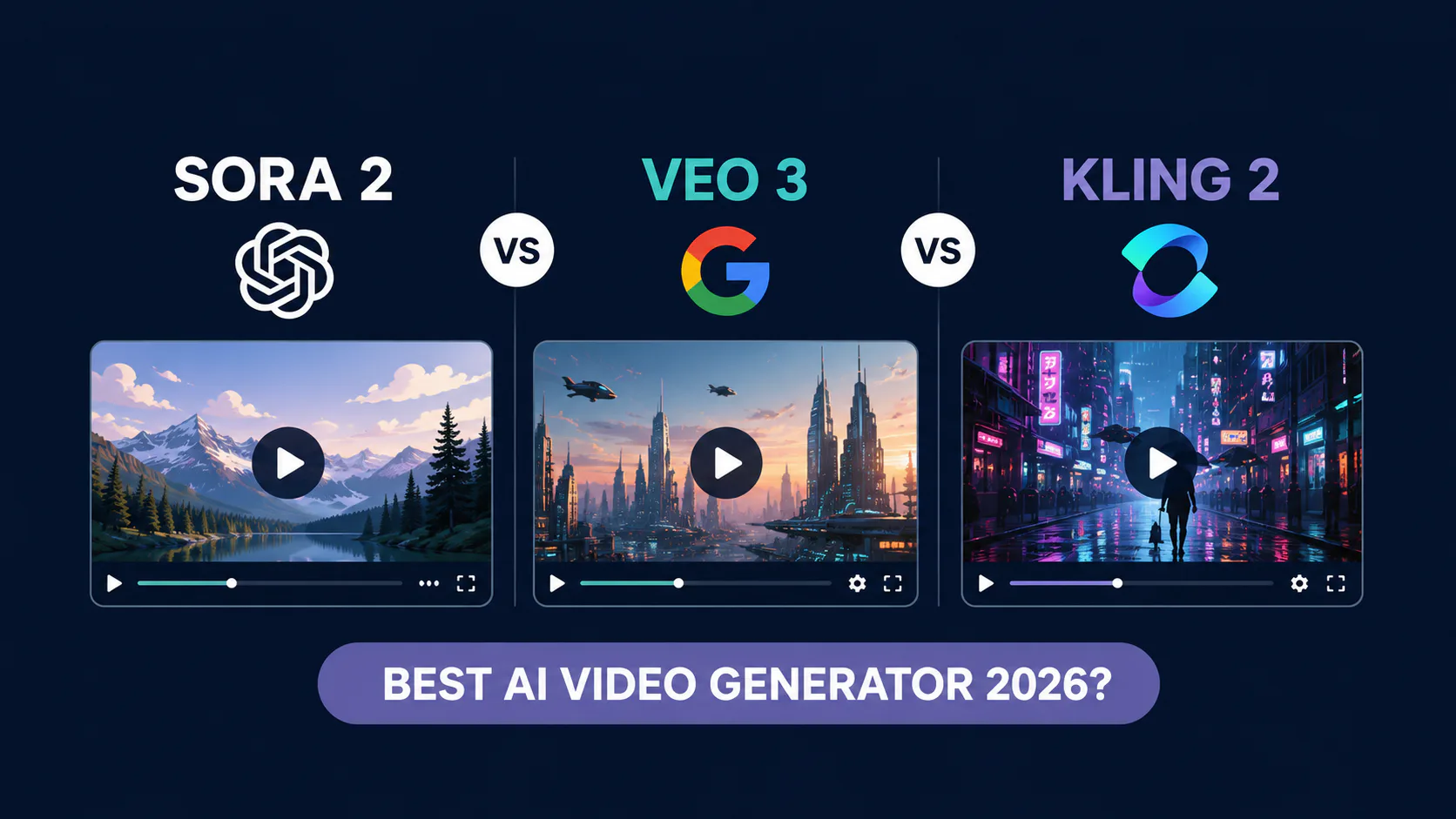
Sora 2 vs Veo 3 vs Kling 2: Best AI Video Generator 2026?
Sora 2 vs Veo 3 vs Kling 2 compared: shutdown timeline, benchmark scores, native audio, API pricing, and which AI video generator fits your workflow in 2026.

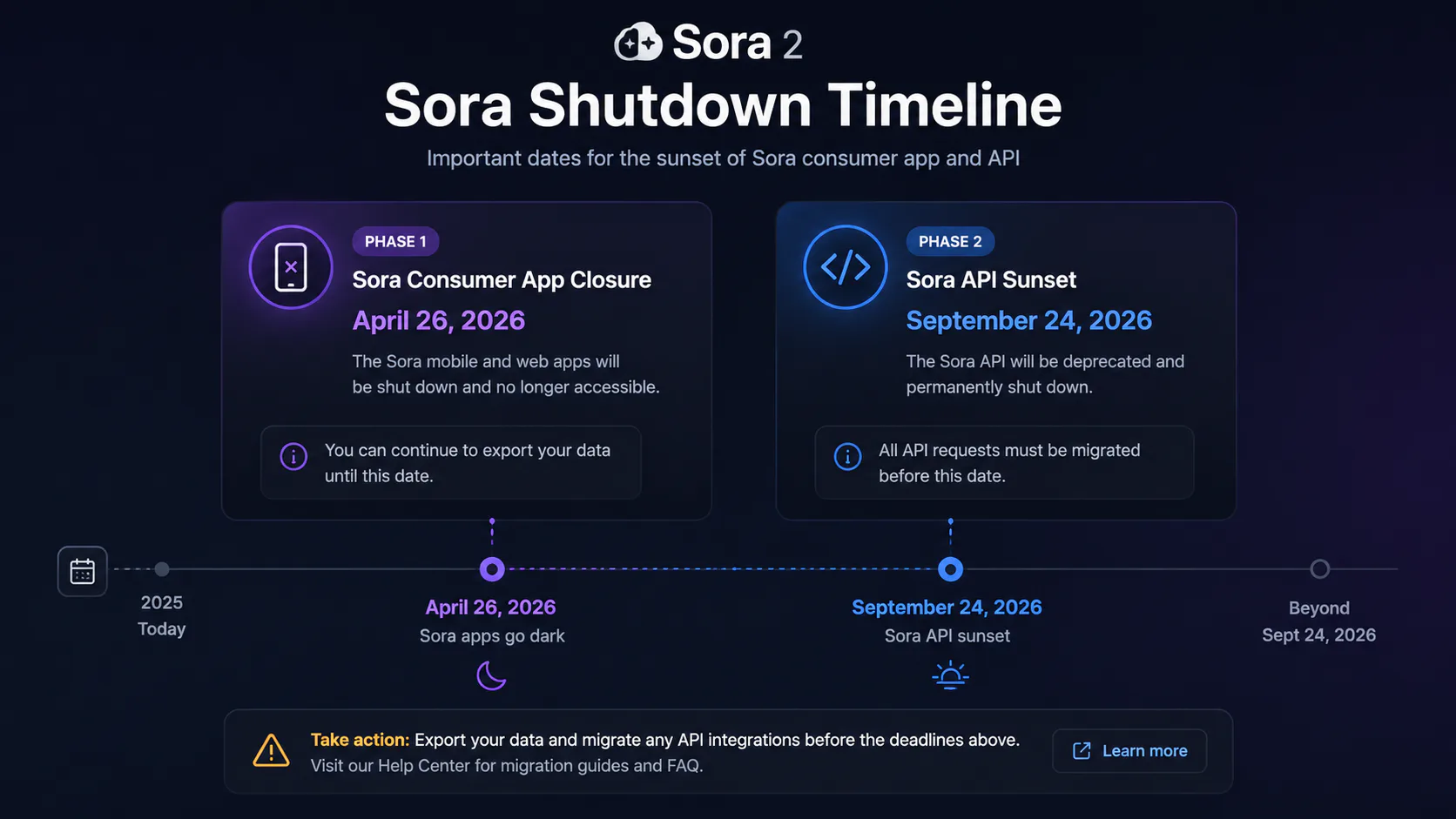
The most hyped AI video model of 2025 is no longer available. OpenAI shut down the Sora consumer app on April 26, 2026, and the API sunsets September 24, 2026. Compute costs ran an estimated $15 million per day against lifetime revenue of roughly $2.1 million.
That leaves a two-horse race: Veo 3.1 (Google DeepMind) and Kling 3.0 (Kuaishou). One holds the quality ceiling. The other holds the #1 ELO benchmark rank and the most competitive pricing in the market. Neither is right for every team, and picking the wrong one will cost you real money.
This comparison covers what each model actually does well, where each one fails, what the Sora shutdown means for your workflow, and which tool you should be using right now.
If you're using the Sora API: The deprecation deadline is September 24, 2026. Any production
workflow depending on Sora model strings (sora-2, sora-2-pro, sora-2-2025-10-06,
sora-2-2025-12-08) must migrate before that date. Veo 3.1 and Kling 3.0 are the primary targets;
see the migration section below.
Quick verdict
Veo 3.1 is the right choice if cinematic output quality is non-negotiable: broadcast-ready photorealism, the most mature native audio generation, and deep Google Cloud integration. The price is real: API access runs $0.50-$0.75 per second on Vertex AI.
Kling 3.0 wins the overall benchmark (ELO score: 1,243 as of April 2026), costs roughly 10x less per second at API level, and offers features Veo simply doesn't have: frame-by-frame Motion Control, native 4K at 60fps, and the best character consistency of any current model. The trade-off is data jurisdiction: Kling is a Chinese-regulated platform, which matters for enterprise security reviews.
If you were on Sora and need a direct replacement, Kling is the faster and cheaper migration path. Teams doing broadcast or agency work should evaluate Veo 3.1 seriously despite the cost.
What happened to Sora 2
Sora launched in late 2022 to a wave of coverage that treated it as a near-certain disruption to professional video production. Sora 2 shipped September 30, 2025, and was technically impressive: physics-accurate motion, synchronized audio, 25-second single-shot generation, and a Disney licensing deal worth $1 billion that seemed to confirm its commercial viability.
It wasn't commercially viable. Each 10-second clip cost approximately $1.30 to generate at production quality. Monthly active users peaked around 1 million, then declined to under 500,000 by the time the shutdown was announced in March 2026. The math never worked.
The structural problem was not model quality. Sora 2 was genuinely the best AI video model for physics simulation at launch, and its multi-character scene coherence was unmatched. The problem was that video generation is 10-50x more expensive per output than image generation, and the market expected low prices. OpenAI couldn't close that gap with the architecture they'd shipped.
The practical consequence for anyone building with AI video: single-vendor infrastructure is demonstrably fragile. The 500,000+ developers and creators on Sora had weeks of notice. The lesson is now part of the professional standard: multi-model routing, not single-provider dependence.
How Veo 3.1 and Kling 3.0 actually work
Understanding the architecture differences explains why each model leads on the dimensions it leads on.
Veo 3.1: 3D latent diffusion with native audio
Veo 3 uses a 3D latent diffusion architecture that treats time as a spatial dimension alongside width and height. This means the model doesn't process video as a sequence of frames. It processes the full spatiotemporal volume at once. The practical result is physical consistency across frames: light behaves the same way, materials deform correctly, and motion maintains coherence because the model has learned the physics of the scene rather than interpolating between frames.
Native audio generation in Veo 3 is not a bolt-on. Audio and video patches are processed simultaneously within the same diffusion space, which is why lip-sync accuracy reaches within 120 milliseconds (the perceptual threshold at which desynchronization becomes noticeable to most viewers). This was the breakthrough that shipped at Google I/O in May 2025, and Veo 3.1 (October 2025 update) refined human rendering and temporal coherence on top of it.
The 4K implementation matters here. Veo 3.1's 4K is genuine texture reconstruction at the model level, not upscaling. Fabric, skin, and foliage are reconstructed at resolution, not magnified. For broadcast and commercial production, this distinction is real.
Kling 3.0: proprietary architecture with reference-based generation
Kuaishou has not fully disclosed Kling's architecture. What's confirmed: Kling 3.0 uses a reference-based generation system that builds a 360-degree model of a subject from up to four input images. Independent benchmarks consistently credit this for Kling's character consistency advantage.
The @ reference syntax is the feature that most differentiates Kling from every other current model. Feed it four images of a person from different angles, and it builds an identity model precise enough to place that character consistently across multi-shot sequences. No other mainstream model does this at Kling's fidelity. It's why Kling dominates branded character work and product spokesperson campaigns.
Kling 3.0's native 4K at 60fps is also architecture-level, not post-processing. Combined with up to 2-minute single-pass generation and the 6-shot storyboarding feature (generate a multi-cut sequence in one pass), Kling enables production workflows that weren't possible at this price point in 2024.
Feature comparison
| Feature | Veo 3.1 | Kling 3.0 | Sora 2 (historical) |
|---|---|---|---|
| Overall ELO benchmark | Top tier | #1 (1,243) | Discontinued |
| Photorealism | Leads | Very good | Strong |
| Physics simulation | Good | Moderate | Was the leader |
| Native audio | Leads (original pioneer) | Strong (5-language lip-sync) | Added Sep 2025 |
| Character consistency | Good (improved in 3.1) | Leads (@ reference system) | Multi-scene coherence |
| Native resolution | 4K (true reconstruction) | 4K at 60fps | 1080p |
| Single-shot duration | 8 seconds | Up to 2 minutes | 25 seconds |
| Multi-shot | Via scene stitching (60+ sec) | Native 6-shot storyboard | Limited |
| Motion Control | Standard | Frame-by-frame (unique) | None |
| Native vertical video | Yes (true 9:16) | Yes | No |
| SynthID watermarking | Yes | No | No |
| API cost | $0.50-$0.75/sec | $0.07/sec | $0.10-$0.70/sec (deprecated) |
| Consumer entry price | $19.99/month | $6.99/month | N/A (shut down) |
| Free tier | No | Yes (66 daily credits) | Was available |
| Data jurisdiction | US (Google Cloud) | China (Kuaishou) | US (OpenAI) |
Pricing breakdown
Veo 3.1
Veo 3.1 is available through Google AI Studio and Vertex AI. Consumer access requires either Google AI Pro at $19.99/month (Veo 3.1 Fast) or Google AI Ultra at $249.99/month for the full model. Direct Vertex AI API pricing runs $0.50/second for video-only and $0.75/second for video with audio.
Third-party access through partner platforms typically costs $0.05-$0.25/second, which makes it substantially more accessible than the direct API. For teams already on Google Cloud, the ecosystem integration justifies the price premium. For teams not on GCP, the migration overhead is a real cost to factor in.
One honest note: Veo launched with waitlists and access restrictions. Direct API access has opened up since then, but enterprise teams should verify current availability directly at Google's Veo model page.
Kling 3.0
Kling's pricing structure is the strongest value case in the market. The entry plan starts at $6.99/month and includes commercial rights from the lowest tier. Standard video generation runs approximately $3 per video; API access is $0.07/second.
There are real caveats. Independent reviews consistently flag two billing issues: renewal pricing silently increases from introductory rates, and credits are deducted for failed generation attempts, not just successful outputs. If you're doing high-volume production work, model rejection rates (which are probabilistic for all AI video) will affect your actual cost per usable clip.
Kling also offers a free tier with 66 daily credits, which makes it accessible for evaluation without committing to a subscription.
Cost at production scale
If you're modeling costs for a team generating high volumes, the per-second API gap is significant:
| Volume (seconds of video/day) | Veo 3.1 (@ $0.75/s) | Kling 3.0 (@ $0.07/s) | Monthly difference |
|---|---|---|---|
| 100 seconds/day | $2,250/mo | $210/mo | $2,040/mo |
| 500 seconds/day | $11,250/mo | $1,050/mo | $10,200/mo |
| 1,000 seconds/day | $22,500/mo | $2,100/mo | $20,400/mo |
At production volume, this is not a marginal difference.
Where each model leads
Veo 3.1: cinematic quality and audio maturity
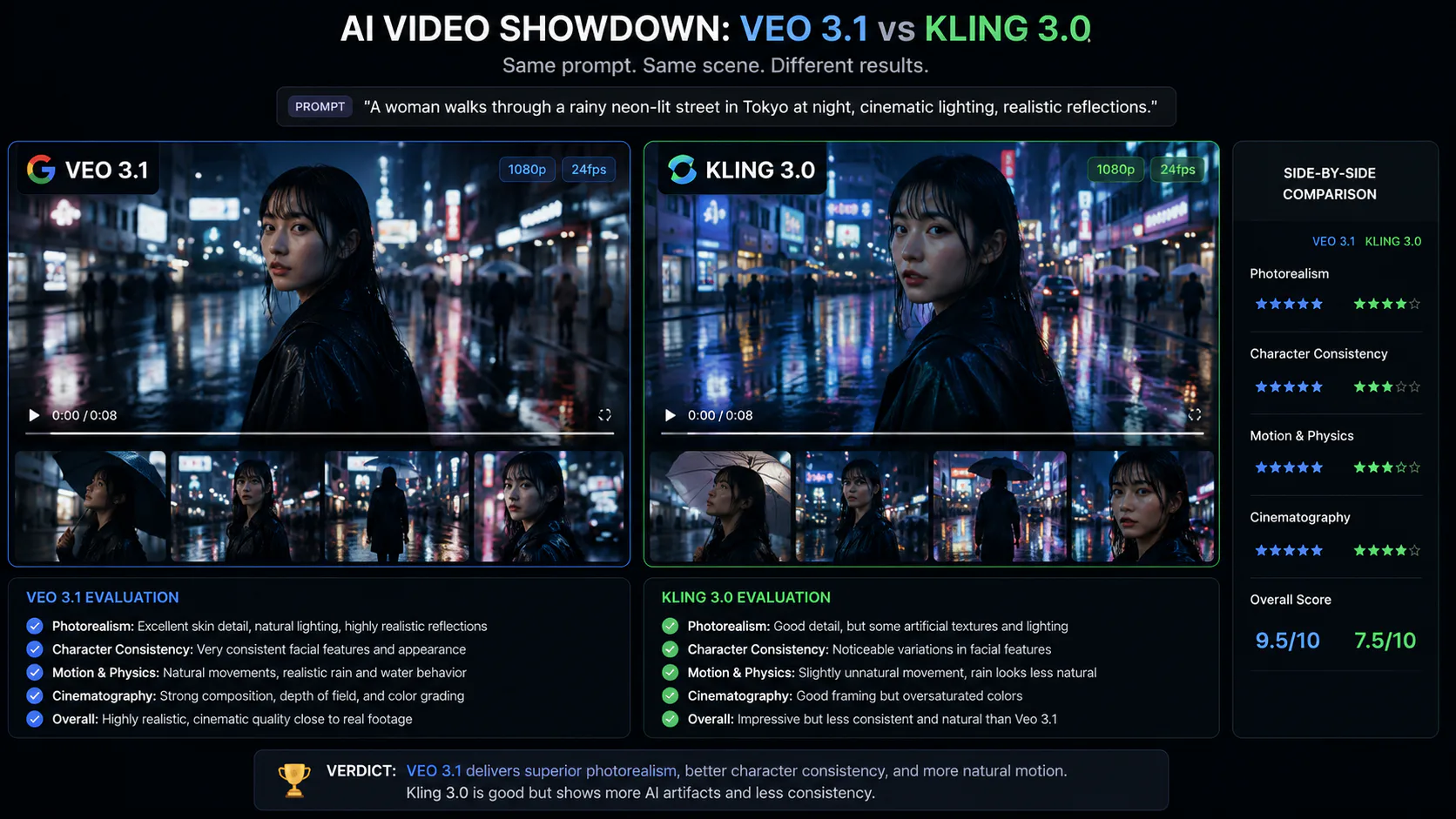
If broadcast-standard output is the requirement, Veo 3.1 is the current ceiling. The photorealistic material rendering, professional color science, and native audio maturity (the original pioneer of joint audio-visual generation) produce output that independent reviewers consistently describe as "broadcast-ready" in a way that Kling, despite its benchmark lead, doesn't quite match.
Veo 3.1 is the right tool for:
- Hero shots and beauty footage requiring maximum photorealistic fidelity
- Projects where synchronized, natural-sounding dialogue is critical
- Teams already on Google Cloud who can absorb the API costs within existing infrastructure
- Content requiring SynthID watermarking for platform compliance
Kling 3.0: creative control and value
Kling wins on the benchmark, on price, and on the specific capabilities that matter most for commercial and branded content production: character consistency, motion control, and multi-shot storyboarding.
The @ reference system is genuinely without parallel in the current market. For any project that requires a consistent human character across multiple shots (spokesperson campaigns, branded content, e-commerce product videos with a consistent presenter, game pre-visualization), Kling 3.0 is the right model. No current alternative comes close on this specific dimension.
Motion Control (frame-by-frame camera path control) is also unique to Kling. If you need a specific dolly move, a precise rack focus, or a defined camera arc, Kling is the only mainstream model that gives you this level of production direction.
Kling 3.0 is the right tool for:
- Branded character work and consistent spokesperson content
- Multi-shot narrative sequences where 6-shot storyboarding saves production time
- High-volume production workflows where API cost matters
- Teams evaluating options with a free tier before committing
The data jurisdiction question
Kling's data jurisdiction is the most significant enterprise procurement issue in this comparison, and it deserves a direct answer rather than a footnote.
Kling is Kuaishou's product. Kuaishou is a Chinese company. User data processed by Kling is subject to Chinese data law. For enterprise teams in the US and EU, especially those handling proprietary creative assets or client footage, this is a real risk factor that has to go through a security review.
This is not a reason to dismiss Kling for all use cases. Individual creators, small teams, and companies without enterprise data compliance requirements are using Kling without issue. But if your organization has data residency requirements, handles client confidential material, or has government contracts, you need to verify with your legal and security teams before using Kling in production.
Veo 3.1 runs on Google Cloud infrastructure in the US, with the data governance and compliance certifications that Google Cloud carries. This is a meaningful advantage for enterprise procurement regardless of the per-second cost comparison.
What to do if you're migrating from Sora
The Sora API deadline is September 24, 2026. If you're still using any Sora model string in production, here's the migration decision:
Migrate to Kling 3.0 if:
- Your primary use case is character-consistent branded content
- Cost efficiency at scale is a priority
- You don't have enterprise data compliance requirements that would block a Chinese platform
- You want the fastest path to production on similar or better benchmark quality
Migrate to Veo 3.1 if:
- Your workflow requires broadcast-quality photorealistic output
- Physics simulation quality matters (Veo is the closest current replacement for what Sora 2 did)
- You're already on Google Cloud
- Data jurisdiction is a compliance requirement
Consider Runway Gen-4.5 if:
- You need an editing workflow, not just generation (Runway's production toolchain has no equal)
- Stylized, VFX-heavy output is the primary requirement
- You want the commercially established option with the longest track record
For teams that were using Sora specifically for physics-accurate motion, the honest answer is that no current model fully replicates what Sora 2 did on complex physics simulation. Veo 3.1 is the closest, but the gap is real. If physics simulation was your core use case, evaluate both Veo 3.1 and Runway Gen-4.5 before committing.
For broader coverage of Runway, Seedance, and the rest of the 2026 landscape, see our AI video tool hub.
The multi-model production stack
Professional production teams have moved away from single-model dependence. The standard 2026 production stack routes different shot types to different models:
- Maximum photorealism (hero beauty shots, architectural visualization): Veo 3.1
- Character-consistent narrative (branded character work, multi-shot sequences): Kling 3.0
- Dialogue-driven content (spokesperson, multilingual): Seedance 2.0 or Veo 3.1
- Stylized or VFX work: Runway Gen-4.5
- Rapid storyboarding and iteration: LTX-2 (significantly faster, lower quality ceiling)
- Physics demonstrations (until September 24): Sora 2 API; Veo 3.1 after that
The Sora shutdown has made multi-model architecture a professional requirement, not an optimization. Any team that builds a workflow on a single AI video provider is now exposed to the same structural risk that 500,000+ Sora users experienced.
Pros and cons
Veo 3.1
Pros
- Produces the highest photorealistic output quality of any current model, with cinema-standard color science and genuine 4K texture reconstruction
- Native audio generation is the most mature in the market, with lip-sync accuracy within the 120ms perceptual threshold
- SynthID watermarking provides provenance compliance that platform publishing increasingly requires
- Google Cloud integration means enterprise data governance, security certifications, and existing GCP spend applies
Cons
- API costs at $0.50-$0.75/second are the highest of any major model, making high-volume production significantly more expensive than Kling
- No free tier exists; the $19.99/month consumer entry is higher than Kling's $6.99/month starting price
- Native single-shot duration is 8 seconds (extended via stitching), well behind Kling 3.0's 2-minute maximum
- Ecosystem lock-in favors teams on Google Cloud; teams not on GCP face real migration overhead
Kling 3.0
Pros
- Holds the #1 ELO benchmark ranking (score: 1,243) based on human blind-comparison evaluation across tens of thousands of outputs
- The @ reference system for character consistency has no equivalent in any current competing model at any price
- API pricing at $0.07/second is roughly 10x cheaper than Veo 3.1 at comparable output quality for most use cases
- Frame-by-frame Motion Control gives production-direction capability that no other mainstream AI video model offers
Cons
- Data jurisdiction under Chinese law is a genuine enterprise compliance barrier for US and EU organizations with data residency requirements
- Billing practices are problematic: intro pricing increases at renewal, and credits are deducted for failed generations rather than only successful outputs
- Customer support is consistently rated as a significant weakness across independent reviews
- Content restrictions around political topics and content conflicting with Chinese regulations have caused unexpected generation rejections for Western creators
Which one should you choose?
The decision comes down to three questions.
What's your primary output type? If cinematic photorealism and audio quality are the job, Veo 3.1 is the right call despite the cost. If consistent character work, volume production, or multi-shot narrative sequencing is the primary use case, Kling 3.0 wins on features and wins by a large margin on price.
What's your data compliance situation? If your organization has data residency requirements or government contracts, Kling's Chinese data jurisdiction is a blocker. Veo 3.1 is the choice. If you're an individual creator or a team without enterprise compliance requirements, Kling's value proposition is difficult to argue against.
What's your volume? At low volume, the per-second cost difference is manageable. At scale, the difference between $0.07/second and $0.75/second is tens of thousands of dollars per month. High-volume production workflows that can use Kling should be using Kling.
Browse the full AI video tool reviews on Bytewaves if you want deeper coverage of Runway, Seedance 2.0, and the rest of the 2026 landscape.
Frequently asked questions
The Sora 2 consumer app shut down on April 26, 2026. The API is still accessible but officially deprecated and sunsets September 24, 2026. After that date, all Sora API model strings become non-functional. Developers using Sora should migrate to Veo 3.1 or Kling 3.0 before the September deadline.
By benchmark, yes. Kling 3.0 holds the #1 ELO score (1,243) as of April 2026 based on human blind-comparison evaluation. In practice, it depends on the use case. Veo 3.1 produces better photorealistic cinematic output and more mature native audio. Kling 3.0 leads on character consistency, Motion Control, multi-shot storyboarding, and value. Most professional teams use both.
Yes. Veo 3 was the first major AI video model to generate synchronized audio and video from a single prompt (launched May 2025 at Google I/O). The architecture processes audio and visual patches simultaneously, producing dialogue, ambient sound, and music alongside video. Lip-sync accuracy is within 120 milliseconds. Kling 3.0 also generates audio natively with five-language dialogue lip-sync.
For most use cases, Kling 3.0 is the direct migration target from Sora: #1 benchmark, lower cost, commercial rights at the entry tier. For teams that need broadcast-quality photorealism or Google Cloud integration, Veo 3.1 is the better match. Teams that relied on Sora specifically for physics simulation should evaluate Veo 3.1 most closely, as it is the nearest current equivalent on that specific dimension.
It depends on your organization's data compliance requirements. Kling is a Kuaishou product, and user data is subject to Chinese data law. For teams with data residency requirements in the US or EU, government contracts, or enterprise security reviews, this is a real procurement concern. Individual creators and teams without data compliance requirements use Kling without issue. When in doubt, consult your legal and security teams before using Kling with confidential client assets.