AI Music Generation 2026: Suno, Udio, and the State of AI Audio
Suno v5.5 vs Udio v4 reviewed in 2026: audio quality, pricing, copyright risk, and who each tool is actually for. Plus the legal cases you need to understand.

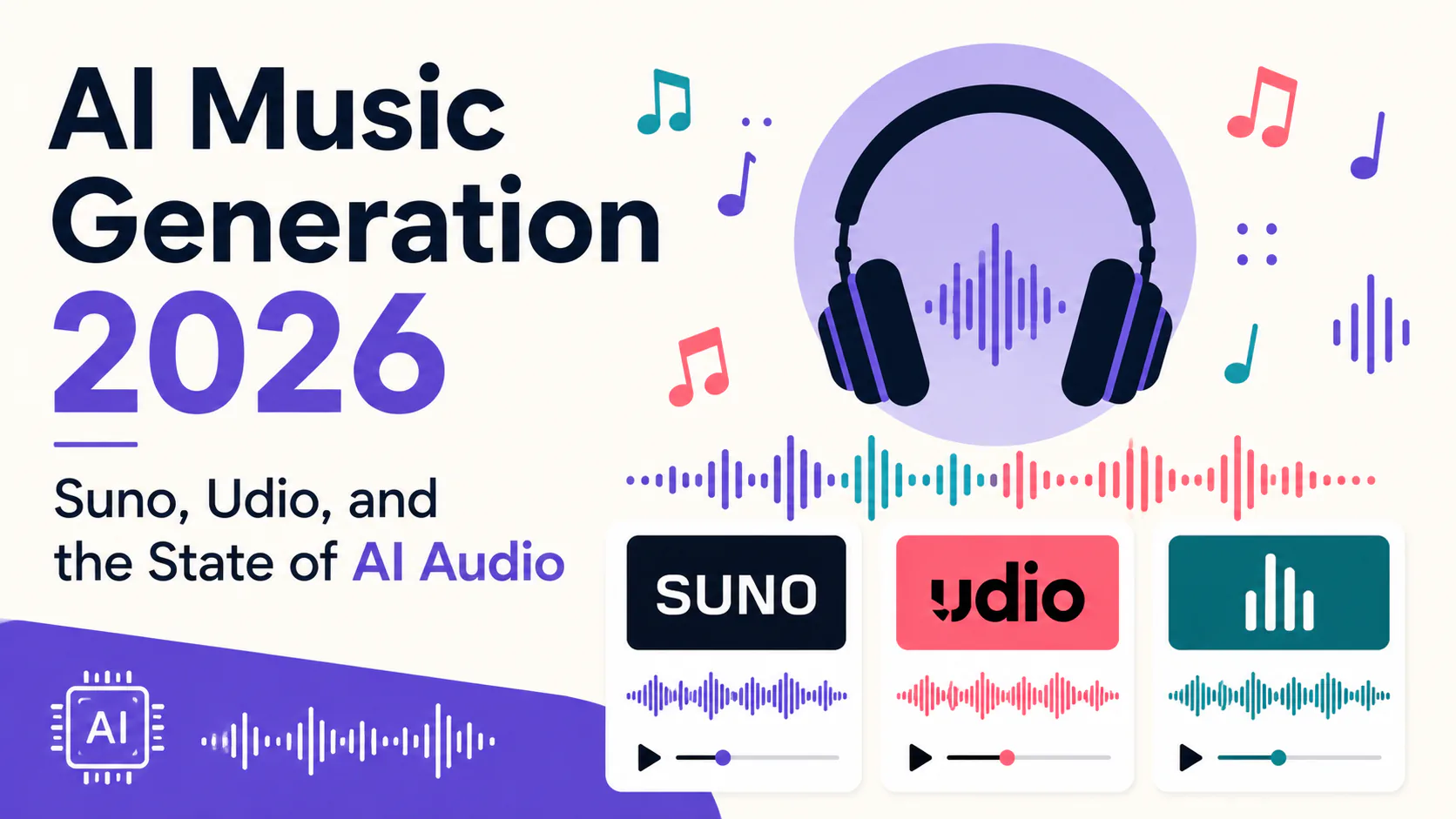
Bytewaves Score Card
Type a sentence. Receive a fully produced song, complete with vocals, instrumentation, and mix, in under 60 seconds. That's where AI music generation sits in 2026, and the two platforms that got it here are Suno and Udio.
But the story is more complicated than a product launch. AI music in 2026 involves a $5.4 billion valuation, three active federal lawsuits, a pivotal copyright ruling expected this summer, and a streaming ecosystem being structurally reshaped by a flood of AI-generated tracks. If you're a content creator, marketer, educator, or musician considering these tools, you need to understand all of it before you spend a dollar.
This review covers what both platforms can actually do in 2026, what each costs, where the legal risk lives, and which tool fits which use case.
TL;DR: Suno v5.5 is the better choice for most users: larger free tier, more genres, voice cloning, and the most mature ecosystem. Udio v4 edges ahead on raw audio quality and has a cleaner (if still incomplete) licensing story for commercial work. Neither is safe for professional client deliverables until Sony's lawsuit resolves. Use both free tiers to test before committing to a paid plan.
What AI music generation actually is in 2026
Before comparing platforms, it helps to understand what these tools are doing. Modern AI music generators are not sample libraries or remixers. They generate novel audio through neural networks: you provide a text prompt, and the model synthesizes a complete audio file from scratch, including melody, rhythm, harmony, arrangement, and (optionally) vocals and lyrics.
The technical stack combines transformer models (which handle sequences, and music is inherently sequential) with diffusion models (which progressively shape structured audio from noise, the same class of approach used by image generators) and latent audio representations that compress the computational cost. The result is a 30-to-90-second generation time for a fully produced track.
The training data behind these models is the source of every legal dispute currently in play. Both Suno and Udio were trained on large datasets of existing recorded music. The central question heading into a pivotal July 2026 summary judgment in Sony Music's federal lawsuit against Suno: does training on copyrighted recordings constitute infringement, or does it qualify as transformative fair use? The ruling will affect not just music AI but every company training models on creative works.
Suno v5.5: the market leader's current state
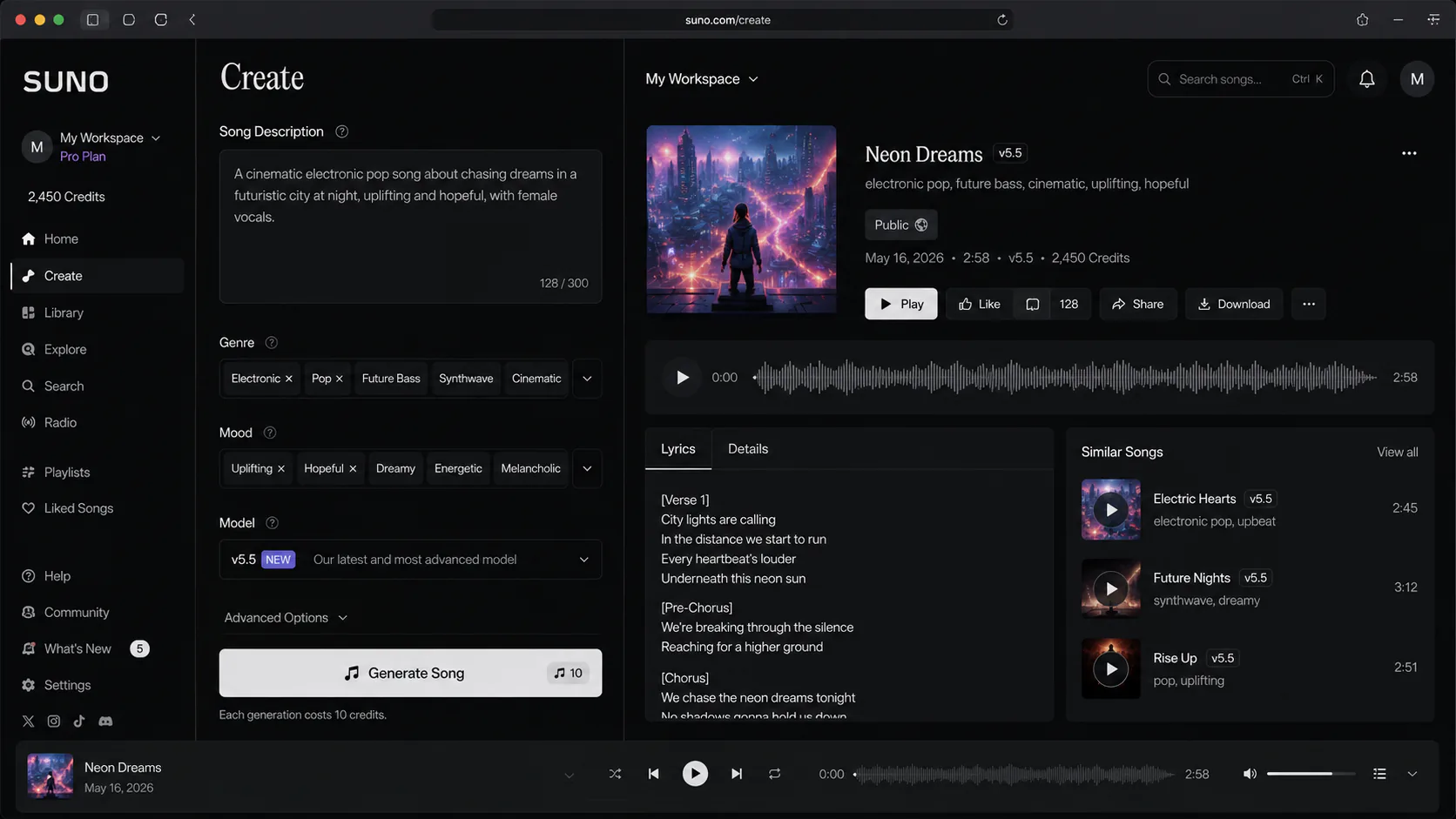
Suno is the default when people say "AI music" in 2026. The numbers are unambiguous: 100 million users, 2 million paid subscribers, $300 million ARR as of February 2026, and a $400 million Series D at a $5.4 billion valuation closed June 3, 2026. Led by Bond Capital with participation from IVP, Lightspeed, and Menlo Ventures, this is not a speculative startup. It is the established leader of a category it largely created.
What v5.5 added that matters
The March 2026 v5.5 update introduced three features that separate Suno from every competitor:
Voices lets Pro and Premier subscribers train the model on their own singing voice. You record yourself speaking a phrase for identity verification, the system builds a private voice profile (only your account can use it), and future generations are sung in your voice at 4 credits per generation. This is not cloning another artist's voice, which both platforms explicitly prohibit. It is your own sonic identity, AI-powered.
Custom Models takes personalization a step further: you train a model on your musical preferences and output history, creating a personalized generation assistant tuned to your style rather than the generic defaults.
My Taste is the lighter version of the above, a personalization layer that adjusts recommendations based on your listening and generation history without requiring explicit training.
Suno also added a Warner Music Group licensing partnership in November 2025, acquiring the concert-discovery platform Songkick in the deal. CEO Mikey Shulman described v5.5 as "the foundation for the next generation of music models we're launching with the music industry later this year." A fully licensed model built on WMG catalog is coming.
Suno Studio: the DAW that isn't quite ready
Suno Studio, launched September 2025, is the most ambitious feature in the AI music category: a browser-based Digital Audio Workstation with a multitrack timeline, AI stem generation into "Take Lanes," mixing controls (EQ, faders, pan, solo/mute), up to 12-stem separation, and MIDI export at 10 credits per stem.
The honest assessment: it's not production-ready. The community consensus is blunt. Power users call the current build "pre-beta." Studio sessions can burn through credits faster than the plan pricing implies, because stem regeneration is multiplicative (each alternate take costs full credits), MIDI export is 10 credits per stem, and Stem Cover runs 40 credits per call. Real Studio workflows should budget 3x to 5x the apparent plan cost.
The vision is genuinely interesting. The execution needs another major update cycle.
Suno pricing
| Plan | Monthly | Annual (per month) | Credits/month | Commercial use |
|---|---|---|---|---|
| Free | $0 | $0 | ~1,250 | Personal only |
| Pro | $10 | $8 | ~10,000 | Yes |
| Premier | $30 | $24 | ~30,000 | Yes + Studio |
The free tier allows roughly 50 songs per day with attribution required and no commercial use rights. Pro is the entry point for anything you'll publish or monetize.
Udio v4: the quality-first alternative
Udio was founded by former Spotify AI researchers, which explains its priorities. Where Suno optimizes for ease and breadth, Udio optimizes for audio quality. In the electronic, hip-hop, and production-heavy genres, it consistently edges ahead of Suno on the specific dimensions that professional producers care about.
What Udio v4 delivers
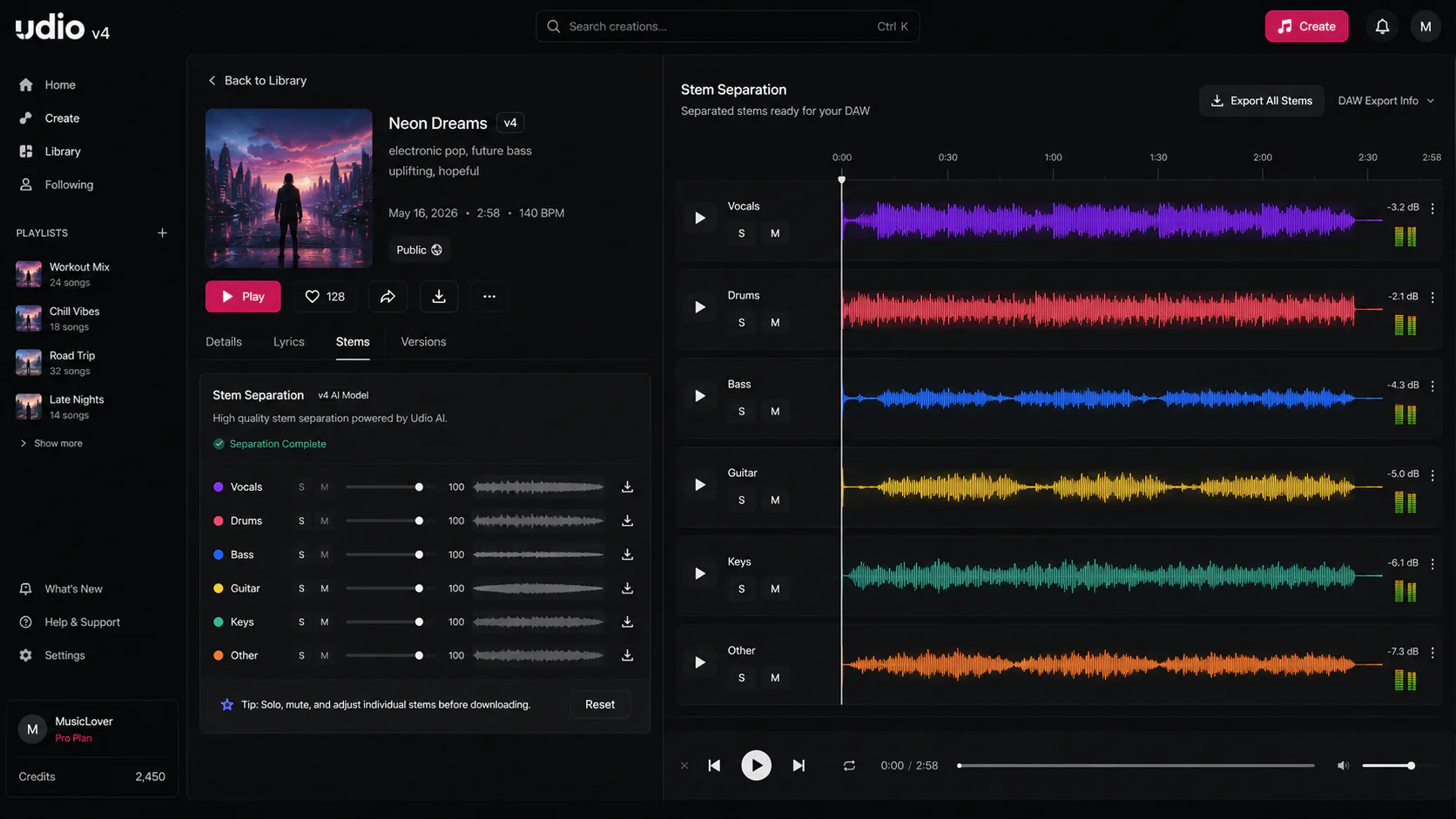
The v4 model outputs at 48kHz stereo (studio-standard sample rate, compared to Suno's 44.1kHz), supports tracks up to 15 minutes (Suno caps at 8), and its pitch stability and natural phrasing on vocals is measurably more consistent than Suno v5.5 on complex or high-register passages.
Udio's key production advantage is its stems export for DAW integration. Rather than a browser-based Studio environment, Udio lets you export separated stems directly into Logic Pro, Ableton, or Pro Tools, where you work with them as raw material in your actual production environment. This is the bridge between AI generation and professional production workflows.
Udio also introduced inpainting before Suno did: the ability to select a specific section of a generated track (a weak bridge, a flat chorus) and regenerate just that portion while leaving the rest intact, rather than regenerating the whole song.
Udio's licensing story: cleaner, but not clean
Udio reached settlements with both Universal Music Group (October 2025) and Warner Music Group (November 2025). The UMG settlement established a per-generation royalty template ($0.002 to $0.005 per output, higher rates for commercially distributed tracks), content identification for UMG catalog similarity, and opt-in artist compensation. The WMG terms were not publicly disclosed.
Sony Music did not settle with Udio. Sony's cases against both Suno and Udio are still active.
Udio's licensing position is cleaner than Suno's for commercial work, but "cleaner" is not "clean." The Sony exposure remains real until there is a ruling or a settlement.
One notable operational risk: Udio temporarily disabled all downloads for all users during its 2025-2026 licensing transition. If you can't download your own generated music, the tool is functionally unusable. Verify current download availability at udio.com before committing to a paid plan.
Udio pricing
| Plan | Monthly | Commercial use | Key feature |
|---|---|---|---|
| Free | $0 | No | ~3 songs/day, limited downloads |
| Standard | $10 | Yes | Bulk download, higher limits |
| Pro | $30 | Yes | Full stems export, priority |
Udio's free tier is more restrictive than Suno's (3 songs/day versus Suno's 50). The Pro plan is where stems export unlocks.
Suno vs Udio: direct comparison
| Dimension | Suno v5.5 | Udio v4 |
|---|---|---|
| Audio quality | 44.1kHz, strong vocals | 48kHz stereo, superior instrumentals |
| Vocal pitch stability | Good; fools casual listeners | More consistent on high register |
| Max track length | 8 minutes | 15 minutes |
| Stem export | Studio Premier only ($24/mo) | Standard Pro ($30/mo) |
| MIDI export | Yes, 10 credits/stem | Not native; use stems in DAW |
| Voice cloning (own voice) | Voices feature, Pro/Premier | Style reference matching only |
| Free tier | ~50 songs/day | ~3 songs/day |
| Paid entry point | $8/mo (annual) | $10/mo |
| UMG settled | Yes (Nov 2025, with WMG) | Yes (Oct 2025, with WMG) |
| Sony settled | No | No |
| DAW integration | Browser Studio (pre-beta) | Native stem export to any DAW |
| Best for | Volume, content creation, voice AI | Audio quality, production workflows |
The copyright situation: what you actually need to know
The legal landscape is the most important non-product factor in any decision about these tools. Here is the current state as of June 2026.
US Copyright Office position: purely AI-generated works cannot be copyrighted in the US. Human-authored elements (lyrics you wrote, significant modifications using stem editing) may qualify for copyright protection. This means AI-generated music, as distributed without substantial human modification, cannot prevent copying by others.
The Sony lawsuits: Sony Music filed suits against both Suno (Massachusetts) and Udio (Southern District of New York). A summary judgment hearing for the Suno case is scheduled for July 2026. If Sony wins, training AI on copyrighted audio without a license is infringement, and every AI music company faces retroactive liability. If Suno's fair use defense prevails, the template for AI training on creative works shifts dramatically. This ruling will be one of the most significant IP decisions in years.
The GEMA ruling: Germany's music rights collecting society, GEMA, filed suit against Suno in Munich in January 2025. A ruling is scheduled for June 12, 2026. A GEMA win would immediately complicate Suno's European operations.
The AFM lawsuit: The American Federation of Musicians filed suit in June 2026 against UMG and Warner Music, alleging that the labels' settlements with Suno and Udio generated revenue for the labels without compensating the session musicians whose performances trained the AI models.
For commercial work, the practical guidance from independent reviewers is direct: careful teams hesitate to ship Suno-generated music in paid client deliverables while the Sony case is active. Udio's position is marginally better given its UMG and WMG settlements, but Sony's active case means neither is legally clear for professional use until a ruling arrives.
Copyright risk: AI-generated music cannot be copyrighted in the US as of June 2026. Sony's federal lawsuit against Suno has a pivotal summary judgment hearing in July 2026 that could significantly change the commercial risk profile of both platforms. If you're producing work for paid client deliverables, consult legal counsel before committing to either tool for high-value commercial use.
Streaming platforms are tightening their policies
An estimated 28% of new uploads to Spotify were AI-generated as of 2025, with that number rising in 2026. The pro-rata royalty model distributes a fixed pool across all streams, so every AI stream is a stream that doesn't pay out to a human artist.
Platforms are responding. Spotify is testing algorithm adjustments to limit AI music in royalty-weighted playlists. YouTube uses deep-waveform comparison to identify AI audio and requires training dataset disclosures before monetizing. Apple Music is implementing similar frameworks. Chartlex campaign data found that fully AI-generated tracks underperform human-recorded releases on the retention metrics that Spotify rewards: skip rate, listen-through rate, and saves-to-streams ratio. For artists building streaming careers, this is a meaningful constraint.
The implication: AI music distributes better for background listening and social content than for building streaming audience.
Who should use AI music generation in 2026
The most effective current use cases for these tools are worth being specific about.
Content creators and YouTubers get the clearest value. Suno-generated tracks are not in any Content ID database, so they don't trigger copyright claims. The "faceless music channel" workflow (Suno generation to AI visuals to YouTube upload) is one of the fastest-growing content formats.
Marketers producing social ads can eliminate stock music licensing fees and Content ID risk. Suno's genre flexibility means you can match a specific sonic identity rather than settling for whatever the stock library has.
Educators have a genuinely novel use case: generating vocabulary-list songs in genre styles students enjoy, or creating ballads about historical events for retention. This is something no traditional music production workflow could serve at this cost and turnaround.
Indie game developers can close the audio budget gap that previously made professional scoring inaccessible. AIVA handles orchestral and cinematic scoring; Mubert's API generates adaptive background music that responds to in-game states; Suno and Udio handle character themes and genre-specific tracks.
Professional producers use these tools as ideation accelerators, not replacements. The hybrid workflow is the emerging standard: AI generation for rapid structural ideation, human editing using exported stems, professional mastering. Udio's stem export and Suno's MIDI export are specifically designed for this hybrid, not for finished-product replacement.
Who should skip AI music generation (for now)
Agencies and freelancers producing commercial client work should wait for the Sony ruling before using Suno or Udio in paid deliverables. The unresolved legal exposure is a real business risk.
Artists building streaming careers face measurable disadvantages: AI tracks underperform on Spotify's retention metrics, platforms are implementing AI content detection, and listener research shows measurably negative sentiment toward AI-generated music, especially when it imitates an existing artist's style.
Anyone who needs copyright ownership of their output cannot get it from purely AI-generated music under current US law.
Pros and cons
Pros
- Any user can produce a professionally produced track from a text prompt in under 90 seconds, requiring no musical training or equipment.
- Suno's free tier (50 songs/day) is genuinely generous for personal and educational use without a credit card.
- Udio's stem export enables real hybrid production workflows in any professional DAW.
- Suno's Voices feature gives creators their own vocal identity in generated music, a meaningful personalization advance over prior versions.
- Genre breadth on both platforms covers 70+ styles and cross-genre combinations that no stock music library matches.
Cons
- Sony Music's active federal lawsuits against both Suno and Udio create unresolved commercial copyright risk that careful teams cannot ignore for paid client work.
- Purely AI-generated music cannot be copyrighted in the US, meaning anyone can copy and redistribute your output without modification.
- Suno Studio is in a pre-beta state: credit costs are multiplicative and opaque, and real production workflows cost 3x to 5x the listed plan price.
- Udio temporarily disabled all downloads during its licensing transition; verify this is resolved before subscribing.
- AI-generated tracks underperform human recordings on Spotify's retention metrics, limiting effectiveness for streaming audience building.
Is AI music generation worth it in 2026?
For content creators, marketers, educators, and indie developers: yes, start with the free tiers today. Suno's free plan alone covers most non-commercial use cases. For anything you'll publish commercially, Suno Pro at $8/month (annual) or Udio Standard at $10/month are defensible investments once you've tested both.
For professional client work or commercial releases: wait until the Sony ruling lands in summer 2026. The legal picture will be materially clearer within 60 days.
For producers looking to integrate AI into an existing workflow: Udio Pro's stem export to your existing DAW is the most professionally defensible approach right now, given its cleaner licensing story and native integration with real production tools.
The platform race is not over. Suno's next major model is being built in partnership with Warner Music Group and will likely launch on licensed catalog later in 2026. If that product delivers on its promise, the commercial risk calculus shifts entirely.
For a broader look at how AI tools are reshaping creative workflows, see our coverage of AI image and video tools.
Frequently asked questions
Suno has a free plan that generates roughly 50 songs per day at no cost. It is limited to personal use with attribution required and does not include commercial rights. The Pro plan at $8/month (billed annually) adds commercial rights and higher generation limits. The Premier plan at $24/month (billed annually) adds Suno Studio access.
With caveats. Suno and Udio both grant commercial rights on paid plans. The unresolved risk is Sony Music's active federal lawsuit against both platforms, with a summary judgment hearing scheduled for July 2026. US Copyright Office guidance also confirms that purely AI-generated works cannot be copyrighted, meaning you cannot prevent others from copying your output. For high-value paid client work, the safer approach is to wait for the Sony ruling or consult legal counsel before committing.
It depends on what you're making. Suno v5.5 is better for volume, breadth of genres, voice cloning, and ease of use. Udio v4 is better for raw audio quality (especially instrumentals and electronic), professional DAW integration via stem export, and a marginally cleaner licensing story following its UMG and WMG settlements. For most users, Suno is the practical default. For producers who treat AI output as raw material in a real DAW workflow, Udio is worth the trade-off.
YouTube uses deep-waveform comparison to identify AI audio and requires training dataset disclosures before monetizing AI-generated content. Spotify is testing algorithm adjustments to limit AI music in royalty-weighted playlists. Neither platform outright bans AI music, but both are actively building infrastructure to detect, disclose, and limit it. AI tracks also underperform human-recorded releases on Spotify's retention metrics (skip rate, listen-through rate, saves), which affects algorithmic distribution.
Sony Music filed a federal lawsuit against Suno alleging that training its AI model on copyrighted recordings constitutes copyright infringement. Suno's defense is fair use, arguing that training is a transformative use. A summary judgment hearing is scheduled for July 2026. If Sony wins, it establishes legal precedent that AI training on copyrighted creative works requires a license, creating retroactive liability for every AI company in the space. The ruling will be one of the most significant IP decisions in years.