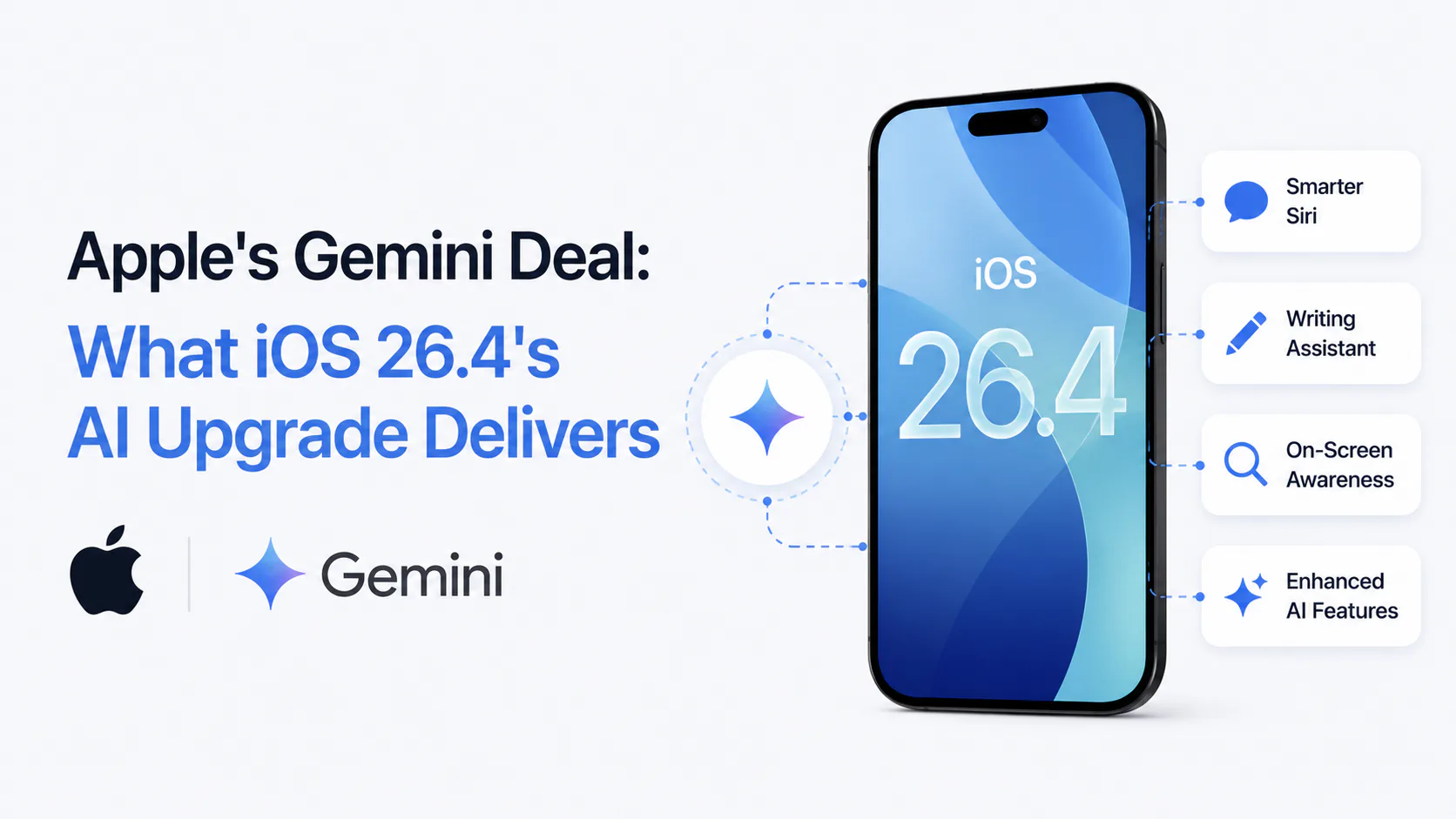
Apple's Gemini Deal: What iOS 26.4's AI Upgrade Delivers
Apple's $1B/year Google Gemini deal explained: what Siri gets in iOS 26.4, what waits for iOS 27, the privacy trade-offs, and the antitrust risk.

Apple spent years promising a smarter Siri. Two years, three iPhone generations, and a $250 million class action settlement later, the mechanism that's supposed to deliver on that promise is a $1 billion per year deal with Google.
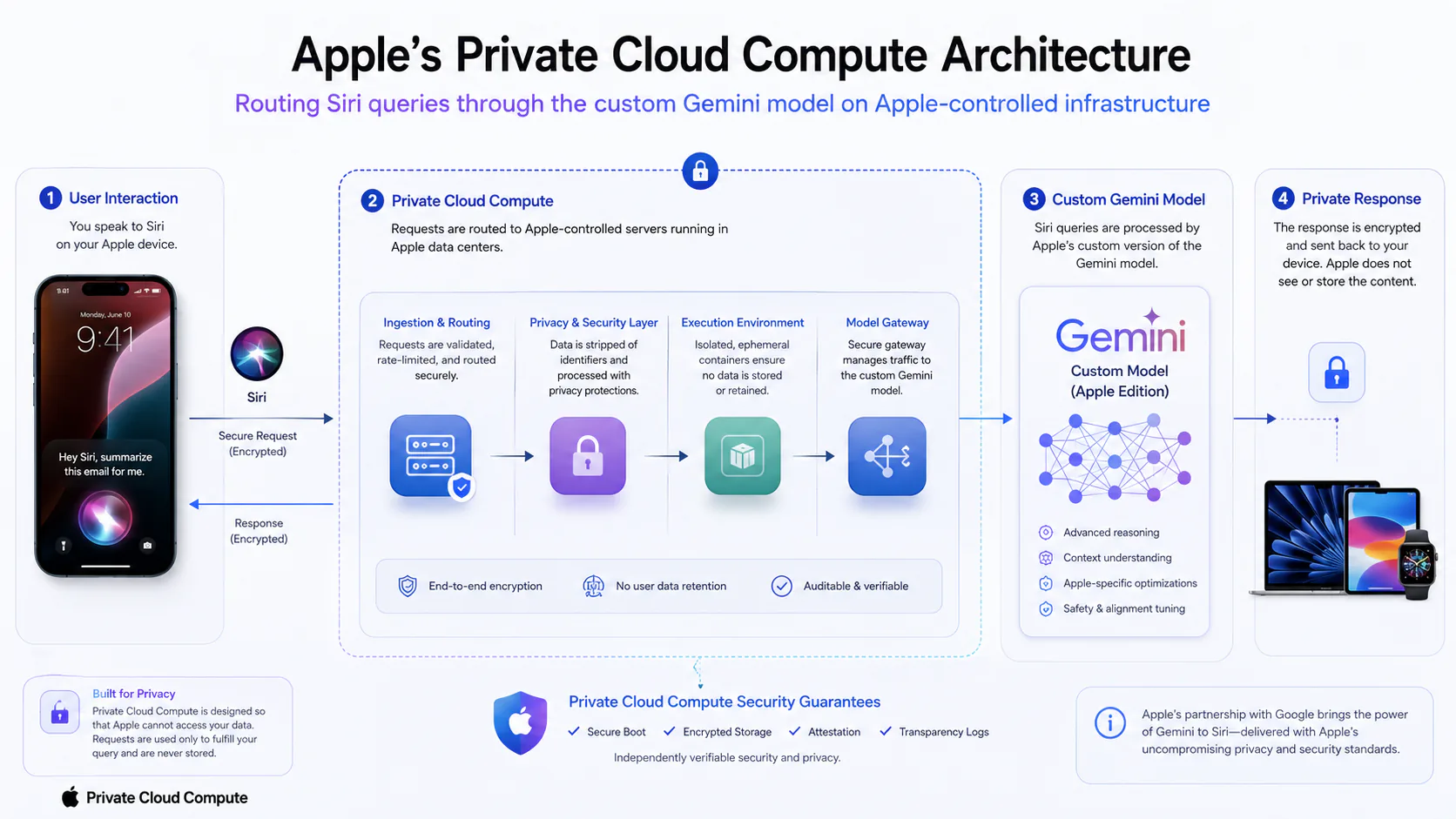
On January 12, 2026, Apple announced a multi-year collaboration under which the next generation of Apple Foundation Models will be powered by a custom variant of Google's Gemini AI. The partnership puts a 1.2-trillion-parameter Gemini model at the cognitive core of Siri, routed through Apple's Private Cloud Compute infrastructure. The features that were supposed to ship with iPhone 16 in 2024 are, finally, arriving now.
This is what the deal actually delivers, what it doesn't, and what's at stake in tomorrow's WWDC keynote.
What changed and why Apple needed Google
Siri's failure wasn't a feature gap. It was architectural. Apple's V1 Siri processed language in stages: speech recognition, then intent parsing, then action execution. Errors compounded at every step, which is why asking Siri anything more complex than a timer or a music request reliably ended in frustration.
Apple rebuilt Siri on a V2 end-to-end deep learning architecture, where speech, understanding, and action handling run through a single integrated neural network. The problem: building a frontier-class model on top of that new foundation fast enough to matter required a scale of AI investment Apple hadn't made three years earlier.
The Gemini deal is how Apple buys time. Rather than waiting two more years for its internal models to close the gap with OpenAI and Google, Apple licensed a custom 1.2-trillion-parameter Gemini model built specifically for its use case. That model is 8 times larger than Apple's own on-device AI, fine-tuned for App Intents integration, and contractually restricted from using Siri interactions to train future Gemini versions.
What iOS 26.4 and iOS 26.5 actually ship
Apple targeted March for iOS 26.4. Internal testing in February revealed reliability problems significant enough to push features across multiple releases. The Phase 1 rollout is now spread across iOS 26.4 (spring) and iOS 26.5 (May).
Here is what the Gemini-powered Phase 1 delivers:
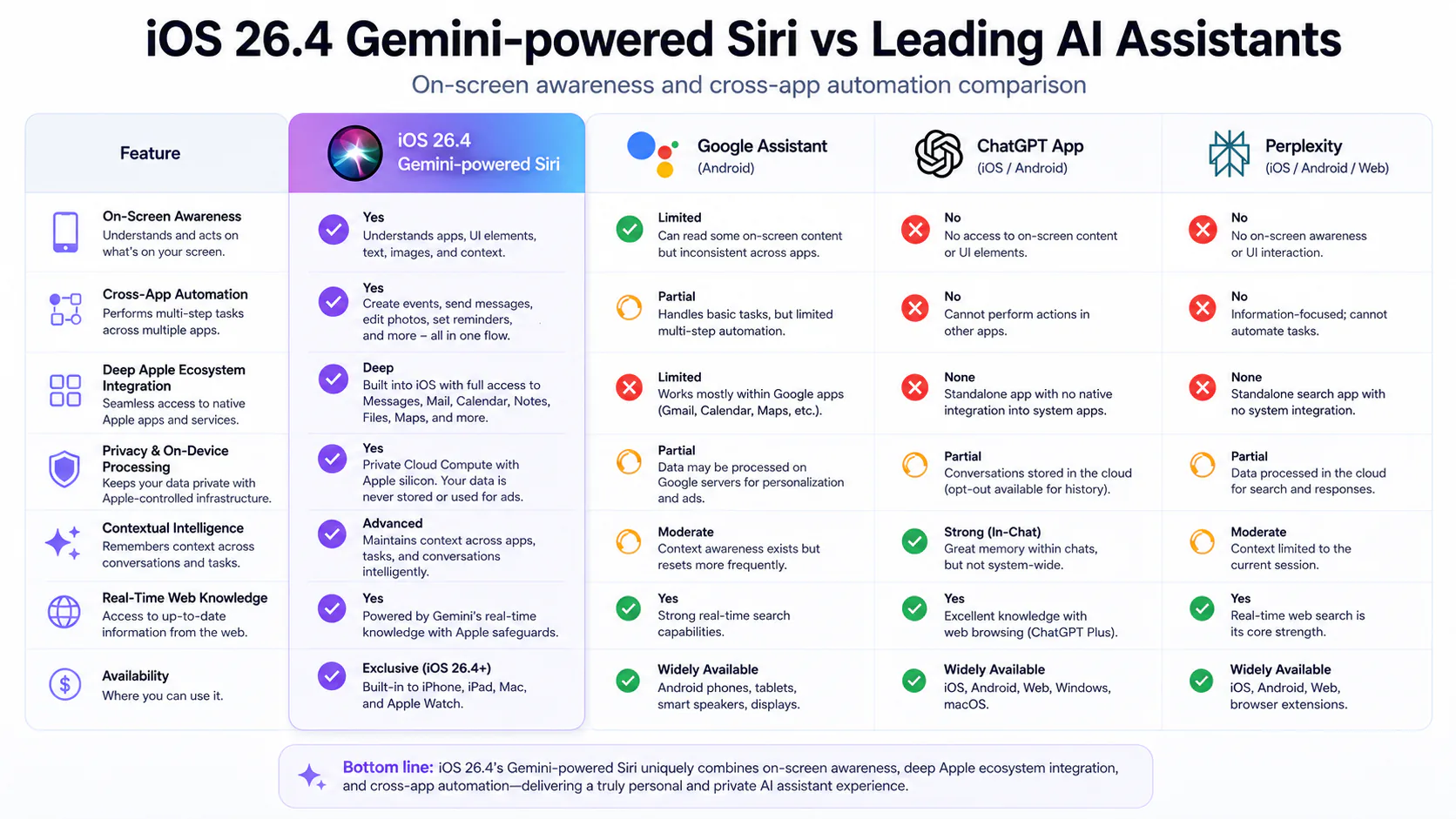
On-Screen Awareness is the headline Phase 1 feature. Siri can read and understand whatever is visible on your screen and respond in context without you leaving the current app. You can open an article in Safari and ask Siri to summarize it. You can view a menu and ask which items are vegetarian. The model sees the screen content semantically, not just as extracted text.
Personal Context Awareness gives Siri access (with explicit user permission) to emails, calendar events, messages, and notes. The demo scenario Apple showed at WWDC 2024 and failed to ship, "when does Mom's flight land?" where Siri reads the email, finds the flight number, checks live status, and reports back, is the centerpiece of this feature.
Email and Document Summarization replaces the simple extraction algorithms in legacy Siri with the Gemini model's actual comprehension. Long email threads and documents get meaningful summaries, not keyword extractions.
World Knowledge Answers (WKA) is a Perplexity-style cited web search built into Siri, answering factual queries with sourced, conversational responses directly in the Siri interface.
Basic Cross-App Actions let Siri execute multi-step requests that span multiple apps using the App Intents framework. Find information in one app, act on it in another, without switching manually.
What waits for iOS 27 (September)
WWDC tomorrow is Tim Cook's final keynote before handing leadership to John Ternus in September. The full Siri redesign ships with iOS 27, and it goes significantly further than Phase 1.
The Phase 2 feature set includes a rebuilt standalone Siri app with a full chatbot interface and multi-turn conversation memory across 20-plus exchange dialogues. Visual Intelligence moves from the Camera Control button workflow into the Camera app as a native mode. The capability most relevant to third-party developers is the Extensions Marketplace: third-party AI models distributed through the App Store (Claude, ChatGPT, and others) can power Siri directly, giving users a choice of AI engine through the same voice interface they already use.
If iOS 27 ships what Apple announces tomorrow, it ends a two-year credibility crisis. If it doesn't, the consequences compound.
The privacy trade-off Apple isn't explaining clearly
Apple's privacy case for the Gemini deal rests on two claims: Private Cloud Compute architecture controls access at the infrastructure level, and a contractual clause prevents Google from using Siri interactions to train future Gemini models.
Both may be true. Neither is independently verifiable.
A June 5 report confirmed that the Gemini inference actually runs on NVIDIA B200 chips via Google Cloud, not on Apple-owned servers. Apple's PCC architecture controls access to that compute environment, but the physical infrastructure is Google's. Apple's own statement on the implementation: "Apple doesn't want to detail any more of the Gemini deal to the public, so we may never know the exact implementation of these models behind the scenes unless there are direct leaks."
Using Gemini through Siri is contractually more private than using gemini.google.com directly. But for users who specifically wanted their most personal AI interactions to run on Apple-controlled hardware, the B200 disclosure is a meaningful gap in Apple's narrative.
The antitrust complication
Google already pays Apple approximately $20 billion per year to be the default search engine on Safari. A federal judge ruled that arrangement an illegal maintenance of a search monopoly in 2024. The Gemini deal adds roughly $1 billion per year on top, deepening the commercial relationship at the exact moment regulators are trying to reduce it.
Antitrust attorneys have described the combined payments as a concentration of platform power with few precedents. The DOJ's Google antitrust appeal is ongoing, and the new AI deal will almost certainly be cited in remedies proceedings.
OpenAI, which had its ChatGPT integration elevated to Apple's primary AI partnership just 18 months ago, is now the opt-in overflow layer. Gene Munster put the shift bluntly: "The Gemini integration effectively demotes ChatGPT from a co-pilot to a backup system." TechCrunch reported in May that OpenAI was preparing legal action against Apple over the change.
Why this matters for developers
The iOS 27 Extensions Marketplace is the most significant part of the deal for developers building AI products. If Apple ships it as described, third-party AI models can reach iPhone users through the Siri interface rather than requiring a separate app download and explicit user setup. That changes the distribution math for every company building consumer AI.
The MCP (Model Context Protocol) support Apple added to its ecosystem means AI systems with MCP compatibility can access App Intents, expanding the integration surface beyond Apple's native tools. Developers building on any MCP-compatible stack have a path to the iPhone's app and data ecosystem that didn't exist before.
The hardware story is also notable. Running on NVIDIA B200 chips via Google Cloud means the Gemini-powered Siri has access to the same hardware running the most demanding AI workloads globally. That's the compute backing the capabilities that ship tomorrow.
Tomorrow's WWDC keynote will confirm the iOS 27 feature set, open the developer beta, and either restore Apple's credibility on Siri or extend the streak of promises that didn't land on time. Based on everything known as of today, the pieces are finally in place. Whether they ship is the only question left.
For Google's side of the same platform war, see our Google I/O 2026 recap. For the private LLM alternative enterprises are exploring, our guide to deploying self-hosted open-weight models covers the path when neither option feels comfortable. Browse more AI tools coverage on Bytewaves.
Frequently asked questions
Apple's contract explicitly prevents Google from using Siri interactions to train future Gemini models. Apple's Private Cloud Compute architecture handles encryption and access controls before inference runs. However, a June 5, 2026 report confirmed the inference physically runs on NVIDIA B200 chips via Google Cloud infrastructure, not Apple-owned servers. The contractual protections are real but not independently auditable by users.
Advanced Apple Intelligence features, including the Gemini-powered Siri capabilities arriving in iOS 26.4 and iOS 27, require iPhone 15 Pro or later. Users on iPhone 15 (non-Pro) and earlier models will not have access to the new Siri capabilities, regardless of iOS version.
ChatGPT remains integrated into Apple Intelligence as a secondary, opt-in layer. Users who explicitly enable it can still route certain Siri requests to ChatGPT. However, it is no longer Apple's primary AI partnership. Gemini powers the default cloud AI tier. TechCrunch reported in May 2026 that OpenAI was preparing legal action against Apple over the change in its position.