Genie 3 Explained: DeepMind's Real-Time World Model (2026)
Genie 3 generates navigable 3D worlds from text prompts in real time. How it works, what Waymo already built with it, and where it still falls short.

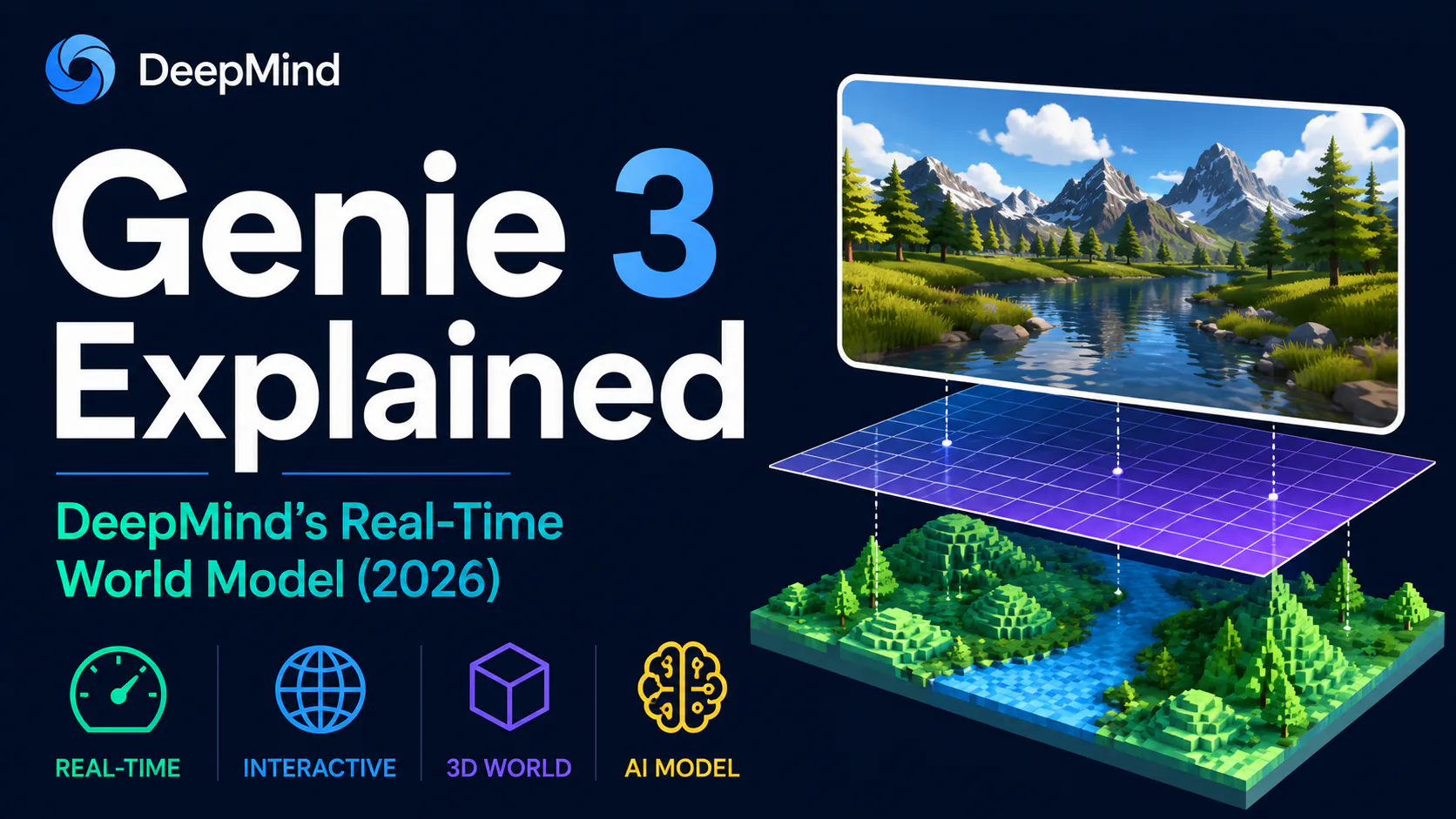
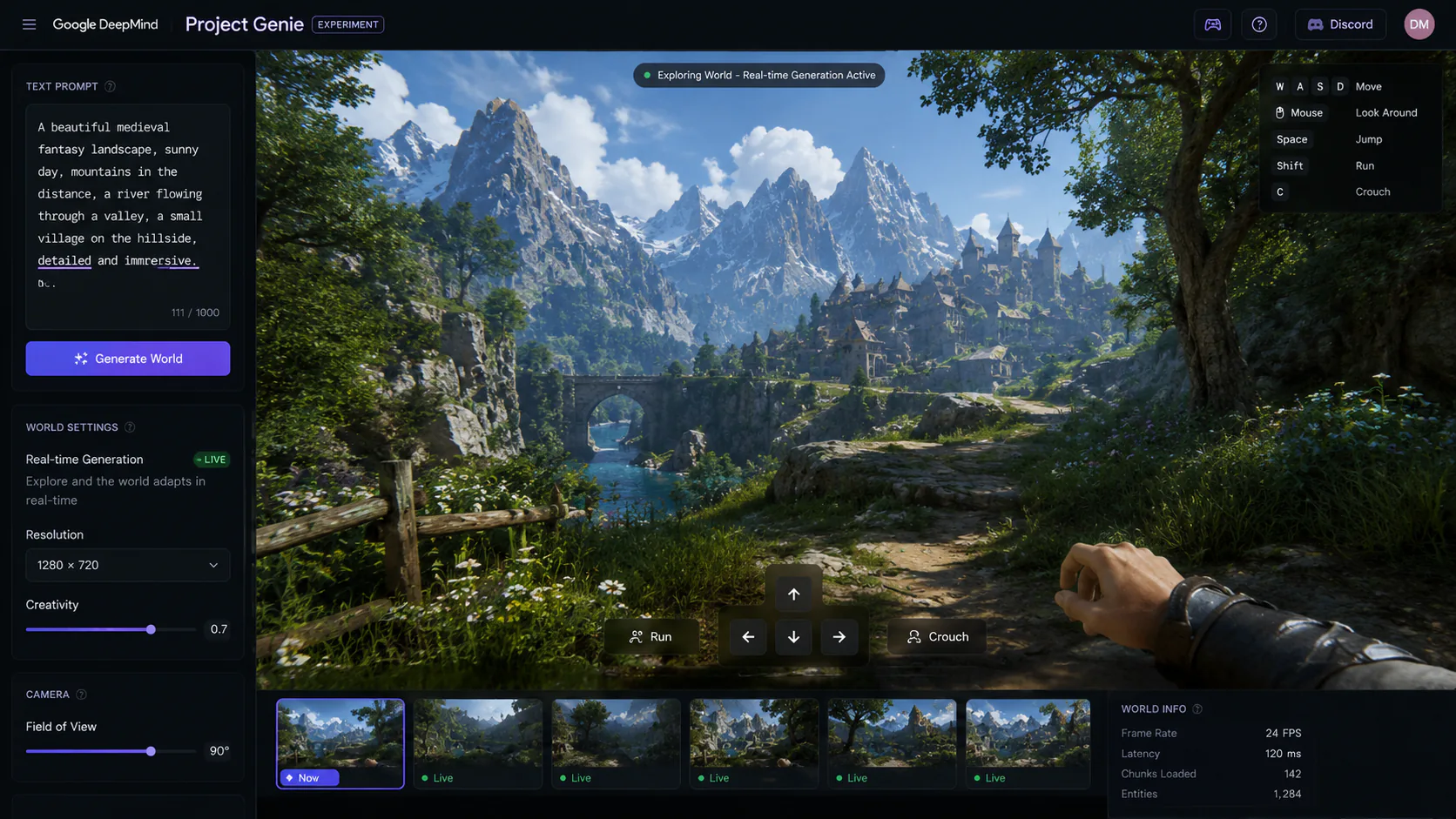
Type a prompt into Genie 3 and a 3D world appears that you can walk through. That world responds to follow-up text commands mid-session: add rain, shift the time of day, introduce objects, all without restarting.
Most AI video tools generate content you watch. Genie 3 generates worlds you act inside, and that distinction puts it in a completely different category from anything OpenAI, Runway, or Kling have shipped.
This post covers how the technology works, what DeepMind has already deployed commercially, and where the model still falls flat. Sources are DeepMind's research publications, the Waymo World Model announcement from February 2026, and the Google I/O 2026 updates from May.
TL;DR: Genie 3 is a real-time AI world model that generates navigable 3D environments from text or image prompts. It is the engine behind Waymo's autonomous vehicle simulation and powers Project Genie, available to Google AI Ultra subscribers at $200/month. Significant limitations remain: sessions hold coherence for roughly one minute, physics is approximate, and there is no public API.
What Is Genie 3?
A world model is an AI system trained to learn how the physical world works, not just what it looks like. Where a video generator produces a fixed sequence of pixels, a world model builds an internal representation of physics, object permanence, and spatial cause-and-effect. The result is something you can act inside rather than something you passively consume.
Genie 3 is Google DeepMind's third-generation world model, announced on August 5, 2025. It generates interactive 3D environments at 720p resolution and 24 frames per second from a text or image prompt. The model maintains visual and physical consistency for roughly one minute of session time, far beyond what its predecessors could manage.
The primary intended use is not consumer entertainment. DeepMind's lead researcher Jack Parker-Holder has explicitly framed Genie 3 as infrastructure for training AI agents and robots in simulated environments at a scale that real-world data collection cannot match. The consumer platform, Project Genie, is the visible surface of a much deeper research agenda.
How Genie 3 Works Under the Hood
Genie 3 runs on an auto-regressive architecture, the same fundamental mechanism behind large language models. Instead of predicting the next token in a text sequence, it predicts the next video frame given the history of all previous frames and the user's latest action. That process runs continuously, dozens of times per second, to maintain the appearance of real-time interaction.
Text or Image Prompt
        │
  Latent Encoder
        │
┌───────┴────────┐
│ Auto-Regressive│
│  Transformer   │
│   (Genie 3)    │
└───────┬────────┘
        │
  Frame History
  (last ~1 min)
        │
  ┌─────┴──────┐
  │            │
Frame      Consistency
Generator    Module
  │
720p @ 24fps
Interactive World
(accepts mid-session prompts)
Physics is not hard-coded. Genie 3 uses self-supervised learning on large datasets of video to infer how gravity, momentum, water, and object collisions behave. This "emergent physics" lets the model simulate scenarios it was never explicitly programmed for, though with meaningful inaccuracies (see Limitations).
The memory constraint is the most important parameter to understand. Genie 3 retains awareness of its generated world for roughly one minute of session time. Events and objects from earlier in the session can be forgotten as new frames push old ones out of the context window, which is why extended navigation breaks down.
From Genie 1 to Genie 3: What Changed
The three-generation progression happened in approximately 18 months, which is fast even by AI standards.
| Model | Released | Resolution | World Coherence | Key Capability |
|---|---|---|---|---|
| Genie 1 | March 2024 | Low (2D) | Seconds | 2D environments from sketches and images |
| Genie 2 | December 2024 | 360p | 10-20 seconds | Basic 3D, early physics, limited interactivity |
| Genie 3 | August 2025 | 720p @ 24fps | ~60 seconds | Real-time 3D, promptable events, Street View |
The jump from 10-20 seconds of coherence to one full minute is significant for agent training use cases. A robot agent needs at least tens of seconds of consistent environment context to practice any meaningful skill sequence. Genie 2 was too short for most practical training loops. Genie 3 is not yet sufficient for extended training runs, but it opens the door.
Street View Integration: The Biggest Update Yet
At Google I/O in May 2026, DeepMind announced that Genie 3 can now draw from Google's archive of 280 billion Street View images collected across 110 countries since 2007. The practical effect: you can anchor a Genie 3 world to a real geographic location and navigate it as a simulation grounded in actual photographic data.
This changes the application profile considerably. A purely synthetic world is useful for abstract agent training. A world grounded in real geography is useful for urban planning simulations, emergency response training, geospatial AI research, and navigation agents that need to transfer skills to real cities.
The integration does not produce accurate real-world mapping. Google is not shipping a photorealistic digital twin of your city street. What it does produce is a simulation that reflects the visual character and spatial layout of real places, which is substantially more useful for training than a completely synthetic scene.
Real-World Deployments: Waymo and Robotics
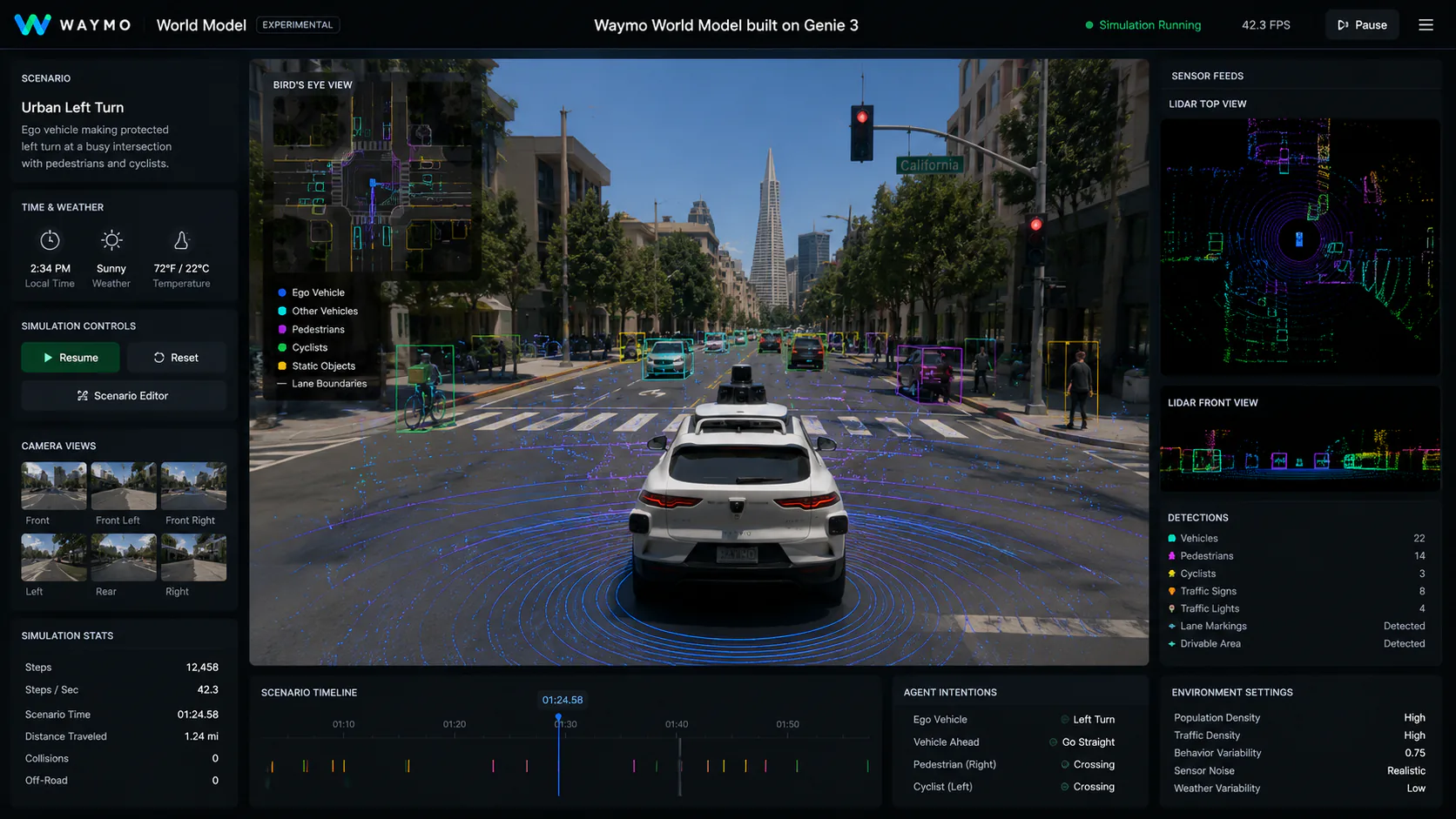
Genie 3 has one live enterprise deployment of significant scale. In February 2026, Waymo announced the Waymo World Model, built directly on Genie 3. The system generates photorealistic driving environments (including synchronized camera and lidar outputs) to train Waymo's autonomous vehicles on rare "long-tail" scenarios: events that are too dangerous, illegal, or statistically rare to observe on real roads.
Documented training scenarios include tornadoes, elephant encounters, snow on the Golden Gate Bridge, and simultaneous sensor failures. Waymo has attributed its expansion to 11 U.S. cities in part to the additional training data Genie 3 simulations provided.
DeepMind has also demonstrated their SIMA (Scalable Instructable Multiworld Agent) operating inside Genie 3 environments, pursuing navigation goals in real time. The thesis behind this work mirrors what AlphaGo demonstrated with self-play: an agent trained on unlimited diverse environments can develop generalizable skills that transfer to the real world. If you are building production AI agents today, the guardian agents pattern in CI/CD pipelines reflects a similar principle at the code level (train and validate in simulation before real-world exposure).
How Genie 3 Compares to Sora, Cosmos, and Game Engines
The most common source of confusion is comparing Genie 3 to AI video generators like Sora. They are not solving the same problem.
| Feature | Genie 3 | OpenAI Sora | NVIDIA Cosmos | Unity/Unreal Engine |
|---|---|---|---|---|
| Real-time interactivity | Yes | No | Limited | Yes |
| Text-to-world | Yes | Yes (video only) | Yes (video only) | No (manual content) |
| Emergent physics | AI-learned | Limited | Physics-aware | Hard-coded (rule-based) |
| Resolution | 720p @ 24fps | Up to 1080p | Variable | Unlimited |
| Open-source | No | No | Partial | Commercial / mixed |
| Primary use case | Agent training, sim | Cinematic video | Industrial robotics | Game and sim development |
| Access model | $200/month (AI Ultra) | ChatGPT Pro ($200/mo) | Research / enterprise | Subscription + licensing |
Sora produces higher-fidelity video output. It does not respond to navigation input. You cannot act inside a Sora video. Genie 3's output is lower fidelity than Sora's best work, but the interactivity is not a feature addition: it is a different category of system.
NVIDIA Cosmos (launched at CES 2025) is the more direct competitor for the enterprise simulation use case. Cosmos prioritizes deterministic, sensor-accurate physics for industrial robotics. Genie 3 is more flexible and faster to prototype with, but less physically precise. The two systems are more complementary than competitive: Genie 3 for rapid exploratory generation, Cosmos for final high-fidelity validation. Projects building agents that need to graduate from simulated to real environments will eventually need both real-world tool connections, where setting up MCP servers for your AI agent stack becomes relevant.
Limitations and Access
The current limitations are real and worth naming clearly, because the technology is being described in sweeping terms that outrun what it can actually do.
Technical limitations:
- ~1 minute coherence window. Objects and places generated early in a session can be forgotten as new frames push them out of context. Extended navigation, multi-scene storytelling, or training runs requiring extended temporal context all break down.
- Approximate physics. Complex multi-object collisions, rigid body dynamics, and intricate surface interactions can behave implausibly. The model learned an approximation of physics from video data, not physics itself.
- Multi-agent breakdown. Coordinated interactions between more than two agents degrade quickly. One-on-one scenarios are manageable; complex group dynamics are not.
- Limited action space. Agent control options are narrower than in traditional game engines. Promptable events are not always executed predictably.
Access limitations:
- No public API. Model weights and specific hardware requirements have not been disclosed. There is no programmatic access for developers building applications.
- $200/month paywall. Project Genie is available exclusively to Google AI Ultra subscribers. For researchers in lower-income contexts or independent developers, this is a significant barrier.
- Closed-source. Unlike NVIDIA Cosmos (partial open-source) or Meta's V-JEPA 2, Genie 3 is proprietary. DeepMind has not indicated a path toward open weights.
External researchers have also called for clearer disclosure of training data sources and energy consumption metrics. The current access model, limited to a small group of enterprises and paying consumers, follows an increasingly common pattern in high-capability AI development and raises legitimate questions about who benefits from the technology.
The Takeaway
Genie 3 is genuinely novel. The shift from passive AI video to interactive, promptable world simulation is not incremental; it is a change in what AI can be used for. Waymo's deployment is evidence that the technology works at production scale for a specific, high-value use case.
For most developers and researchers, Genie 3 is not accessible today. The $200/month subscription, the lack of an API, and the one-minute coherence ceiling all constrain practical use. The Street View integration is the most concrete recent expansion of the system's real-world relevance, but it does not change the access situation.
Watch for API access and extended session lengths as the signals that Genie 3 has moved from research infrastructure to something developers can build on directly. Until then, Waymo's deployment is the clearest picture of where the technology actually delivers.
Frequently asked questions
Genie 3 is an interactive world model: it generates 3D environments you can navigate and modify in real time using text prompts. AI video generators like Sora produce passive video clips you watch but cannot interact with. The distinction is fundamental, not cosmetic. Genie 3 is designed for training AI agents and robots; Sora is designed for cinematic content creation.
Genie 3 is available through Project Genie, part of the Google AI Ultra subscription at $200/month (as of June 2026). There is no free tier, no public API, and no open-source release. Access is available at one.google.com/about/ai-premium. Researchers seeking programmatic or lower-cost access currently have no official path.
Three limitations matter most. First, the coherence window is roughly one minute: objects and places from earlier in a session can be forgotten. Second, physics is approximate and breaks down for complex multi-object interactions. Third, there is no public API, which means developers cannot build applications on top of it directly. All three are active areas of research at DeepMind.