Make vs Zapier vs n8n: Best Automation Tool in 2026?
Make, Zapier, and n8n compared on pricing, AI agents, and self-hosting in 2026. Clear picks for non-technical teams, power users, and engineering orgs.

Three automation platforms run most of the no-code workflows you'll ever touch, and picking the wrong one gets expensive fast. Not "slightly more than you budgeted" expensive. "We just outgrew this in four months and now we're migrating 80 workflows" expensive.
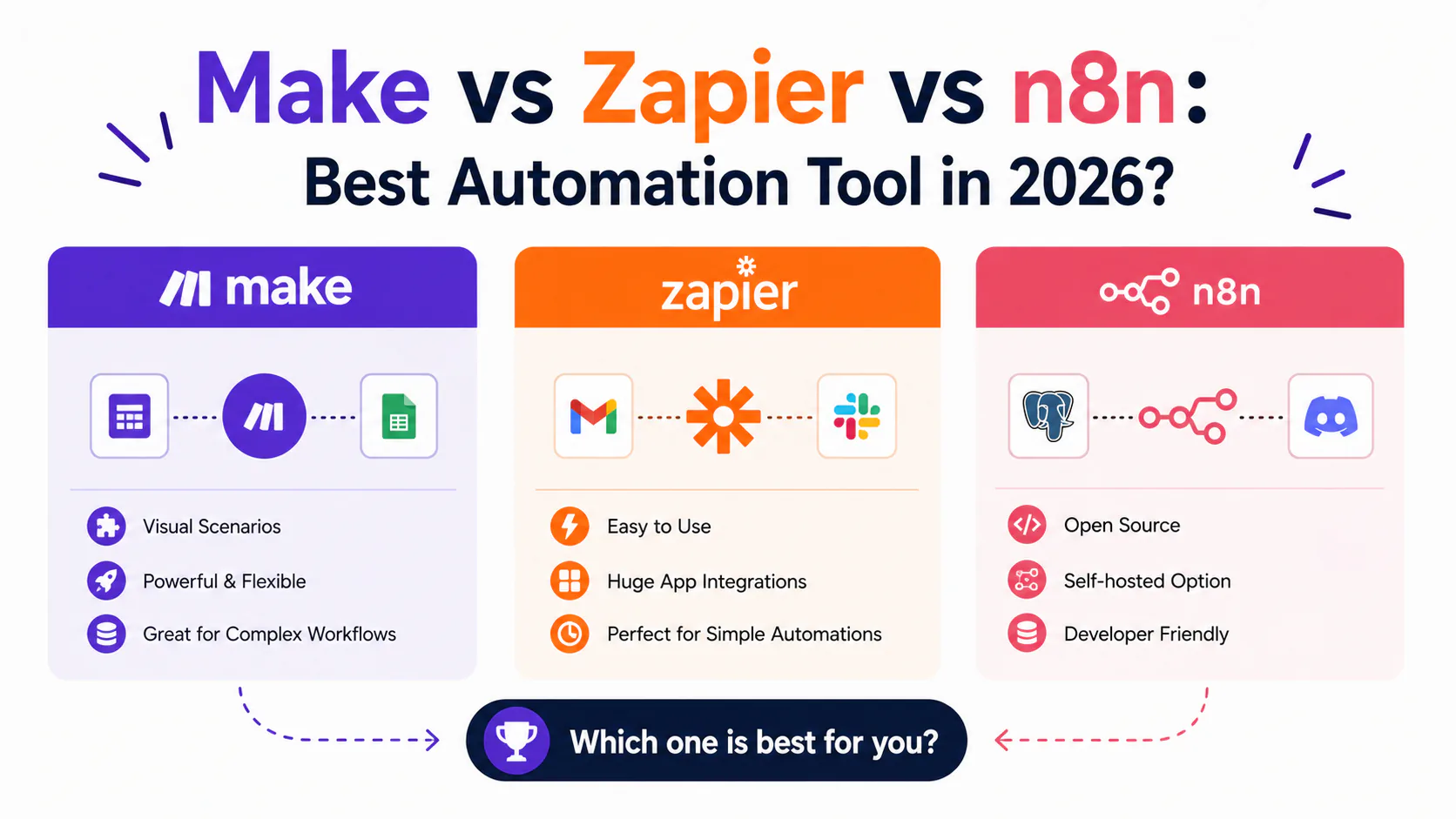
Zapier, Make, and n8n all connect your apps and move data between them. Past that, they barely resemble each other. One is a linear wizard built for speed. One is a visual canvas built for branching logic. One is open-source infrastructure you run yourself.
This comparison is built from current pricing pages, official case studies, and the platforms' own 2026 documentation, not marketing copy. Here's which one actually fits your team.
TL;DR: Zapier wins on speed and integration breadth for non-technical teams. Make wins on price-to-power for mid-complexity workflows. n8n wins on cost at scale and data control, if your team can handle the learning curve.
Quick verdict
If you're a solo founder or a small ops team automating simple two-to-five-step tasks, use Zapier. Its linear trigger-action model and 6,000+ app catalog mean you'll have a working automation in minutes, not hours.
If your workflows involve branching logic, multiple conditions, or merging data from several sources, Make gives you a visual canvas that handles that complexity at roughly a third to a fifth of what the equivalent setup costs on Zapier.
If you're an engineering-led team that needs unlimited executions, full data residency, or genuinely custom logic, n8n is the only one of the three you can self-host. The tradeoff is a steeper learning curve and real infrastructure ownership.
What each platform actually is
All three solve the same problem: connecting SaaS apps so they pass data and trigger actions without someone copy-pasting between tabs. How they get there is where the similarities end.
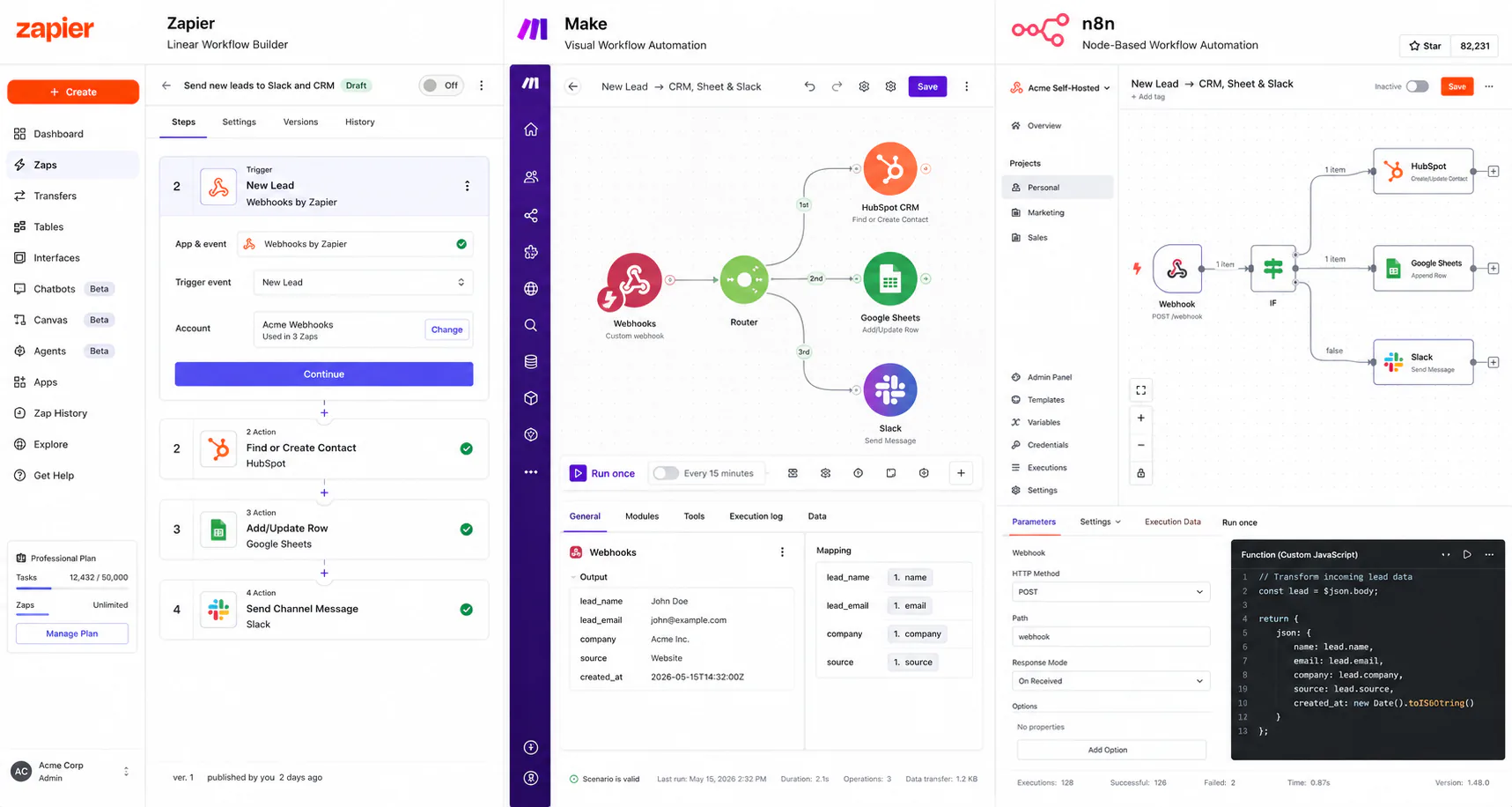
Zapier: the linear trigger-action wizard
Zapier, founded in 2012, built its dominance on simplicity. You pick a trigger (a new lead in Salesforce), then chain one or more actions (add the lead to Mailchimp, post a Slack message). It's IFTTT logic: if this happens, then do that.
That simplicity is also its ceiling. Express a workflow with multiple branches or parallel paths, and you end up chaining several separate Zaps together instead of building one coherent flow.
Make: the visual canvas
Make started life in Prague in 2012 as Integromat and was acquired by Celonis in 2020. Instead of a linear list, you build "Scenarios" on a drag-and-drop canvas where you can literally watch data flow between modules.
This makes branching, conditional routers, iterators, and aggregators far easier to build and debug than chaining linear steps. It's the middle tier: more power than Zapier, no code required.
n8n: the node-based, code-capable editor
n8n, founded in Berlin in 2019 by Jan Oberhauser, uses a node-based editor that reflects his background in VFX tooling. Nodes connect in nearly any configuration, and you can drop real JavaScript into a built-in Function node or call Python through an Execute Command node.
The defining difference is licensing. n8n runs on a "fair-code" Sustainable Use License: the source is public, you can self-host it freely for internal use, but you can't resell it as a competing SaaS product without authorization. Zapier and Make are cloud-only and closed-source. n8n is the one platform here you can run entirely on your own infrastructure.
Pricing: how each platform actually charges you
This is where most teams get surprised. Each platform counts "usage" with a different unit, so a workflow that's cheap on one platform can be expensive on another at the same volume.
Zapier charges per task. Every individual action inside a workflow run counts separately, so a five-step Zap firing once burns five tasks against your plan limit. Most teams outgrow their starter plan within about six months of real use.
Make charges per credit, having transitioned from its older "Operations" unit on August 27, 2025. Most standard actions still convert one-to-one, but AI-powered modules now consume variable credits based on token usage, file size, or processing time. That makes budgeting harder than the old flat-rate model, but Make remains the most generous free tier of the three: 1,000 operations or credits per month with two active scenarios.
n8n self-hosted charges nothing per execution. Once deployed, you run unlimited workflows regardless of volume, because the cost shifts entirely to your own infrastructure instead of per-use billing. n8n Cloud, the managed option, does use execution-based tiers, but the self-hosted Community Edition removes per-execution cost entirely.
Pricing and plan comparison
| Dimension | Zapier | Make | n8n |
|---|---|---|---|
| Pricing unit | Per task | Per credit (was Operations, changed Aug 2025) | Self-hosted: infrastructure cost only; Cloud: execution-based |
| Free tier | Limited | 1,000 ops/credits/month, 2 scenarios | Unlimited executions on self-hosted Community Edition |
| Self-hosting | ✗ | Limited (on-prem agent for data access only) | ✓ Full self-hosting, free Community Edition |
| Integrations | ~6,000-9,000+ | ~1,000-2,000+ | ~400-1,500 (extensible via HTTP/custom nodes) |
| Coding required | None | None (custom functions are Enterprise-only) | Optional, unlocks full power (JavaScript/Python) |
| Learning curve | Lowest | Moderate | Highest |
A mid-size operations team running 50,000 executions a month across marketing, sales, and support will pay dramatically different amounts on each platform. That's why the pricing unit, not the headline number, is the comparison that matters.
AI agent capabilities
All three platforms shipped meaningful AI agent features within roughly the same 12-to-18-month window, and feature depth still varies by the week, so treat this section as a snapshot rather than a permanent ranking.
n8n's AI nodes go deepest
n8n 2.0, released December 2025 through January 2026, added 70+ AI nodes with native LangChain integration, an AI Agent Tool Node for multi-agent orchestration, persistent agent memory across executions, and vector database support for retrieval-augmented generation (RAG) workflows. By most technical assessments, this makes n8n the most AI-native of the three, with the customization depth that comes from direct code access.
Make's Maia targets accessibility with depth
Make introduced AI Agents in October 2025 alongside Maia, an assistant that builds automation scenarios from plain-language descriptions. It's a middle path: deep enough to be genuinely useful, but with less raw customization than n8n's code-level access.
Zapier prioritizes reach over depth
Zapier Copilot builds workflows from natural-language prompts, and Zapier Agents are described as autonomous systems that execute tasks across 8,000+ connected apps without human intervention. MCP (Model Context Protocol) support is planned for 2026, which would let Zapier plug into the same agent-interoperability standard covered in our MCP vs A2A protocol comparison. For now, Zapier's AI strategy leans toward accessibility over deep customization, consistent with the rest of its product philosophy.
Zapier                Make                  n8n
Copilot + Agents       Maia + AI Agents      AI Agent Tool Node
(natural-language      (scenario generation  (LangChain native,
workflow builder)      from prompts)         70+ AI nodes, RAG)
      │                     │                      │
 Accessibility         Balanced depth        Maximum customization
Real-world performance
Numbers from comparison roundups are useful, but documented production results tell you more about what each platform does at scale.
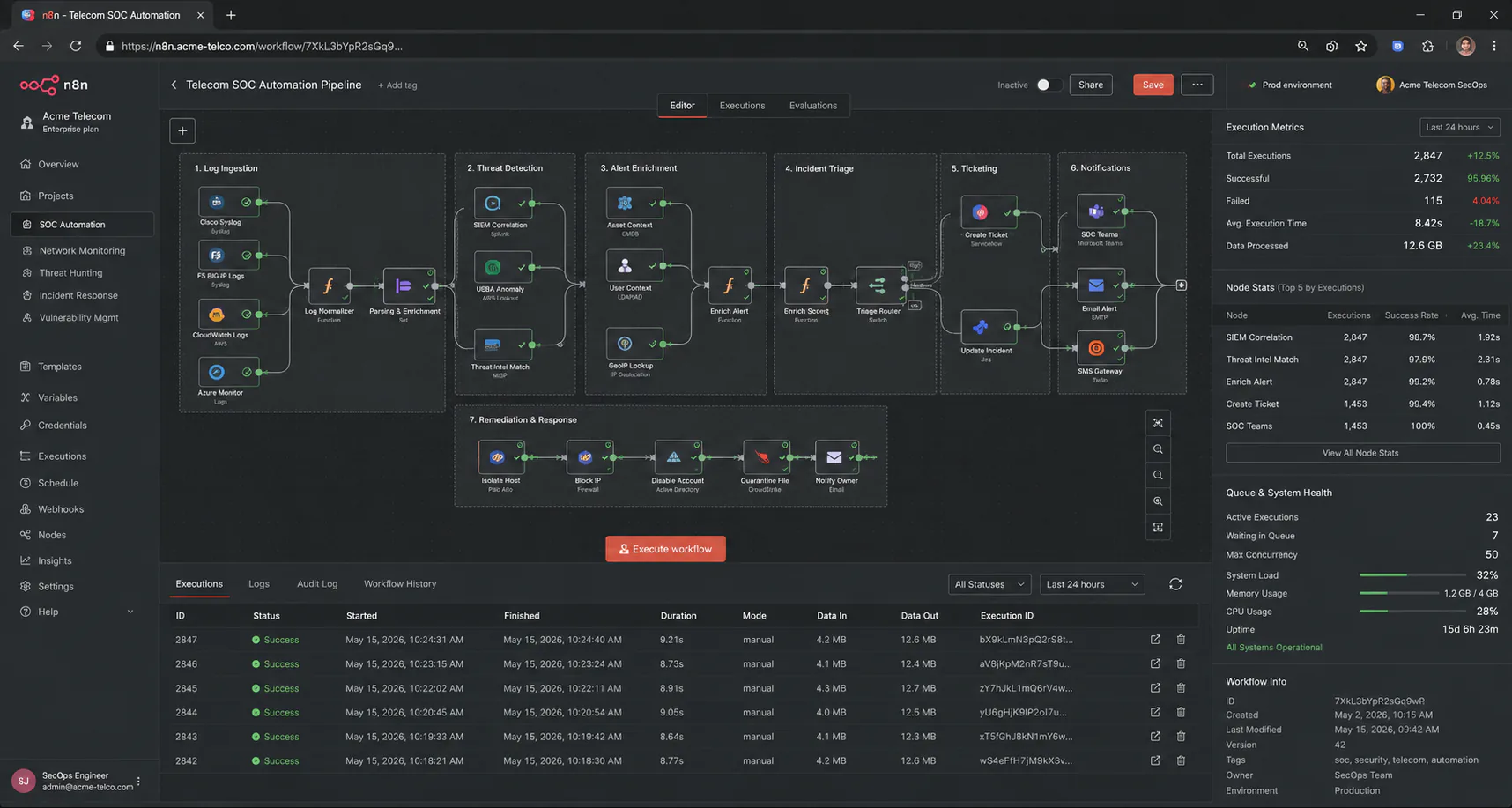
n8n's case studies are the most detailed of the three. Vodafone's cybersecurity team built 33 workflows after evaluating and rejecting traditional SOAR tools like IBM Resilient and Tines, and documented roughly £2.2 million in costs avoided along with about 5,000 person-days saved, plus continuing monthly savings near £300,000 in 2025. Delivery Hero rebuilt its IT account-recovery process around a single n8n workflow, cutting average lockout time from 35 minutes to 20 and saving 200+ hours of cumulative employee downtime per month.
StepStone, one of Europe's larger recruiting platforms, runs 200+ production workflows on n8n and cut the time to integrate a new data source from two weeks to about two hours, a 25x improvement. Musixmatch saved 47 days of engineering work in four months using n8n for internal pipeline automation.
Make's documented scale is more aggregate than case-study specific: its users have collectively automated the equivalent of 331 years of manual work in a single year, with the platform's router and iterator model showing up most often in multi-channel marketing orchestration and conditional e-commerce order routing.
Zapier's most common real-world pattern, across nearly every comparison source reviewed, is the two-to-five-step automation: a new Salesforce lead lands in a Mailchimp audience and triggers a Slack ping, or a Typeform submission writes straight into a CRM. It's the long tail of simple, high-volume automation that doesn't need Make's or n8n's added power, and it's where Zapier is genuinely hard to beat on setup speed.
Ease of use and learning curve
Zapier's linear wizard is the lowest-friction starting point of the three. Business users can build a working automation in minutes with zero training, which is exactly why it remains the default first platform for most teams.
Make's canvas is more powerful but takes longer to feel natural. The visual branching is a genuine strength once you're comfortable with it, though some users describe early scenarios as "spaghetti-looking" until they get a handle on routers and iterators.
n8n has the steepest curve by a real margin. The interface looks approachable until it expects you to understand variables and expressions, which can be empowering for a developer and disorienting for someone who just wants to automate a lead handoff. Choosing self-hosted n8n also means owning the infrastructure: patching, staging, and permissions become your team's job, not a vendor's.
Comparison table
| Feature | Zapier | Make | n8n |
|---|---|---|---|
| Core model | Linear trigger-action | Visual canvas / Scenarios | Node-based, code-capable |
| Self-hosting | ✗ | Limited (data-access agent only) | ✓ Full self-hosting |
| Error handling | Basic | Solid (routers, error modules) | Most granular |
| AI capability depth | Accessible, less customizable | Intermediate | Most advanced, native LangChain |
| Custom code access | None | Enterprise tier only | Most tiers |
| Best for | Non-technical teams, fast setup | Mid-complexity, visual thinkers | Engineering-led, compliance-heavy |
| 2025-2026 funding signal | Not disclosed in recent reporting | Part of Celonis portfolio | $2.5B valuation, Oct 2025 |
n8n's valuation jumped from roughly $270 million to $2.5 billion within about a year, on a $180 million raise led by Accel with Sequoia, Felicis, HV Capital, and Nvidia's NVentures participating. That kind of run-up signals real investor conviction that self-hosted, AI-native automation is becoming a structural enterprise need, not a niche developer preference. You can read more about how that AI-native shift is playing out across the broader tooling stack in our roundup of project management tools with embedded AI.
When to choose Zapier
Choose Zapier if you're a non-technical team that needs an automation working today, not after a learning curve. Its 6,000-to-9,000+ app catalog (estimates vary by source) is the largest in the category, and 69% of Fortune 1000 companies already use it, alongside Meta, Dropbox, Shopify, and Toyota.
It's the right call for straightforward two-to-five-step automations: lead-to-CRM syncs, form-to-spreadsheet pipelines, Slack notifications. Push past that complexity and you'll feel the linear model strain, usually around the same time your task-based bill starts climbing.
When to choose Make
Choose Make if your workflows need branching logic, conditional routing, or data transformation that a linear wizard can't express cleanly. At comparable automation volume, Make commonly costs three to five times less than Zapier for equivalent complexity, and its 1,000-credit free tier is generous enough for real evaluation before you commit budget.
The canvas model is the differentiator: seeing data flow visually between modules makes complex scenarios easier to build and, critically, easier to debug when something breaks at 2 a.m.
When to choose n8n
Choose n8n if data residency, execution volume, or true customization make self-hosting worth the operational overhead. The Community Edition is the full platform, not a crippled free tier, with unlimited executions and no per-task billing once you're running it.
It's the clear choice for engineering-led organizations with compliance requirements, like Vodafone's security operations team, or for teams hitting unpredictable scaling costs on task-based platforms. It's the wrong choice if your team doesn't have the bandwidth to own infrastructure, because that overhead is real and ongoing.
Pros and cons
Zapier
- Fastest time-to-first-automation, with no training required for non-technical staff
- Largest integration catalog in the category, reducing the odds you'll hit an unsupported app
- Per-task pricing scales poorly. A five-step Zap firing once can burn five tasks against your plan, and most teams outgrow their starter tier within six months
Make
- Visual canvas handles branching and multi-source data merges that a linear wizard struggles to express
- Most generous free tier of the three, giving you real room to evaluate before paying
- Custom function and code access is locked to the Enterprise plan, capping how far lower-tier customers can customize
n8n
- Self-hosted Community Edition has unlimited executions and full data control with no per-task billing
- Most advanced native AI tooling, with 70+ dedicated nodes and built-in LangChain and RAG support
- Steepest learning curve of the three, and self-hosting means your team inherits real DevOps work, not just a settings menu
Who should use each platform
Use Zapier if:
- You're a non-technical team or solo founder who needs a working automation in minutes
- You're automating simple two-to-five-step workflows across mainstream SaaS tools
- Integration breadth matters more to you than workflow complexity
Use Make if:
- Your workflows need branching, conditional routing, or merging data from multiple sources
- You're comfortable with flowchart-style thinking but aren't a professional developer
- Cost at moderate-to-high complexity matters more than Zapier's simplicity
Use n8n if:
- Data residency or compliance requirements rule out cloud-only platforms
- Your execution volume makes per-task or per-credit billing unpredictable or expensive
- You have engineering capacity to own self-hosted infrastructure
Skip n8n if:
- Your team has no developer or DevOps support to maintain a self-hosted instance
- You need a pre-built integration for a niche app rather than building a custom HTTP node
Final recommendation
Most teams should start with Zapier or Make and migrate to n8n only when cost, compliance, or scale forces the question. That progression isn't a knock on n8n. It reflects a genuine maturity curve: simple needs are served well by simple tools, and the cost of n8n's flexibility is infrastructure ownership most early-stage teams don't need yet.
If you've already hit Zapier's complexity ceiling or its unpredictable per-task billing, Make is usually the next stop, not n8n directly. Reserve n8n for when self-hosting solves a real problem, not as a default upgrade. If you're also evaluating AI-native build tools alongside automation platforms, our Lovable vs Bolt.new vs v0 comparison covers a closely related decision for teams building app logic rather than connecting existing apps.
Frequently asked questions
The self-hosted Community Edition is free with unlimited executions, but you cover your own infrastructure (servers, maintenance, and DevOps time). n8n Cloud, the managed option, uses paid execution-based tiers instead.
Make is typically three to five times cheaper than Zapier at equivalent workflow complexity, because Zapier charges per task while Make's credit system handles branching logic more efficiently per automation.
Not easily. n8n's variables and expressions create a real learning curve that a marketing or ops team without developer support will likely find frustrating compared to Zapier's linear wizard.
Not yet. MCP (Model Context Protocol) support is planned for Zapier in 2026, while n8n already ships AI agent tooling natively through LangChain integration.
Make switched its billing unit from "Operations" to "Credits" on August 27, 2025. Most actions still convert one-to-one, but AI-powered modules now consume variable credits based on token usage and processing time, which makes cost forecasting harder than the old flat-rate system.