Perplexity Computer vs ChatGPT Codex: Which AI Agent Wins?
Perplexity Computer and ChatGPT Codex both cost $200/month for full access. Here's which multi-agent AI tool actually fits your work in 2026.

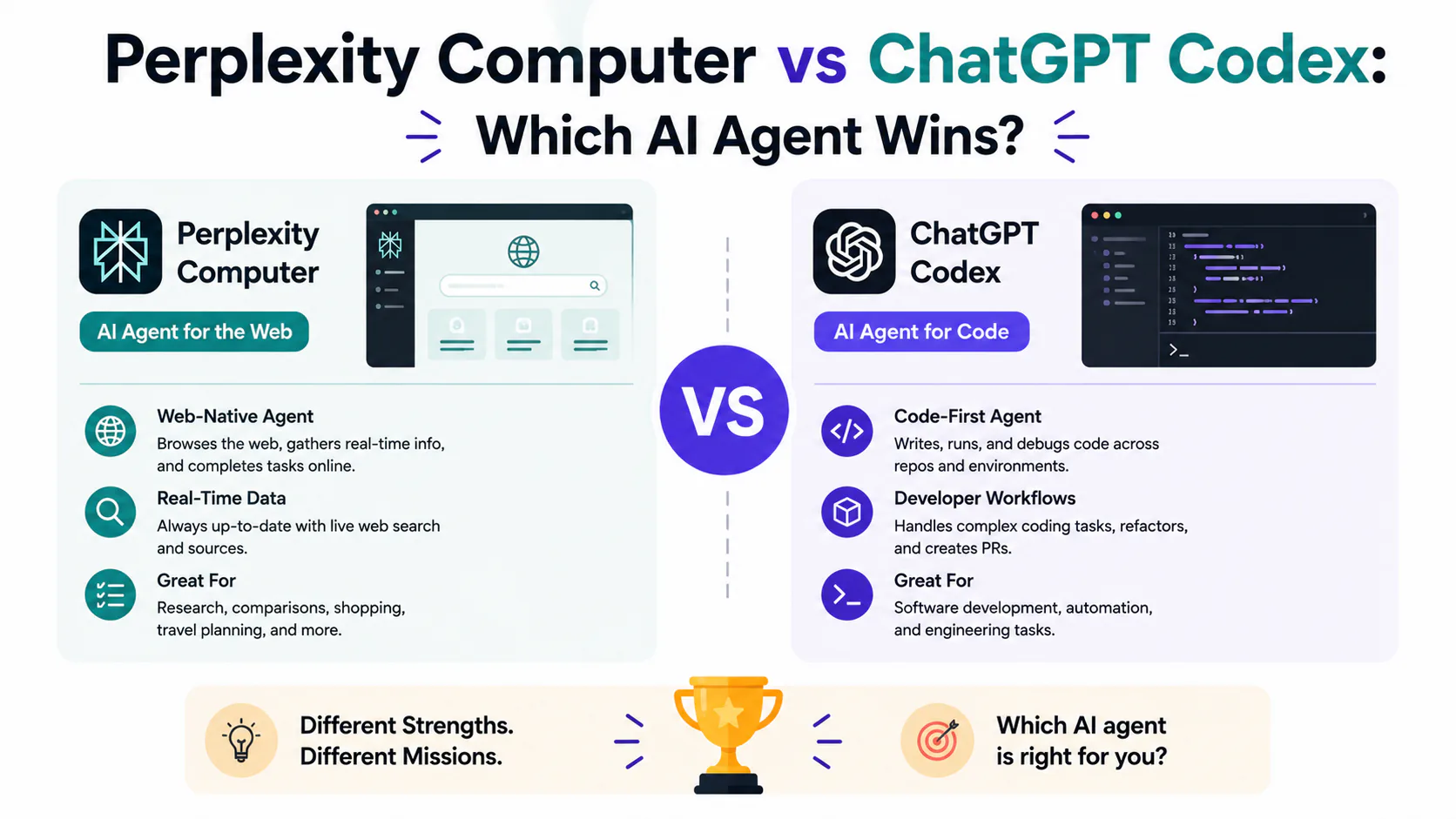
Both cost $200/month for full access. Both promise to run multi-step AI work in the background while you focus on something else. But Perplexity Computer and ChatGPT Codex are built for fundamentally different people, and paying for the wrong one means $2,400 a year spent on a tool that doesn't match how you actually work.
Perplexity Computer launched February 25, 2026, routing tasks across roughly 20 AI models simultaneously. ChatGPT Codex shipped GPT-5.3-Codex on February 5, 2026, and has since expanded to Computer Use on desktop, a Chrome extension, iOS and Android, and six new business-function plugins. The surface-level pitch looks similar. Their actual job-fits are almost entirely separate.
This comparison is based on the research brief, community testing data, and official documentation available as of June 2026. Specific model versions and credit figures are dated throughout because both products update on near-weekly cadences.
TL;DR: Choose Perplexity Computer if your core work is research, competitive intelligence, due diligence, or multi-source analysis. Choose ChatGPT Codex if you're a developer who needs a coding agent that can also operate a computer. If you're already paying for ChatGPT Plus ($20/month), you can try Codex's core features today at no extra cost.
Quick verdict
Third-party tier-rubric reviews score these tools at 8.4/10 (Perplexity Computer) and 8.3/10 (ChatGPT Codex): effectively tied on overall quality. The meaningful split is not quality but job-fit. One independent analysis framed it directly: Codex suits "developer-shaped" work (engineering, code, automation); Computer suits "operator-shaped" work (research, ops, executive decisions, founder workflows). That framing holds across every dimension in this comparison.
Neither tool is wrong. Buying the one that doesn't fit your day-to-day is.
The "Codex Pro" naming confusion, cleared up
"Codex Pro" is not an official OpenAI product name. OpenAI does not sell a standalone SKU called Codex Pro. Codex is a feature set bundled with ChatGPT's existing plans, and what third-party reviewers mean by "Codex Pro" is Codex accessed via the ChatGPT Pro plan ($200/month), which unlocks GPT-5.4/5.5 Pro-tier reasoning and the highest monthly usage limits.
This distinction matters for two reasons. First, if you search for a "Codex Pro" subscription on OpenAI's site, you won't find one. Second, unlike Perplexity Computer (which requires the $200/month Max plan from day one), Codex is accessible at lower price points before you commit. All Codex references in this article mean the full Codex feature set, with the plan tier noted where it affects what's available.
How each tool orchestrates work
This is the most fundamental difference between the two products, and it explains almost every other tradeoff in the comparison.
Perplexity Computer routes each sub-task to whichever model is best suited for that specific piece of work. When you send a complex goal (say, "compile a competitive analysis of X"), Computer decomposes it into sub-tasks, spins up specialized sub-agents, and routes each to a different underlying model. Claude Opus 4.6 handles core reasoning; Gemini handles deep research; GPT-5.2 handles long-context recall; Grok handles fast, lightweight tasks; Nano Banana generates images; Veo 3.1 produces video. Every data point in the final output links to a verifiable source, carried over from Perplexity's search roots.
ChatGPT Codex takes the opposite approach: deepen one model family's capability across more surfaces and longer task horizons. GPT-5.3-Codex (the primary model driving Codex as of early 2026, now being superseded by 5.4 and 5.5) achieved state-of-the-art results on SWE-Bench Pro and Terminal-Bench 2.0 with independently reproducible scores. Rather than routing to the best model per sub-task, Codex ships the same GPT lineage to more places: web app, desktop app, CLI, IDE extension, and mobile.
Perplexity Computer (multi-model)         ChatGPT Codex (single-family depth)
─────────────────────────────────         ───────────────────────────────────
User goal → Orchestrator                  User goal → GPT-5.x-Codex
     │                                          │
     ├── Claude Opus 4.6  (reasoning)           ├── Web app   (ChatGPT.com)
     ├── Gemini           (research)            ├── Desktop   (macOS / Windows)
     ├── GPT-5.2          (long context)        ├── IDE ext.  (VS Code + others)
     ├── Grok             (fast / light)        ├── CLI
     ├── Veo 3.1          (video)               └── Mobile    (iOS / Android)
     └── Nano Banana      (image gen)
     │
Cited, merged output                      Shared context across all surfaces
Perplexity's stated philosophy is that models are "specializing, not commoditizing," making multi-model routing more cost-effective and accurate than relying on any single provider. TechCrunch summarized this at launch as "another bet that users need many AI models." Codex's counter-argument is implicit in its benchmark scores: one deeply optimized model family outperforms stitched-together multi-model pipelines for engineering work.
What each tool can actually do
The capabilities of these two products diverge most sharply at the task level.
Perplexity Computer
Every Computer task runs in an isolated cloud environment with a real filesystem, a real browser, and access to more than 400 app integrations: Google Sheets, Google Drive, Slack, Microsoft 365, and others. Tasks run in the background even if you close the browser window, and sub-agents can spawn additional agents for workflows that run for hours or longer.
Documented early-user results include:
- Competitive intelligence: automated monitoring of competitor product launches, pricing changes, hiring patterns, and public filings, with each data point linked back to its source
- Due diligence: multi-source market analysis for investment or M&A research, packaged as a shareable report
- An overnight session documented by one user produced two functional micro-apps, four finished research packets, and one new automation in a single run
- Interactive data visualization: a bubble chart plotting every S&P 500 company by revenue, profit, market cap, and share-price change, exported as a shareable website
- Research-backed drafting directly inside Word, Excel, and Outlook via the Microsoft 365 add-in
Computer can navigate and read code repositories, but it is not built for writing, testing, or deploying production software at the depth of a dedicated coding agent. That is a real limitation if engineering output is what you need.
ChatGPT Codex
Codex is built around running long-horizon engineering tasks in sandboxed environments with GitHub integration: writing code, running tests, opening pull requests, and managing multiple branches simultaneously. GPT-5.3-Codex is 25% faster than its predecessor and set a new industry high on SWE-Bench Pro and Terminal-Bench 2.0 (as of early 2026; newer model versions are replacing it).
Beyond coding, Codex has expanded substantially:
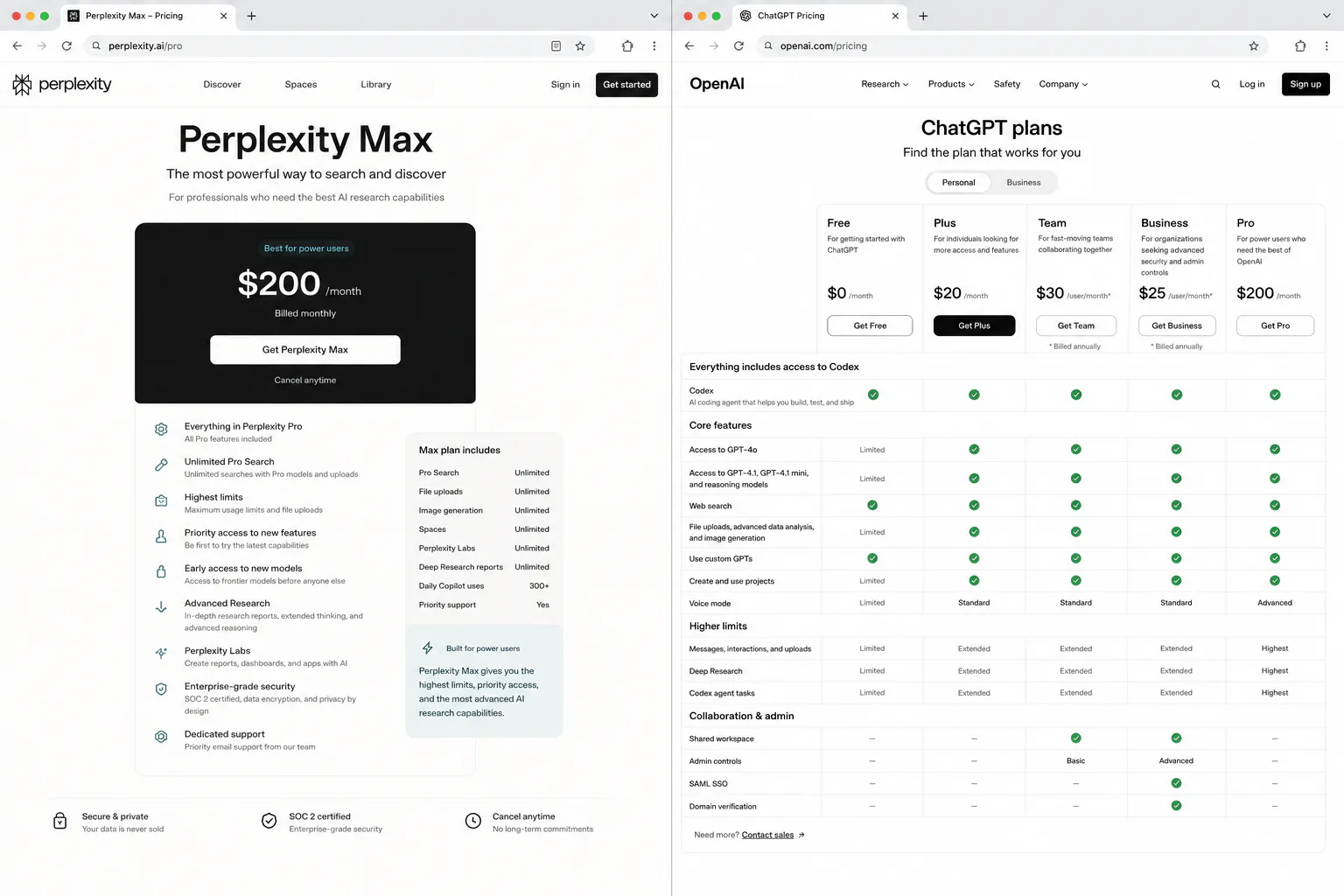
- Computer Use (macOS and Windows, rolling out from EEA/UK first): Codex can see, click, and type to operate desktop apps directly, sharing context with the same agent that's writing code
- Chrome extension: handles signed-in browser tasks in the background across tabs
- Sites: turns Codex's analysis, plans, and dashboards into shareable URLs accessible to a whole team
- Six business plugins (announced June 2, 2026): sales, data analytics, creative production, product design, public equity investing, and investment banking, explicitly aimed at non-developer functions
- Mobile (iOS/Android, available from May 14, 2026): monitor threads, review diffs, approve commands, or redirect a running task from your phone
- Goal mode (generally available): define an outcome and success criteria, then let Codex keep working toward it without step-by-step direction
The plugin expansion is a clear platform signal from OpenAI: agentic coding infrastructure is being repositioned as general enterprise automation, well beyond its developer-only origin.
Pricing: $200/month, but not the same deal
At the top tier, both products cost $200/month. That's where the similarity ends.
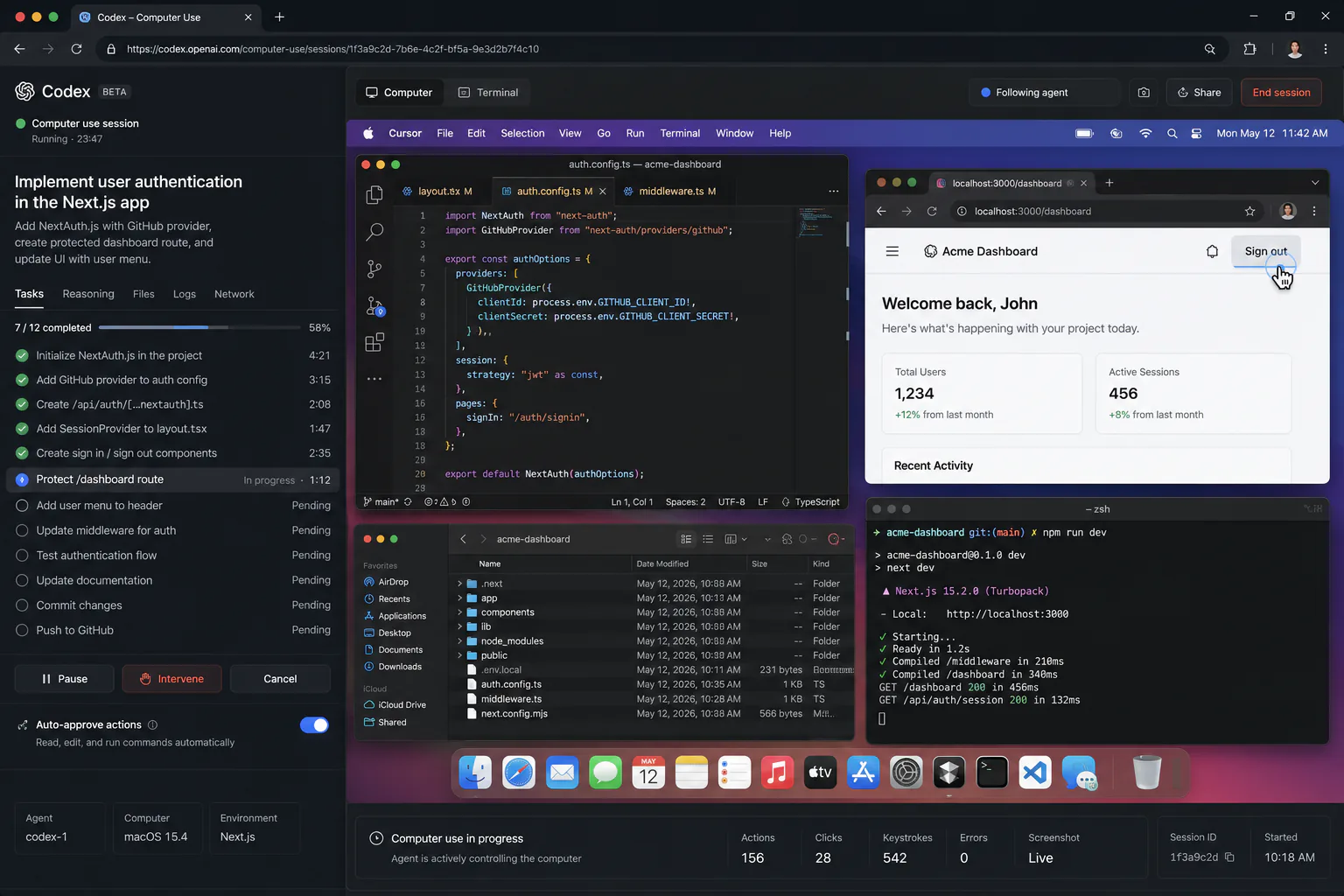
Perplexity Computer is available exclusively through the Perplexity Max plan at $200/month (as of early 2026, with rollout to lower tiers planned later in the year). The Max plan includes 10,000 monthly Computer credits, plus a reported 20,000 to 35,000 bonus credits for new subscribers. The problem: Perplexity has not published a credit-per-task conversion table, so you cannot look up how many credits a competitive analysis will cost before running it. Early users describe the credit system as "budgeting blind" until you've built enough personal usage history to estimate your own burn rate. For European subscribers, the price is approximately €200/month, which multiple reviewers flag as an uncommonly steep all-or-nothing entry point compared to alternatives.
ChatGPT Codex is bundled into ChatGPT plans rather than priced as a standalone product. Free and Plus users ($0 and $20/month respectively) get access to Codex, with lower usage ceilings than the Pro tier. The ChatGPT Pro plan ($200/month) unlocks GPT-5.4/5.5 Pro-tier reasoning and the highest Codex usage limits, including full Computer Use and priority access. For Business and Enterprise customers, OpenAI shifted in April 2026 from per-message estimates to API-style token-rate credit pricing, moving toward more predictable consumption-based billing. The key difference from Perplexity's pricing model: you can try Codex on your current Plus plan before deciding whether $200/month is justified.
On Perplexity's credit economics: there is no published table showing how many credits each task type consumes. Before committing to Max at $200/month, look for public usage logs from current Max subscribers in forums or review sites to estimate your real burn rate. The one-time bonus credits can mask actual ongoing costs during the first month.
Platform and integration coverage compared
| Feature | Perplexity Computer | ChatGPT Codex |
|---|---|---|
| Orchestration model | Multi-model (~20 models) | Single GPT family (5.x) |
| Entry price | $200/month (Max only) | $0 (Free/Plus bundled) |
| Full-access price | $200/month (Max) | $200/month (Pro) |
| Credit transparency | ✗ No per-task conversion rate published | Partial (shifting to token-rate) |
| Platform surfaces | Browser/cloud only | Web, desktop, CLI, IDE, mobile |
| Computer Use (click/type in desktop apps) | ✗ | ✓ macOS and Windows |
| Background tasks | ✓ | ✓ (Goal mode + mobile monitoring) |
| Source citations on every data point | ✓ | ✗ |
| Production code generation and testing | ✗ Limited | ✓ Core capability |
| GitHub integration and PR automation | ✗ | ✓ |
| Mobile monitoring and task control | ✗ | ✓ iOS/Android from May 2026 |
| Microsoft 365 integration | ✓ Word, Excel, Outlook add-in | Partial (via plugins) |
| App integrations | 400+ | 6 business plugins + growing |
| Independent benchmark verification | ✗ Draco is Perplexity's own benchmark | ✓ SWE-Bench Pro, Terminal-Bench 2.0 |
| Try before paying $200/month | ✗ | ✓ Free and Plus tiers |
| Multi-model routing | ✓ | ✗ GPT family only |
When to choose Perplexity Computer
Perplexity Computer is the right pick when your primary daily output is synthesized knowledge work: research reports, competitive briefings, due-diligence packets, market analyses, or any deliverable where citing every data point back to its source is part of the value.
The multi-model routing is a genuine differentiator for this use case. You are effectively getting frontier-tier performance at each stage of a research pipeline without managing multiple API subscriptions. Claude Opus 4.6 reasons about what the analysis means; Gemini digs deep into web sources; GPT-5.2 holds the full context window as it accumulates; specialist models generate the charts and visuals. The Microsoft 365 add-in means you can run research-backed drafting directly inside the documents your stakeholders already work in.
The pricing math works when you are a consultant, analyst, investor, or founder who currently spends meaningful hours per week on tasks this tool can compress. One enthusiastic early reviewer described it as a complete unlock for entrepreneur and creator workflows. A more cautious bootstrapper review put it plainly: "Do not touch Perplexity Computer until you have validated a specific workflow that justifies €200/month," and recommended Claude Code for most early-stage founder needs at a fraction of the cost.
Use Perplexity Computer if:
- Your core work is research, competitive intelligence, due diligence, or multi-source synthesis
- You need every data point in your output linked to a verifiable source, for auditability or compliance reasons
- You need deep Microsoft 365 integration for research-backed drafting inside Word, Excel, and Outlook
- You work entirely in the browser and don't need to write, run, or deploy code
- You want multi-model routing across frontier providers without managing the infrastructure yourself
Skip it if:
- You're primarily a developer who needs to write and ship production software
- You can't yet validate whether your specific workflow justifies $200/month (the opaque credit economics make it hard to know in advance)
- You need repeatable, scheduled automations on a trigger-based cadence rather than ad-hoc deep research tasks (for that pattern, our Make vs Zapier vs n8n comparison covers lower-cost workflow automation alternatives)
When to choose ChatGPT Codex
Codex is the right pick when your primary output is working software: code written, tests passing, branches merged, and systems running.
The SWE-Bench Pro and Terminal-Bench 2.0 results are independently reproducible benchmark scores, not a vendor-designed test. Parallel task execution is the workflow capability that has no real equivalent in Perplexity Computer: you can assign multiple bug fixes or feature branches to Codex simultaneously, step away, and get notified on your phone when a decision point requires your input. The Computer Use feature means the same agent context spans from IDE extension to desktop applications without losing state. For teams with complex engineering workflows, that continuity matters.
The six business plugins added in June 2026 (sales, data analytics, creative, product design, public equity investing, investment banking) show that Codex is moving beyond its developer-only origin into general professional work. For non-developers in those functions who are already ChatGPT users, the effective entry cost is zero: try Codex on your current Free or Plus plan before deciding whether the Pro upgrade is worth it.
One genuine risk: OpenAI is actively deprecating older model versions. GPT-5.3-Codex and GPT-5.2 are being phased out in favor of the 5.4 and 5.5 line as of mid-2026, which can disrupt workflows tuned to a specific model's behavior. If you are building automation on top of Codex, treat the developer changelog as required reading. This pattern of rapid version succession is consistent with OpenAI's broader API deprecation history, as covered in our guide to migrating from the Assistants API to the Responses API.
Use ChatGPT Codex if:
- You write code professionally and want an agent that handles full engineering workflows (writing, testing, PRs, parallel branches)
- You're already a ChatGPT Free or Plus user and want to try agentic capabilities before paying more
- You need Computer Use: clicking and typing in real desktop applications, not just web tasks
- You want a single agent context to span IDE, browser, desktop, and mobile without switching tools
- You're in a business function (sales, analytics, finance, creative) already using ChatGPT and want plugin-based workflow extensions
Skip it if:
- Your work is primarily research and knowledge synthesis rather than software or structured data work
- You need every claim in your output traced to a verifiable source (Codex has no citation grounding)
- Multi-model routing matters to you and you want the best available model for each sub-task type, not one model family doing everything
Our pick
For developers, ChatGPT Codex is the clear choice. The independently verified benchmark results, GitHub integration, parallel task execution, and Computer Use capability are not things Perplexity Computer can match. The fact that you can access core Codex features on a Plus plan ($20/month) before committing to Pro ($200/month) makes the evaluation cost essentially zero.
For operators and knowledge workers (researchers, analysts, founders, executives making high-stakes decisions), Perplexity Computer is the better-designed tool, provided you can validate that your specific workflow justifies $200/month before the opaque credit system becomes a surprise. The multi-model routing and citation discipline are genuine differentiators that Codex does not replicate.
If your work spans both domains, note that the open-source platform Eigent already markets itself as combining Perplexity Computer's research depth with Codex's coding capability in a single workspace, treating the current split as a gap worth filling. Both products are also updating fast: Perplexity plans to roll Computer access out to lower tiers later in 2026, which would substantially change the entry-price calculation. Check both Codex's official page and Perplexity's Max plan page before committing to an annual subscription on either.
Frequently asked questions
No. OpenAI does not offer a standalone product called Codex Pro. Codex is a feature set bundled with ChatGPT's existing Free, Plus, Pro, Business, and Enterprise plans. When third-party reviewers say "Codex Pro," they mean Codex accessed via the ChatGPT Pro plan ($200/month), which unlocks the highest usage limits and GPT-5.4/5.5 Pro-tier reasoning. There is no separate subscription to purchase.
Perplexity Computer is a cloud-based agentic AI tool that decomposes a complex goal into sub-tasks, routes each sub-task to whichever of its ~20 underlying models is best suited, and returns a cited, merged result. It runs in isolated cloud environments and requires no installation. The Max plan ($200/month) includes 10,000 monthly Computer credits plus a one-time bonus of roughly 20,000 to 35,000 credits for new subscribers. Perplexity has not published a per-task credit conversion rate, so the actual monthly credit burn depends on your usage pattern.
Not at the depth of a dedicated coding agent. Computer can navigate and read code repositories and generate basic code snippets as part of a broader research or workflow task, but it is not designed for writing, testing, and deploying production software end-to-end. For engineering work, ChatGPT Codex or Claude Code are the better-suited tools.
Yes. Codex is bundled with ChatGPT's Free and Plus plans, giving you access to core coding-agent features, including Goal mode, at no additional cost beyond your existing subscription. The ChatGPT Pro tier ($200/month) unlocks GPT-5.4/5.5 Pro-tier reasoning, higher usage limits, and full Computer Use access. This try-before-you-commit path does not exist for Perplexity Computer, which requires the Max plan from the start.
Perplexity Computer is the better-designed tool for research. Its multi-model routing sends research sub-tasks to models optimized for web research, long-context recall, and data synthesis, and every claim in the output links to a verifiable source. ChatGPT Codex has no equivalent citation grounding and is primarily optimized for engineering workflows. For competitive intelligence, due diligence, and multi-source analysis, Computer is the more purposefully built option.