AI Certifications in 2026: Which Credentials Are Actually Worth It
AI certifications are multiplying fast. Here's which credentials actually signal competence to employers in 2026, and which ones pad a resume without proving much.

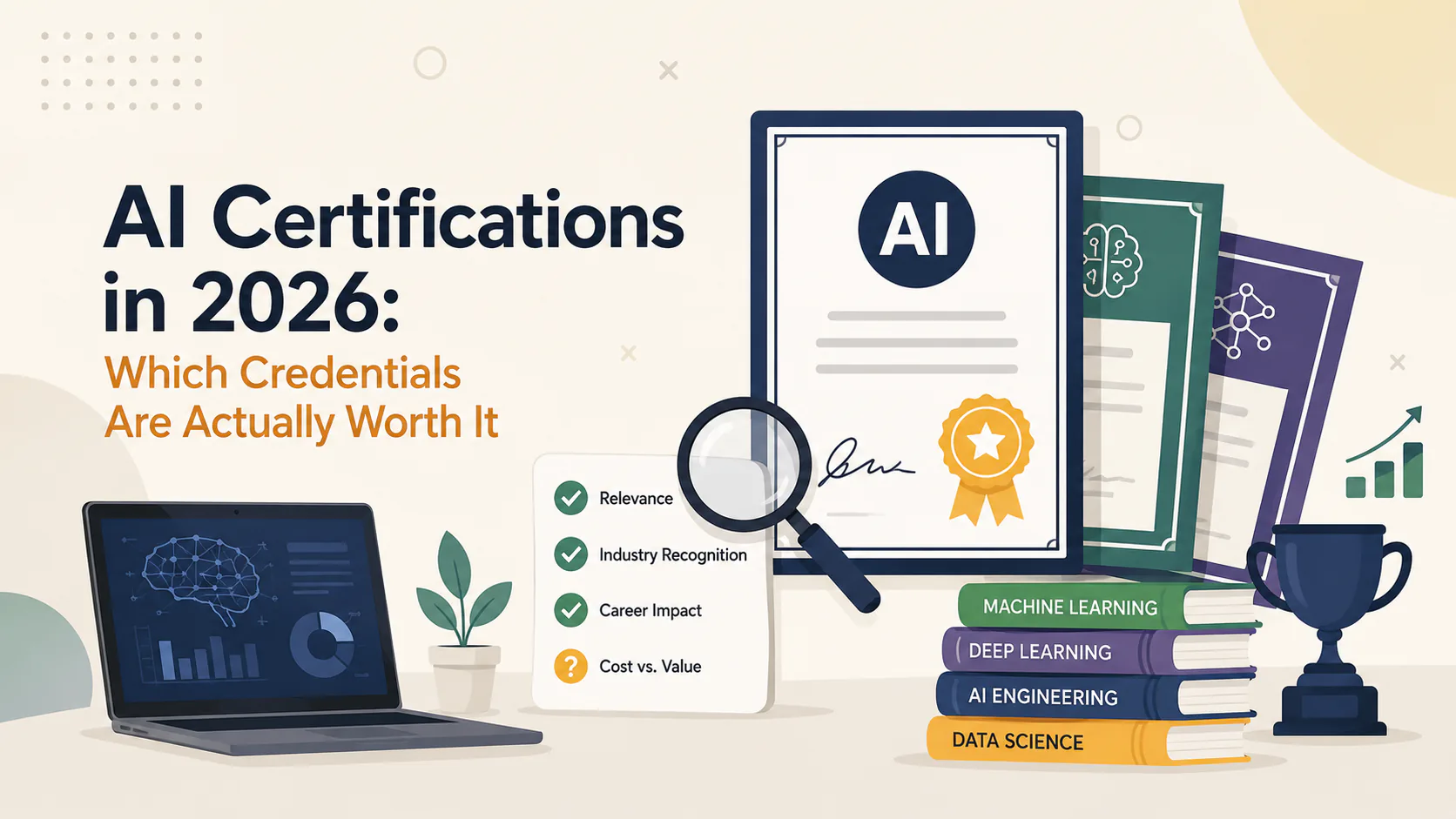
The AI certification market has become a mess. Hundreds of providers now issue credentials, bootcamps sell "AI engineer certificates" after 12 hours of video, and every major cloud platform has launched at least one new badge since 2024. Employers are openly skeptical. Hiring managers at companies like Stripe and Notion have said publicly that a credential without a portfolio is close to worthless.
That does not mean certifications are useless. The right ones still open doors, especially at large enterprises where HR filters require vendor credentials before a resume reaches a human. The wrong ones waste your time and $400.
This article covers the certifications that hiring data and developer community feedback suggest are worth pursuing in 2026, the ones you can skip, and what actually matters more than any badge.
TL;DR: Google's Professional Machine Learning Engineer and AWS's MLS-C01 carry the most weight for ML practitioners. The AWS AI Practitioner (AIF-C01) and Microsoft AI-900 work well as entry-level signals. Vendor-neutral options like the CDAI are gaining traction in enterprise procurement. No certification replaces a portfolio of working AI projects.
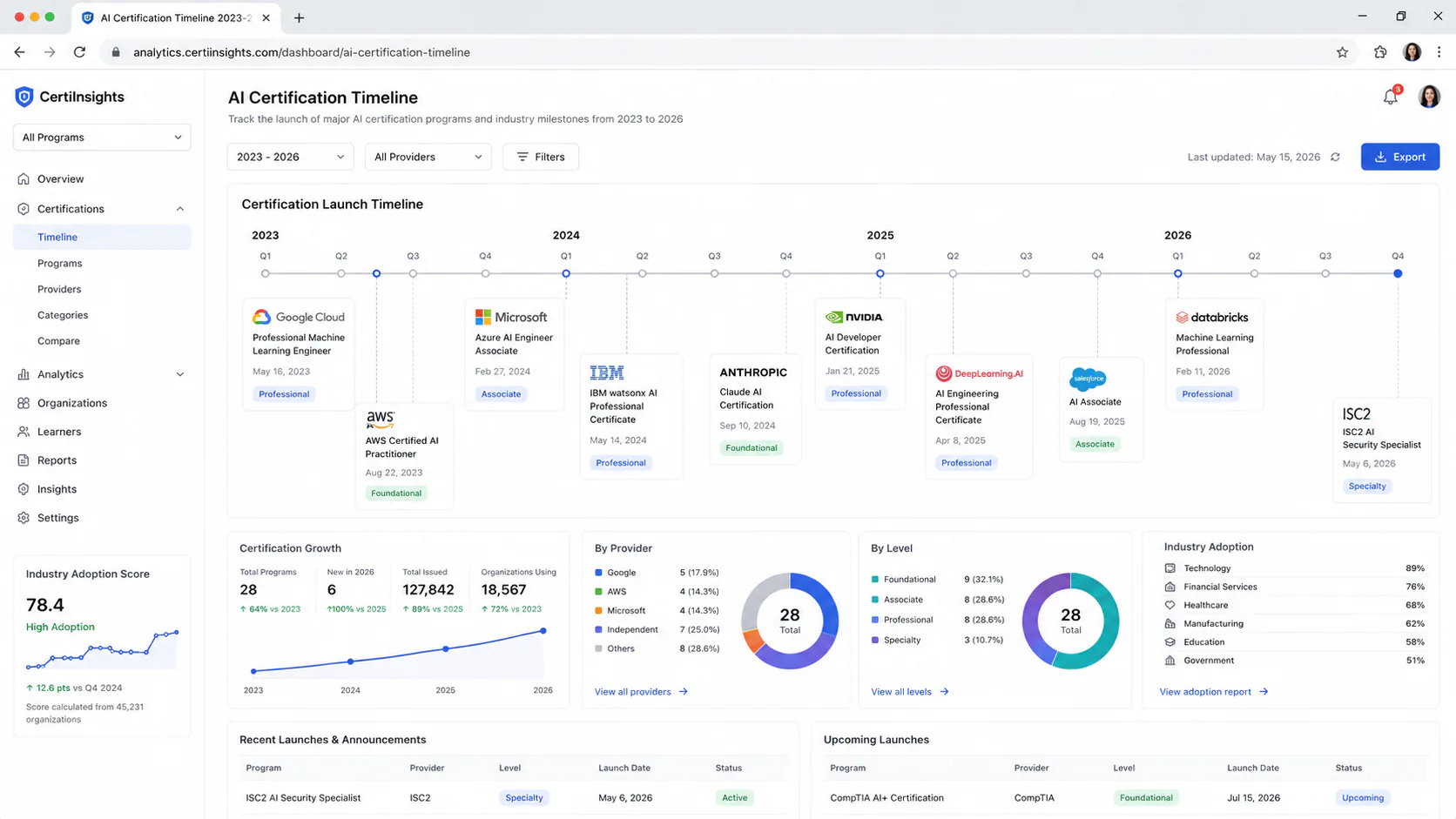
Why the 2026 Market Is Different from 2024
Two years ago, the shortage of AI credentials made any structured training stand out. That gap has closed. According to LinkedIn's 2026 Workforce Confidence Index, "AI and ML skills" is now the most-added credential category on the platform globally, overtaking cloud computing for the first time.
The direct result: credential inflation. Hiring managers at mid-to-large companies now see multiple candidates per role holding the same certificate. The signal value has compressed. What has replaced it as the primary filter is a combination of: the issuer's brand weight, the difficulty of the exam or project, and evidence the candidate has applied the skill to something real.
Three structural shifts define the 2026 landscape.
First, enterprise procurement is driving demand for vendor credentials. Many Fortune 500 IT departments require vendor certifications for internal AI tool deployments, which means the AWS, Google, and Microsoft badges carry purchasing-cycle relevance beyond just hiring.
Second, Anthropic, OpenAI, and Cohere each launched credentialing programs between late 2024 and early 2026. These are still early, but they are gaining traction specifically in the developer community. Being early to a growing credential has historically rewarded people more than joining a saturated one.
Third, the gap between associate-level and professional-level credentials has widened. Entry-level badges (AI-900, AIF-C01, Google's Cloud Digital Leader) have become table stakes at some companies. Professional-level exams (MLS-C01, Google Professional ML Engineer) remain genuinely selective because they require hands-on lab work and real infrastructure knowledge, not just multiple-choice comprehension.
The Credentials Actually Worth Pursuing
Google Professional Machine Learning Engineer
This is the hardest cloud ML credential to earn and the most respected among ML practitioners. The exam covers model training pipelines on Vertex AI, MLOps, feature engineering, and production monitoring. Google requires hands-on lab completions (via Google Cloud Skills Boost) alongside the written exam, which filters out candidates who learned only theory.
Job postings for senior ML engineer roles at Google, Airbnb, and several mid-size AI companies explicitly list this credential. The renewal cycle is two years, so a 2026 pass stays current through 2028. Cost is $200 per attempt.
The right candidate: someone already working in Python and TensorFlow or PyTorch who wants to formalize their cloud ML deployment knowledge. This exam punishes people without real project experience.
AWS Certified Machine Learning Specialty (MLS-C01)
AWS MLS-C01 has been the dominant ML credential for cloud-deployed models since 2019 and it has held its value better than most because AWS updated the exam in late 2024 to include generative AI, SageMaker pipelines, and foundation model fine-tuning via Bedrock. The 2024 revision also raised the pass threshold.
The credential shows up consistently in enterprise job descriptions where AWS is the primary cloud. Teams running inference on SageMaker, building RAG pipelines with Bedrock, or evaluating models in production have used it as a hiring filter for several years. Cost is $300 per attempt.
One honest limitation: MLS-C01 is AWS-specific. If your organization is multi-cloud or Google-first, its signal value drops significantly.
AWS AI Practitioner (AIF-C01)
Launched in September 2024, AIF-C01 is the entry-level AWS credential for AI and ML concepts. It does not require hands-on lab work, but the exam covers generative AI fundamentals, responsible AI, and how AWS AI services (Bedrock, Rekognition, Comprehend, Transcribe) fit together at an architectural level.
For product managers, solutions architects, or developers moving into AI roles who do not have a deep ML background, this is a reasonable first credential. It costs $150 per attempt and the study material is free via AWS Skill Builder.
Do not pursue this if you already have a technical ML background. AIF-C01 will not differentiate you. It is an entry point, not a career accelerator.
Microsoft Azure AI Engineer Associate (AI-102)
AI-102 is the practitioner-level Microsoft credential for building AI solutions on Azure: Azure OpenAI Service, Azure AI Search, Document Intelligence, and Cognitive Services. Microsoft redesigned it in early 2025 to shift emphasis from classic cognitive services to GPT-4o integration and responsible AI implementation.
This credential matters most in Microsoft-centric enterprise environments. If your company is buying Microsoft 365 Copilot Wave 3 or running AI workloads on Azure, AI-102 holders will be handling implementation. For that context, it carries real weight with procurement teams and hiring managers. Cost is $165 per attempt.
AI-900 (the foundational level) has become so common that most mid-level developers should skip it and go directly to AI-102 if Azure is their target environment.
Anthropic's Prompt Engineering and API Certification
Anthropic launched a two-tier credentialing program in Q1 2026: a Prompt Engineering Certificate targeting non-technical users and an API Developer Certificate targeting engineers. The API track covers the Messages API, tool use, computer use, structured outputs, and responsible deployment patterns.
These are new, so long-term hiring signal data does not exist yet. What is clear is that Anthropic is actively promoting the credentials to enterprise customers, and early adopters in Claude-heavy development environments report that interviewers at AI-native companies recognize them. The API Developer Certificate requires passing a practical project evaluation, not just a written exam, which gives it more credibility than a simple multiple-choice badge.
Cost and exam logistics are managed through Anthropic's developer portal. The credential is worth pursuing now if you work primarily with the Claude API. Being in the first cohort of a growing credential has historically been more valuable than joining it once it is saturated.
Certified Data and AI Professional (CDAI) - Vendor-Neutral Option
The CDAI is issued by the Data Management Association (DAMA) and covers AI governance, model risk management, data lineage, and ethical AI deployment rather than a specific cloud platform. It is gaining traction among teams that manage AI in regulated industries (financial services, healthcare, government) where vendor-neutral governance frameworks matter more than specific tool credentials.
This is not for developers building models. It is for AI program leads, data governance specialists, and enterprise architects who need to demonstrate AI risk management competence to auditors and executive stakeholders. The exam is experience-gated: DAMA requires documented professional experience before you can sit. Cost is approximately $395.
If you work in a regulated-industry AI role, the CDAI may matter more than any cloud vendor badge. Outside that context, it is niche.
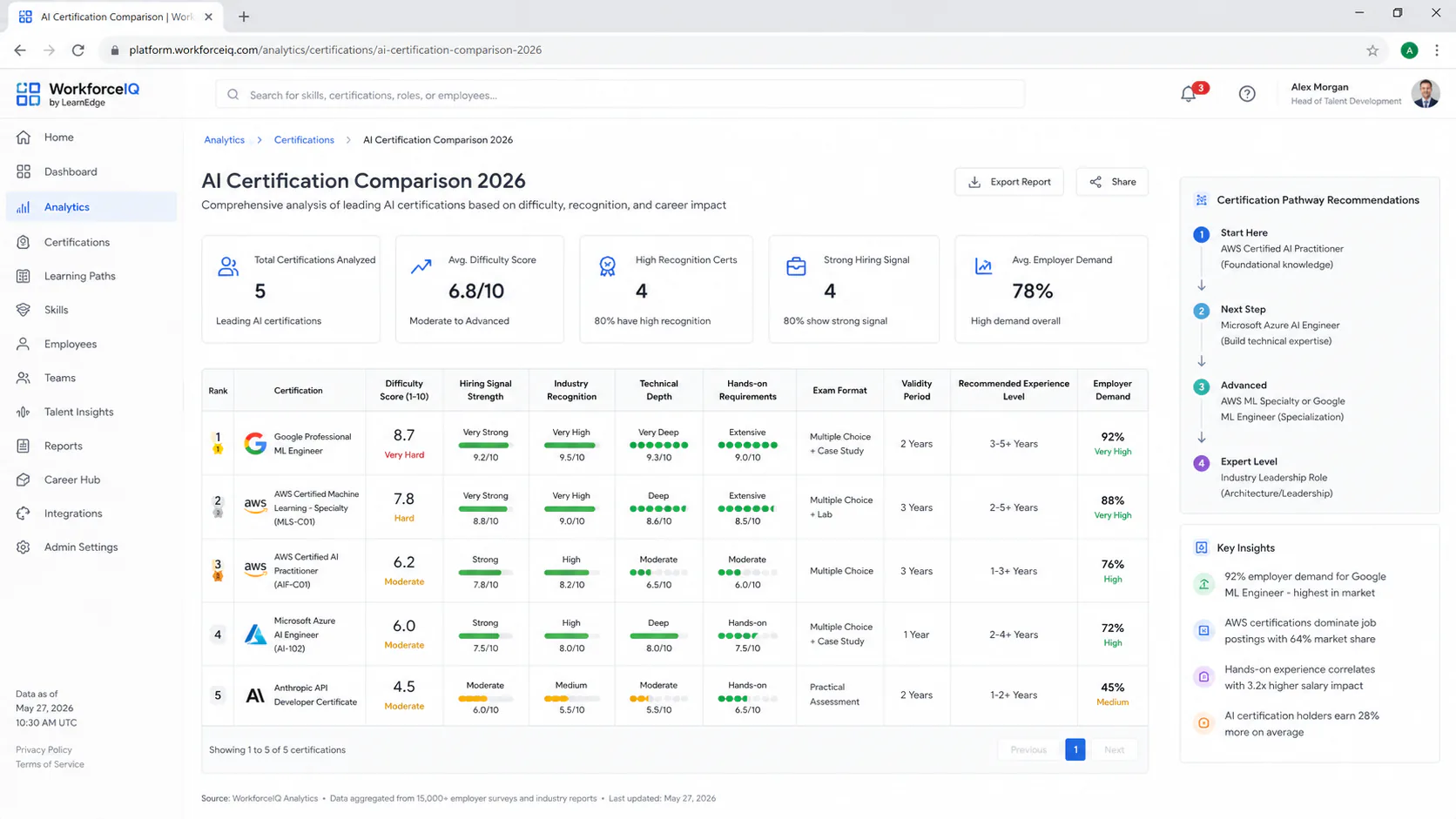
The Full Comparison
| Credential | Issuer | Level | Exam cost | Renewal | Best for |
|---|---|---|---|---|---|
| Professional ML Engineer | Google Cloud | Advanced | $200 | 2 years | ML engineers on Vertex AI / GCP |
| AWS MLS-C01 | AWS | Advanced | $300 | 3 years | ML engineers on AWS / SageMaker |
| Azure AI Engineer (AI-102) | Microsoft | Intermediate | $165 | 1 year | Azure-centric AI developers |
| AWS AI Practitioner (AIF-C01) | AWS | Foundational | $150 | 3 years | Non-ML professionals entering AI |
| Anthropic API Developer Certificate | Anthropic | Intermediate | Varies | TBD | Claude API developers |
| CDAI | DAMA | Advanced | $395 | 3 years | AI governance in regulated industries |
| Azure Fundamentals (AI-900) | Microsoft | Foundational | $165 | None | Absolute beginners; skip if mid-level |
| Google Cloud Digital Leader | Foundational | $200 | 3 years | Business/product roles, not technical |
Credentials You Can Skip
Coursera and edX "AI Professional Certificates": These are useful learning resources. They are not professional credentials. Hiring managers at technical companies know exactly what these programs are, and a Coursera completion badge does not carry the same weight as a proctored vendor exam. Use them to learn, but do not list them as credentials on a resume alongside AWS or Google certifications.
Bootcamp-issued AI engineer certificates: An increasing number of coding bootcamps issue their own AI Engineer Certificate after a 4-12 week program. Some programs are good; the certificates they issue are not independently verifiable, have no standardized curriculum, and no third-party examination. They mean different things at different institutions. Employers know this.
AI-900 if you have any ML background: Microsoft's AI Fundamentals cert has become so common that it signals very little above the foundational level. If you already know Python and have built anything with a language model, spend the same time studying for AI-102 instead.
OpenAI's early certifications: As of mid-2026, OpenAI's credential offerings are still maturing. The programs exist but the hiring signal is inconsistent. Check current status before investing time; this may change by late 2026.
What Actually Matters More Than Any Certification
No credential compensates for an empty portfolio. This is not a contrarian opinion; it is what hiring managers at technical companies consistently report when asked how they evaluate AI candidates.
The portfolio items that carry the most weight are concrete and specific: a RAG pipeline you built and deployed, a fine-tuned model with documented evaluation results, a production application that uses LLM APIs under real load. These demonstrate the things certifications cannot test: judgment, debugging instinct, and the ability to make working systems rather than answer exam questions.
The most credible AI candidates in 2026 combine one or two vendor certifications with a GitHub repository or demo environment that shows what they built. The certification provides a searchable, filterable signal in applicant tracking systems. The portfolio closes the deal.
If you are choosing between spending 80 hours on a certification and 80 hours building something with the Claude API, a Bedrock pipeline, or a Vertex AI deployment, build the thing first. Then certify.
For developers who want to understand how AI tooling fits into production environments, our AI security tools for developers guide covers what the deployment context actually looks like. And if you are evaluating which AI coding assistant to pair with your learning path, the self-hosted AI coding tools overview covers options for teams with data residency constraints.
Why It Matters Now
The AI certification market is going to look different in 18 months. Credentials that are genuinely selective today may become table stakes by late 2027 if the volume of certified professionals keeps growing at the current pace. The practical implication: the time to earn a professional-level credential is before the cohort is large enough to make it unremarkable.
Google Professional ML Engineer and AWS MLS-C01 are the two credentials with the clearest track record and the highest ongoing selectivity because they require genuine hands-on knowledge, not just exam prep. If you have the background for either one, the credential still differentiates in 2026. AIF-C01 and AI-102 work as entry-level signals for non-ML professionals or Azure-centric developers.
Skip anything that is not externally proctored, not tied to demonstrated skills, or issued by a provider whose name HR departments will not recognize. The market for impressive-looking certificates that do not prove much is large and growing. The market for credentials that actually tell an employer something useful is smaller, which is exactly why it is still worth investing in the right ones.
Frequently asked questions
Google's Professional Machine Learning Engineer and AWS MLS-C01 are the strongest signals for ML practitioner roles because both require hands-on lab work and have established hiring track records. For entry-level or career-change candidates, AWS AIF-C01 or Azure AI-102 are more accessible starting points. No certification replaces a portfolio of working AI projects.
Yes, for non-technical professionals or developers new to AI who want a structured entry point into the field. It is not worth pursuing if you already have ML or LLM development experience, since the exam covers foundational concepts rather than implementation depth. At $150, it is the cheapest AWS credential and the study material on AWS Skill Builder is free.
Both matter, but for different reasons. Certifications help you pass automated resume filters at larger companies. Portfolios close the hiring decision. Candidates who combine a recognized vendor credential with concrete project work (a deployed RAG app, a fine-tuned model, a production integration) consistently outperform those who hold credentials without demonstrable work. Build first, certify second if you have limited time.
Potentially yes, especially if you build primarily with the Claude API. The credential is new as of Q1 2026, so long-term hiring signal data is limited. It requires a practical project evaluation rather than a multiple-choice exam, which gives it more credibility than most entry-level badges. Being early to a growing vendor credential has historically paid off more than joining after saturation sets in.
Most candidates with a working ML background report 60-100 hours of dedicated preparation. Google requires completion of specific lab paths on Google Cloud Skills Boost before you can sit for the exam. The exam itself is 2 hours, multiple sections, with a $200 exam fee. Google recommends at least three years of industry experience before attempting it.