Self-Hosted AI Coding Tools for Regulated Teams (2026)
The best self-hosted and air-gapped AI coding tools for regulated teams in 2026: Tabnine, Continue.dev, Cody, GitLab Duo, and the models to run them.

Bytewaves Score Card
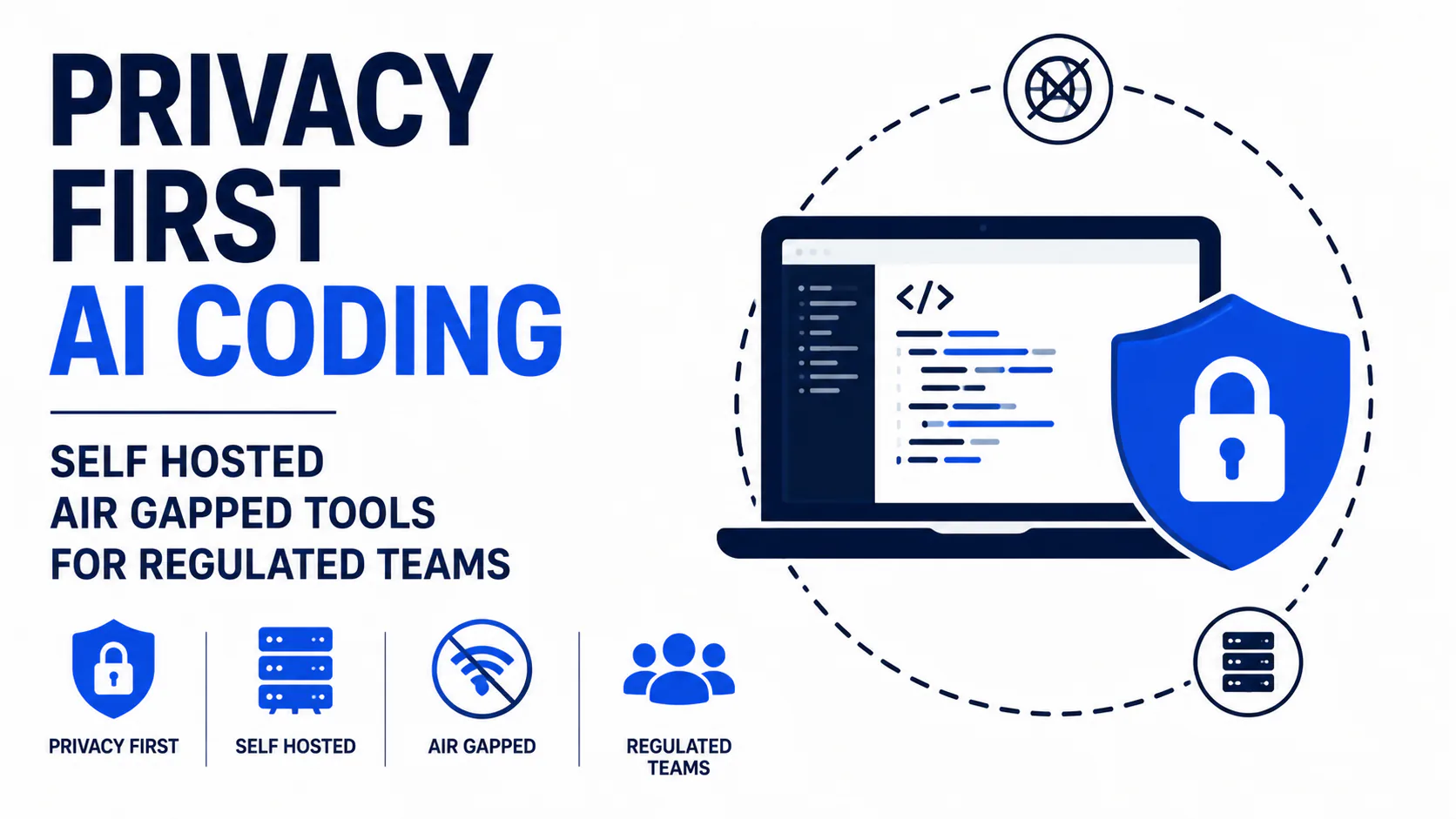
When a developer's IDE sends a code snippet to a cloud API for completion, is that a data transfer? Regulators and CISOs increasingly say yes. For teams building software in healthcare, defense, financial services, and government, that question has a concrete answer in the compliance frameworks they operate under.
GitHub Copilot and Cursor are the dominant tools for most developers. They are also off the table for engineers working on EHR integrations, defense contracts, trading algorithms, and federal systems. The productivity gains from AI coding assistants are now quantified at 20-45% in early enterprise deployments. Regulated teams that can't access these tools fall further behind every quarter.
The self-hosted AI coding landscape in 2026 has matured to the point where "can we do this?" is no longer the question. The question is which stack to build, which models to run, and what the real performance and operational trade-offs are before you commit to the infrastructure.
TL;DR: For most regulated teams, Continue.dev (Apache 2.0, free) paired with a self-hosted Qwen3-Coder or Codestral inference server is the best starting point. Tabnine Enterprise is the right choice when you need a vendor-backed SOC 2 audit trail and zero-training guarantee. True air-gap deployments (SCIF, IL5/IL6) require AirgapAI or a fully custom vLLM stack fronted by the Bifrost gateway.
The four deployment postures: where code actually goes
Before evaluating any tool, you need to be precise about your deployment requirement. There are four distinct postures, and the compliance boundary between them matters more than any feature comparison.
SaaS cloud (GitHub Copilot standard, Cursor, Windsurf): Code and prompts transit the vendor's infrastructure. User interactions may be used for model training unless you opt out. Fast to set up, not suitable for regulated code. This is the default for most developers and the option most CISOs block.
VPC-isolated customer-cloud (OutcomeOps, custom Terraform patterns): The vendor's platform deploys into your AWS or Azure account. No data transits the vendor's systems. Compute, audit logs, and encryption keys stay in your VPC. This is compliant for most organizations already operating in HIPAA-ready AWS, FedRAMP GovCloud, or SOC 2-scoped infrastructure.
On-premises self-hosted (Tabnine Enterprise, Cody self-hosted): The application and AI models run on hardware your organization owns. No external network calls of any kind. This suits organizations with existing on-prem GPU investment and teams in classified-adjacent environments.
True air-gap (Tabnine SCIF tier, AirgapAI): No network path to the outside world exists. Every model weight, dependency, and update package arrives via physical media. Mandatory for DoD IL5/IL6 classification levels and SCIF environments. The operational overhead is the highest of any option, and the performance trade-offs are the steepest.
The distinction between "isolated" and "air-gapped" is legally material under several frameworks. For ITAR-controlled work, cloud providers with international operations introduce foreign person exposure risk regardless of their contractual assurances. An air-gapped deployment resolves this by construction.
The models worth running locally in 2026
The model you choose shapes the performance ceiling of your self-hosted stack. Licensing matters as much as benchmarks here: the Meta Community License has a monthly active user clause and a competitor restriction that requires legal review for commercial deployments at scale. Most regulated enterprise legal teams default to MIT or Apache 2.0 to avoid that complexity.
The strongest options as of June 2026, sorted by use case:
For agentic multi-file coding tasks:
- Kimi K2.6 (Moonshot AI, Modified MIT): 58.6 on SWE-Bench Pro; leads open-source coding benchmarks. Modified MIT requires review but is more permissive than Meta's license.
- Qwen3-Coder-Next (Alibaba, Apache 2.0): 80B total / 3B active MoE; comparable agentic performance to Claude Sonnet on coding tasks at dramatically lower active-parameter cost.
- GLM-5.1 (Zhipu AI, MIT): 200K context window, 58.4 SWE-Bench Pro (self-reported); strong for agentic coding with long repository context.
For IDE autocomplete and completion speed:
- Codestral 22B (Mistral): Fill-in-the-middle (FIM) optimized; the best pure autocomplete model for local inference. Pairs directly with Continue.dev's FIM configuration.
- Devstral Small 24B (Mistral, Apache 2.0): Best performance-to-hardware ratio for agentic multi-file editing on modest hardware. Runs on a single A100 80GB at Q4 quantization.
For batch processing and long-document analysis:
- DeepSeek V4-Flash (DeepSeek, MIT): 284B total / 13B active MoE; 1M token context window; the strongest option for summarization, extraction, and long-context code analysis tasks. For a full breakdown of its benchmarks and pricing, see our DeepSeek V4 review.
Export control note: Using models from Chinese labs (DeepSeek, Qwen, Kimi, GLM) in defense or ITAR contexts requires legal analysis of EAR applicability to open-weight model weights. This is an evolving area without settled guidance. Consult your legal counsel before deploying any Chinese-origin model on ITAR-controlled systems.
Hardware requirements to plan for:
At Q4_K_M quantization, a 70B parameter model requires approximately 40GB of VRAM, achievable on a 2x NVIDIA A100 80GB configuration. Consumer hardware (RTX 3090 or 4090 with 24GB VRAM) comfortably runs Qwen3-Coder-32B at Q4 quantization for individual developer workstations. The minimum viable self-hosted team deployment requires 2-4 A100 80GB GPUs, representing $80,000-$200,000 in capital expenditure before operational costs.
The inference serving layer: vLLM, Ollama, and the rest
Your model choice is only half the stack. You also need a serving layer that handles concurrent requests, manages GPU memory, and in some cases logs every request for compliance purposes.
Developer IDE (VS Code / JetBrains)
        │
 IDE Extension (Continue.dev / Tabnine / Cody)
        │
 [Optional] AI Gateway (Bifrost / TrueFoundry)
   Audit logging, rate limiting, guardrails
        │
Inference Server (vLLM / Ollama / llama.cpp)
        │
Open-Weight Model (Qwen3-Coder / Codestral /
     DeepSeek V4-Flash / Devstral)
        │
On-Prem GPU / Air-Gapped Hardware
Ollama: Single-command local LLM serving; the most accessible entry point. Supports Qwen, DeepSeek, Codestral, and hundreds of models via GGUF format. The right choice for individual developer workstations. Limited production throughput for team deployments.
vLLM: Production-grade serving with PagedAttention for high-throughput inference. The standard for team-scale on-prem deployments. Requires DevOps experience to configure and tune; not a one-command install.
llama.cpp: C++ inference engine optimized for CPU and Apple Silicon. Core of Ollama's backend. Enables air-gapped hardware that lacks NVIDIA GPUs. Essential for SCIFs and industrial control environments where GPU procurement is restricted.
LM Studio: GUI for local model management; useful for enterprise desktop deployments without significant DevOps overhead. Good for piloting before committing to a production vLLM setup.
Text Generation Inference (TGI): Hugging Face's production inference server. Tight integration with the Hugging Face model registry makes model updates straightforward in non-air-gapped environments.
For regulated environments processing sensitive requests, add Bifrost (Maxim AI, Apache 2.0) as an AI gateway layer between every internal application and your local inference servers. It adds 11 microseconds of overhead at 5,000 RPS, provides immutable audit logs, and maps to FedRAMP High, IL5/IL6, CMMC, ITAR, HIPAA, SOC 2 Type II, and ISO 27001 evidence requirements. This single component answers more audit questions than any individual tool can.
The IDE tools: what runs in the editor
This is the layer developers actually interact with. Each tool takes a different approach to the compliance problem.
Continue.dev
Apache 2.0, free, and the most-installed VS Code AI extension with more than 30 provider integrations. You bring your own model: Claude, GPT-4, or any local Ollama/LM Studio instance running Codestral, DeepSeek-Coder, or Qwen Coder. Air-gapped operation works out of the box when configured against a local inference endpoint. No subscription, no vendor data agreement; you manage your API keys and provider costs.
The catch is setup friction. Getting Continue.dev to a production-quality local configuration requires you to choose a model, stand up an inference server, and configure the extension. For teams with DevOps capacity, this is a one-time investment with a permanent payoff. For teams without it, the setup cost is real.
Tabnine Enterprise
The privacy-certified enterprise choice. Zero external network calls, verified by CISO-level traffic analysis on Kubernetes deployments. Zero training on customer code, confirmed by SOC 2 Type II auditors. Fully self-hosted and air-gapped deployment tiers are available. Custom model training on the organization's private codebase is Tabnine's most meaningful enterprise differentiator.
The tradeoff is suggestion quality. Testing consistently finds Tabnine's self-hosted model "correct but less creative and less contextually aware" compared to Claude or GPT-4o-powered tools. If you need a vendor who can stand behind a compliance attestation, Tabnine at $39+/user/month is the clearest answer. If suggestion quality is the primary criterion, the local-model options close the gap.
Sourcegraph Cody Enterprise
Self-hosted deployment with bring-your-own-LLM support, including local models via OpenAI-compatible endpoints. Cody's genuine differentiator is cross-repository context: it indexes entire monorepos with relationship mapping across functions, types, modules, and APIs. That depth of context produces meaningfully better answers for large, complex codebases than file-scoped tools.
The compliance asterisk: Cody Enterprise's code search and indexing runs on your self-hosted Sourcegraph instance, but generation by default routes to cloud AI models. For a true on-prem setup, you need to configure Cody to route to your local inference server, which not all teams do by default. At $59/user/month, it's the most expensive option in this comparison.
GitLab Duo Self-Hosted
General availability since February 2025. Supports on-premises, private cloud, AWS Bedrock, and Azure OpenAI deployment. The compelling case for GitLab Duo is native DevSecOps integration: code suggestions, security scanning, and vulnerability explanations exist inside the same platform as CI/CD, issue tracking, and merge request workflows. For teams already on self-managed GitLab, the incremental cost of adding Duo self-hosted is lower than deploying a separate AI coding tool.
Tabby
Fully open source, Apache 2.0, community-maintained. Run on your own hardware with a model of your choice. Lightweight and appropriate for teams with existing on-prem hardware but limited DevOps capacity. Community support only; limited documentation relative to commercial options. The right answer for budget-constrained teams willing to invest time over money.
Real-world patterns by compliance framework
Healthcare (HIPAA / HITRUST)
HIPAA's "minimum necessary" principle and BAA requirements make any cloud API a compliance discussion when code touches PHI. The practical pattern for most healthcare software teams in 2026: customer-cloud deployment (OutcomeOps or custom Terraform) in a HIPAA-ready AWS VPC, with Continue.dev in VS Code configured to route to an internal vLLM endpoint running DeepSeek V4-Flash. Audit logs go to DynamoDB; CloudWatch provides anomaly detection; VPC Flow Logs confirm no egress to non-approved endpoints.
Financial Services (GLBA / NYDFS / FFIEC)
Non-public financial information in source code (trading algorithms, risk models, customer identifiers) cannot transit external APIs under the FTC Safeguards Rule and GLBA. Banks under SR 11-7 model risk guidance face additional scrutiny for any AI system that generates or modifies code used in production models. The preferred pattern: on-premises GPU cluster running Tabnine Enterprise (for the SOC 2 audit trail and zero-training guarantee) or Cody self-hosted with a local inference server. Model license preference is MIT or Apache 2.0 to avoid the Llama MAU clause.
Defense and Government (FedRAMP / CMMC / ITAR)
The hardest deployment context. Classified program work under DoD IL5/IL6 or in SCIFs requires zero external connectivity. Tabnine on-prem and AirgapAI (SCIF-certified and nuclear facility-certified) are the realistic commercial options. For teams building custom stacks: vLLM or llama.cpp serving a quantized 70B model on an on-prem GPU cluster, fronted by Bifrost as the internal AI gateway. Model weights and updates arrive via air-gapped media on a formal change management cadence. For defense industrial base teams under CMMC Level 2/3, Continue.dev paired with Codestral 22B on local inference is a defensible, cost-efficient starting point.
The performance gap: what you're trading for privacy
The research finding here is clear and doesn't soften with optimism: locally deployed models deliver roughly 40-55% of cloud model performance on complex tasks as of mid-2026. "Correct but less creative and less contextually aware" is how multiple independent testers characterize Tabnine's self-hosted model. Kimi K2.6 at 58.6 SWE-Bench Pro and Qwen3-Coder lead the open-source field but still trail Claude Opus 4.7 and GPT-5.5 on the hardest agentic benchmarks.
For routine autocomplete, the gap is smaller and less consequential. For multi-file agentic tasks (the fastest-growing use case, growing at 52.1% CAGR through 2034), the gap is real and affects daily throughput. Teams migrating from Cursor or GitHub Copilot should plan for a productivity adjustment period and reset expectations on agentic task complexity.
The positive trend: this gap is narrowing. DeepSeek V4-Flash already undercuts all frontier cloud models on price while approaching frontier performance on many common coding tasks. By 2027-2028, the performance gap for typical coding workloads may be negligible. The teams that build on-prem infrastructure now will be positioned to upgrade models without switching tooling when that closes.
Pricing and total cost of ownership
The cost comparison is not as straightforward as per-seat pricing suggests. Two calculus points matter:
The fixed-cost floor. A minimum viable team deployment requires 2-4 NVIDIA A100 80GB GPUs at $80,000-$200,000 in capital plus operational costs. Amortized over three years across a team of 50 developers, this compares favorably to Tabnine Enterprise at $39/user/month ($23,400/year) or Cody at $59/user/month ($35,400/year). The crossover point depends on team size and usage volume.
The variable-cost elimination. Self-hosted inference eliminates per-token API costs entirely. For high-volume engineering teams running agentic workflows that consume tens of millions of tokens per month, this is the single most significant financial argument for on-prem. Continue.dev and Tabby are free; you pay only for hardware and electricity.
| Tool | Deployment | Air-Gap | License | Key Strength | Price |
|---|---|---|---|---|---|
| Continue.dev | Local / BYOM | Yes | Apache 2.0 | Free; 30+ model integrations | Free + compute |
| Tabby | On-prem | Yes | Apache 2.0 | Fully open source | Free + compute |
| Tabnine Enterprise | On-prem, air-gap | Yes | Proprietary | SOC 2 Type II verified; zero training | $39+/user/month |
| Sourcegraph Cody | Self-hosted | Partial | Proprietary | Cross-repo code graph context | $59/user/month |
| GitLab Duo Self-Hosted | On-prem / private cloud | Partial | GitLab EE | Native DevSecOps integration | GitLab EE pricing |
| OutcomeOps | Customer-cloud (AWS) | No | Proprietary | VPC isolation; Terraform-native | Enterprise |
| AirgapAI | On-prem, SCIF | Yes | Proprietary | SCIF-certified; 2,800+ workflows | Enterprise |
Pros and cons
Pros
- Zero data exfiltration is a structural guarantee, not a contractual one. Code that never leaves your network cannot leak through a vendor breach or misconfiguration.
- Open-weight models under MIT and Apache 2.0 licenses eliminate vendor lock-in. You can swap models, fine-tune for your domain, and upgrade independently of your tooling vendor.
- At team scale, fixed hardware costs amortized over years undercut SaaS per-seat pricing. The larger the team and the higher the usage, the better on-prem economics look.
- Data residency compliance is trivially satisfied. No EU GDPR DPA, no NYDFS geographic restriction, no ITAR foreign person risk analysis required when the model runs on your hardware.
- Offline operation is a side benefit that matters in OT and industrial environments where network maintenance windows are scheduled and non-negotiable.
Cons
- Self-hosted models deliver 40-55% of cloud frontier model performance on complex tasks. That gap is real, quantified, and should factor into any productivity projection.
- The minimum viable team deployment costs $80,000-$200,000 in GPU hardware before software and operational costs. That capital requirement eliminates this option for smaller organizations.
- DevOps overhead is significant. GPU infrastructure management, model versioning, inference server tuning, and air-gapped update pipelines require expertise that most engineering teams don't have in-house.
- Air-gapped update delivery requires physical media transfer, change management processes, and model versioning discipline that SaaS tools handle automatically. This is an ongoing operational cost, not a one-time setup.
- Several tools marketed for regulated industries process AI requests in the cloud even when indexing is local. Verify your vendor's architecture in detail. "Self-hosted" in marketing materials does not always mean what CISOs assume.
Who should build a self-hosted AI coding stack
Build it if:
- Your team operates under HIPAA, ITAR, FedRAMP High, CMMC Level 2/3, or similar frameworks where source code is a regulated data asset.
- You have 30 or more developers and existing on-prem GPU infrastructure or a credible plan to procure it.
- Your legal team has reviewed and rejected the vendor data processing agreements for cloud AI coding tools.
- You're operating in a defense or government context where cloud connectivity to commercial vendors is prohibited by policy.
Skip it if:
- You're under 20 developers; the capital cost and DevOps overhead won't yield positive ROI at that scale.
- Your compliance posture allows for cloud tools with appropriate contractual controls (GitHub Copilot Enterprise with content exclusion, for example).
- You don't have a DevOps engineer or ML engineer who can own the inference infrastructure on an ongoing basis. A self-hosted stack that isn't maintained degrades quickly.
- Agentic multi-file coding is your primary use case and you can't close the performance gap with frontier models, which currently top at 88.6% on SWE-bench versus the open-source field's 58-61%.
For deeper integration of AI coding agents into your CI/CD pipeline once the foundation is in place, see our guide to guardian agents in CI/CD for regulated teams.
Is the investment worth it in 2026?
For regulated teams, the question is not whether to self-host AI coding tools. The question is when and how. The compliance frameworks make the decision; the tooling makes it viable.
The ecosystem maturity in mid-2026 is real. Continue.dev, Tabnine Enterprise, and vLLM have all crossed the threshold from promising to production-ready. The model landscape has a genuine choice of capable, permissively licensed options at multiple hardware tiers. Bifrost closes the audit-log gap that prevented many compliance teams from signing off on any AI coding tool, regardless of deployment model.
The performance gap is the honest constraint. You should plan for it, budget realistic productivity targets around it, and build model upgrade cycles into your infrastructure roadmap. The teams that start now will be running better models on the same infrastructure in 12 months, and those that wait will start that clock later.
For a direct comparison of the open-weight models available to run in these stacks, see our Muse Spark vs DeepSeek V4 open-weight model comparison.
Frequently asked questions
Yes. Configure Continue.dev to point to a local Ollama or vLLM instance running on the same machine or internal network, and the extension makes zero external network calls. You manage model weights manually. For true air-gap environments, download the model files on a networked machine and transfer them via approved media. No Continue.dev subscription or cloud account is required.
Tabnine holds SOC 2 Type II certification, which covers security, availability, and confidentiality controls. SOC 2 Type II is not the same as HIPAA authorization or FedRAMP authorization; it does not grant either. For HIPAA deployments, Tabnine can sign a BAA and its on-prem deployment eliminates the data-transit risk. For FedRAMP High or IL5/IL6, verify current authorization status directly with the vendor before procurement, as "FedRAMP in progress" is not the same as "FedRAMP authorized."
For a single developer workstation, an RTX 3090 or RTX 4090 with 24GB VRAM runs Qwen3-Coder-32B or Devstral Small 24B at Q4 quantization. For a shared team inference server handling concurrent requests, a minimum of two NVIDIA A100 80GB GPUs provides adequate throughput for small teams. Teams with CPU-only hardware can run smaller models (7B-14B) via llama.cpp, but the capability trade-off is significant.
If you self-host the weights (MIT license) on your own infrastructure, no data transits DeepSeek's servers. That resolves the data-residency concern for most frameworks. However, for US defense and ITAR contexts, running model weights developed by a Chinese lab requires legal analysis of EAR applicability. There is no settled regulatory guidance on this as of mid-2026. Non-US organizations in healthcare and finance generally face fewer restrictions on Chinese-origin model weights and are actively deploying them.
A basic Continue.dev plus Ollama setup on a developer workstation takes under an hour once hardware is in place. A production team deployment with vLLM, a compliance-grade AI gateway like Bifrost, audit logging, and a fine-tuned model pipeline typically takes two to four weeks for a team with DevOps experience. A SCIF-grade air-gapped deployment with formal change management processes can take two to three months from initial design to operational sign-off.