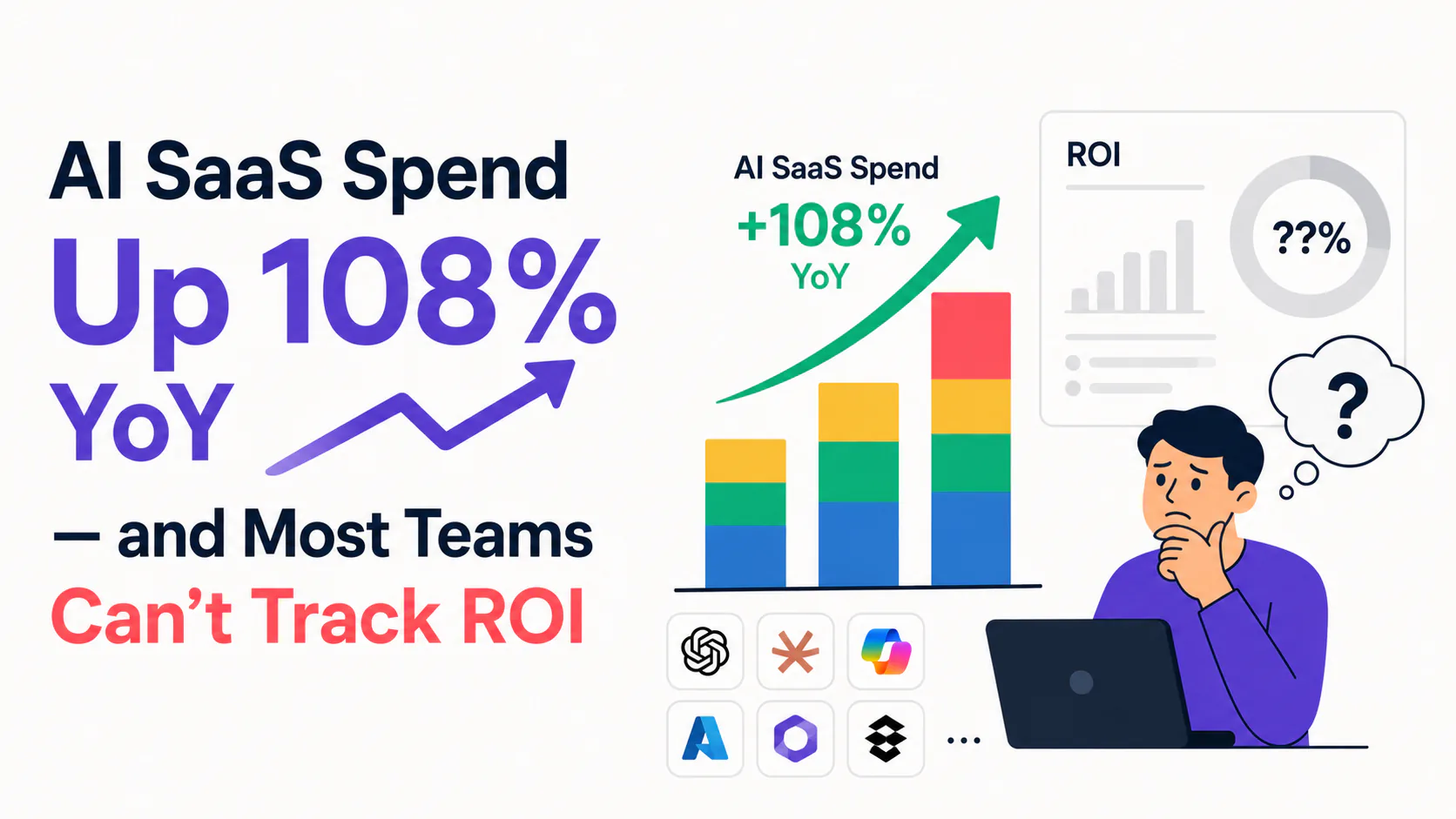
AI SaaS Spend Up 108% YoY and Most Teams Can't Track ROI
AI-native SaaS spend jumped 108% YoY - yet 72% of enterprises are destroying value through waste. Here's what the data shows and how to fix it.

Your AI budget doubled last year. Your board wants proof it's working. Most finance teams have neither the tools nor the framework to give them an answer.
That's not a prediction - it's the current state. Zylo's 2026 SaaS Management Index found AI-native SaaS spend jumped 108% year over year across enterprise, with large enterprises logging a staggering 393% increase in a single year. Average annual spend on AI-native apps now sits at $1.2 million per organization. Yet 72% of enterprises, according to the Larridin State of Enterprise AI report, are actively destroying value through waste - and only 28% of global finance leaders say they can point to clear, measurable returns.
The pattern is consistent across every data source: AI spending is accelerating faster than the organizational infrastructure to govern it. Here's what the numbers actually say, why traditional SaaS management fails for AI workloads, and what the companies handling this well are doing differently.
Key stat: 98% of FinOps teams now manage AI spend, up from 31% just two years ago. The discipline is being rewritten in real time.
The 108% surge is only part of the story
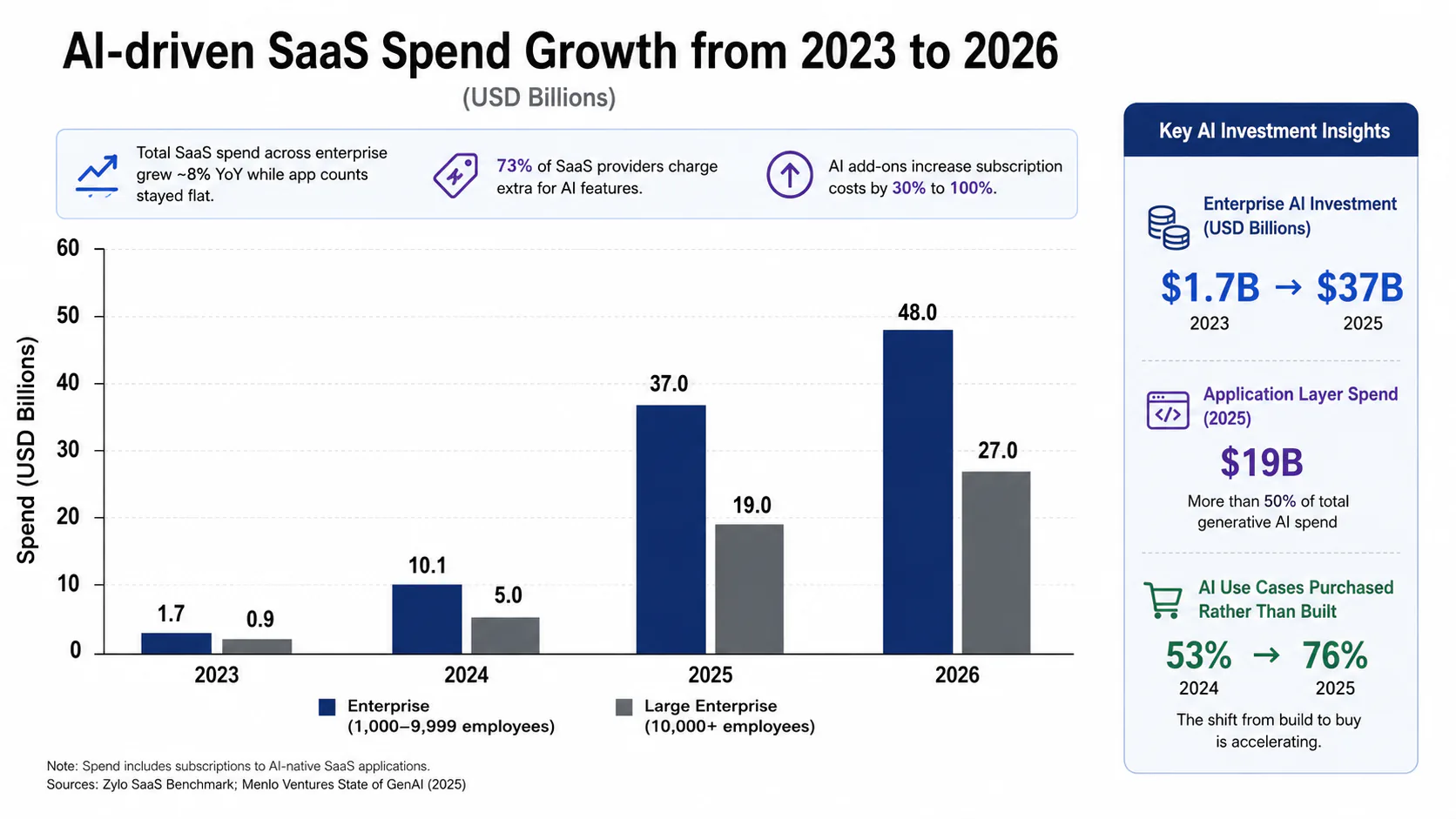
The top-line number from Zylo's index is striking, but the underlying data tells you more. Total SaaS spend across enterprise grew roughly 8% year over year while app counts stayed flat. AI is what's moving the budget needle - not new tools, not seat expansion. The cost per tool is climbing because AI features either add a new line item or reprice the existing subscription at a premium.
73% of SaaS providers now charge extra for AI features, with some AI add-ons boosting subscription costs by 30 to 100% on top of existing contracts. Procurement teams often don't catch this until renewal. By then, the usage is baked in and switching costs are real.
The Menlo Ventures State of GenAI report puts the macro numbers in context: enterprise AI investment has grown from $1.7 billion in 2023 to $37 billion in 2025. The application layer alone captured $19 billion - more than half of all generative AI spend. And 76% of AI use cases are now purchased rather than built internally, up from 53% the prior year. The shift from build to buy is accelerating at exactly the moment that pricing models are getting harder to predict.
Why consumption-based pricing breaks traditional budgeting
For roughly two decades, enterprise software was priced per seat. You bought 500 licenses. You knew your annual cost on day one. SaaS made budgeting predictable.
AI has replaced that model with tokens, API calls, conversations, and outcomes - all of which fluctuate based on usage intensity. A team that doubles its use of an AI coding assistant doesn't pay twice as much on a per-seat model. On a consumption model, they might pay four times as much, or ten, depending on the complexity of the prompts and the size of the codebase being indexed.
78% of IT leaders in Zylo's survey reported unexpected charges from AI pricing models. That's not a billing dispute - that's a structural mismatch between how enterprises budget and how AI tools price.
The failure mode is consistent: a company signs an AI contract with generous pilot credits, rolls out to a few thousand employees, and receives an invoice six times the budgeted amount because token consumption at production scale was never modeled. The 2025 State of FinOps report calls this a distinct and growing category of budget incident.
Capgemini's cloud economist Jez Back describes the dynamic plainly: "When you add AI and consumption-based pricing, we're talking about more budget volatility and pressure on in-year spend, which kills innovation. Organizations are now incurring more unexpected charges and must start looking at their governance model in a different way."
The FinOps Foundation has taken note. Tracking SaaS spending is now a top-3 task for FinOps professionals, and 98% of FinOps teams manage AI spend - up from 31% two years ago. Pre-deployment architecture costing is the number-one missing capability teams are asking vendors to provide: the ability to model costs before infrastructure commitments, not after the invoices arrive.
The ROI measurement gap has board-level consequences
Tracking adoption is not the same as tracking return.
Most organizations measure AI deployment by adoption rates, active users, prompts sent, and logins. These are activity metrics. They tell you the tool is being used. They don't tell you whether it's generating value. According to the High Alpha 2025 SaaS Benchmarks Report, over one-third of companies still lack any formal AI measurement framework, and fewer than 25% use KPIs or dashboards to quantify AI impact.
KPMG research found that for 90% of organizations, investor pressure to demonstrate AI ROI is now considered "important or very important" - a sharp jump from 68% just one quarter earlier. Boards are asking questions that most internal teams can't yet answer.
The accountability gap shows up in practical terms. Revenium's FinOps commentary puts the problem precisely: "Cost per token is an infrastructure metric. Cost per outcome is an economic metric. Most organizations are still guessing in the space between those two numbers."
SAP forecasts that average AI returns will rise from 16% today to 31% within two years for organizations that align technology investments with measurable outcomes. The operative phrase is "measurable outcomes." The delta between 16% and 31% isn't a product difference - it's a measurement infrastructure difference.
Shadow AI is making governance harder, not easier
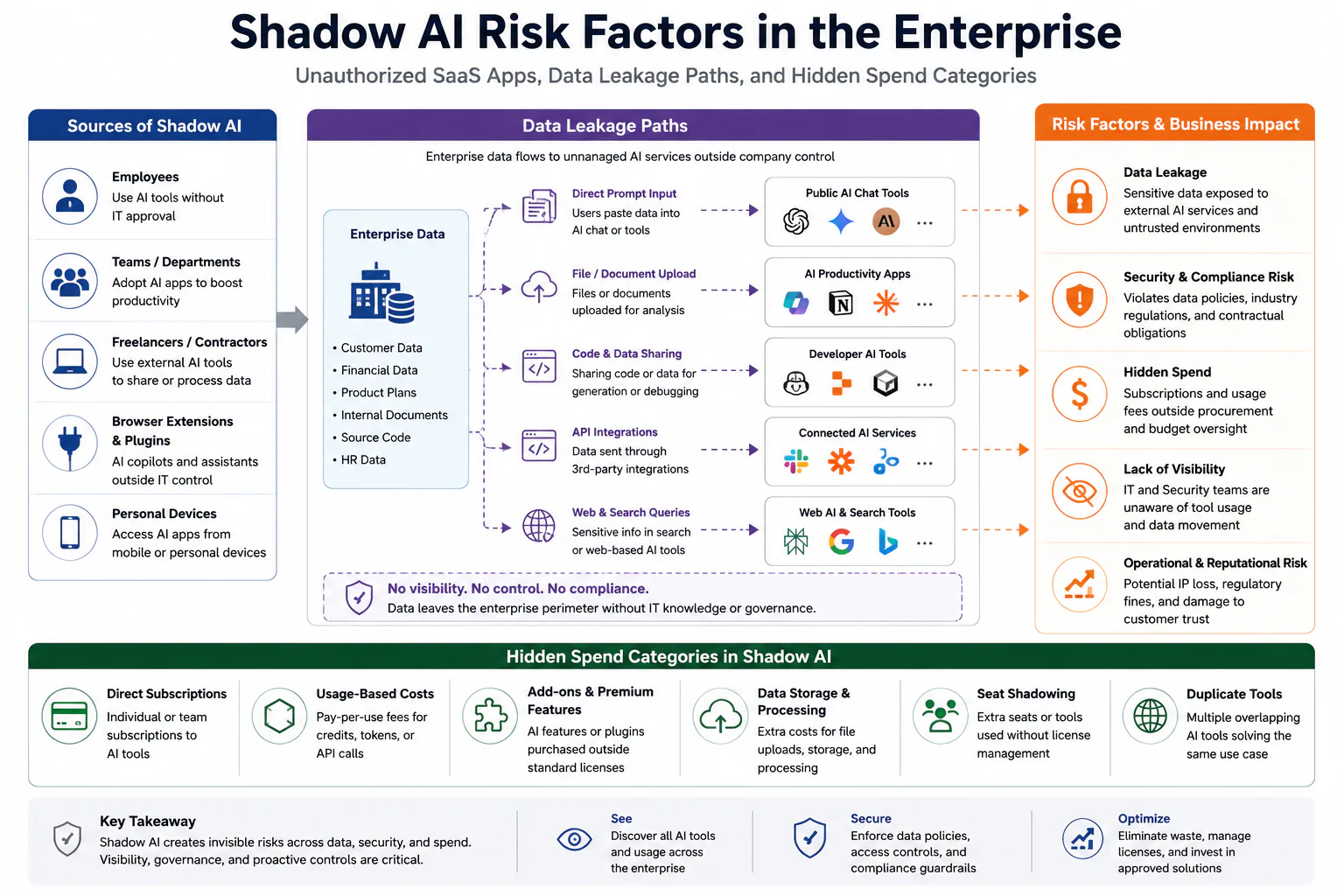
Employees aren't waiting for IT approvals. According to a Gartner survey of 302 cybersecurity leaders, 69% of companies suspect or have confirmed employees using forbidden public GenAI tools. A Reco AI report found that organizations manage an average of 490 SaaS applications - but only 47% are authorized.
Shadow AI creates four compounding problems:
Data exposure. Employees pasting proprietary information into unauthorized AI tools creates IP leakage and potential compliance violations in regulated industries.
Hidden spend. Unauthorized tools often involve personal credit cards or expensed subscriptions that never appear in enterprise procurement data.
Unmeasurable ROI. You can't measure returns on tools you don't know you're running.
Governance failure. Only 22% of enterprises had a defined AI governance policy in 2025. Without a policy, there's no baseline against which to measure or enforce anything.
Gartner's Arun Chandrasekaran offers a direct prescription: "CIOs should define clear enterprise-wide policies for AI tool usage, conduct regular audits for shadow AI activity, and incorporate GenAI risk evaluation into their SaaS assessment processes."
The good news in the data: when approved enterprise AI alternatives are provided, unauthorized shadow AI use drops 89%. The shadow AI problem is often a procurement and communication failure, not a security culture failure.
What companies handling this well are actually doing
The data on governance failures is clear. So is the data on what works.
Zapier: Token dashboards as financial controls. In early 2026, Zapier introduced per-employee AI token consumption dashboards. When one employee's usage runs five times higher than peers, a review is triggered. Chief AI Transformation Officer Brandon Sammut frames tokens as a new line item - analogous to cloud compute costs, not software licenses.
Vercel: Unlimited budgets measured by outcome. CEO Guillermo Rauch extended unlimited token budgets to engineers after one engineer analyzed a research paper and built a working service in a single day. The task would previously have taken a team several weeks. Cost: roughly $10,000 in inference tokens. Measurement approach: labor compression, not cost ceiling. The company is not counting tokens - it's counting what tokens replace.
Salesforce Agentforce: Outcome-based pricing as alignment. Salesforce charges $2 per AI conversation, shifting from per-seat to per-result. This model forces vendor and customer to align on measurable outcomes. Intercom's Fin AI Agent takes the same approach at $0.99 per resolved support ticket - customers pay for completions, not capabilities.
These examples share a common thread. The question is no longer "how many tokens did we consume?" but "what did those tokens accomplish, and at what cost per unit of output?"
McKinsey's research reinforces the structural investment required: for every $1 spent on model development, organizations that budget $3 for change management unlock disproportionate productivity gains when they measure properly. Most organizations invert this ratio.
AI FinOps is becoming a required discipline
Two years ago, "AI FinOps" didn't exist as a formal term. Now the FinOps Foundation formally covers AI as a distinct technology category, with emerging standards around token-level cost attribution, cost-per-outcome measurement, and pre-deployment architecture costing.
The SaaS management platform market is also shifting. Zylo, BetterCloud, and Torii were built for seat-based pricing and renewal tracking. All three are now building AI-specific capabilities. Purpose-built observability tools - Revenium, Traceloop, Portal26 - offer deeper per-request and per-workflow cost attribution but require integration investment. Portal26 launched what it describes as the industry's first AI Value Realization Solution in January 2026, designed specifically to close the gap between AI investment and demonstrated ROI.
For teams starting from scratch, the FinOps Foundation's framework for AI recommends three foundational steps: establish token-level visibility per team and business unit, define cost-per-outcome metrics aligned to specific business processes, and build pre-deployment cost models before signing contracts - not after invoices arrive.
Traceloop's co-founder Nir Gazit summarizes the reactive trap most teams fall into: "Simply looking at the total monthly bill from your provider is a reactive measure. It tells you that you overspent, but not why."
What comes next: agentic AI will amplify every problem
The current governance gap is going to get harder before it gets easier.
Deloitte projects the agentic AI market will grow at a 53% CAGR, from $8.5 billion in 2026 to $45 billion by 2030. IDC forecasts that the global population of actively deployed AI agents will surpass 1 billion by 2029 - a 40x increase over 2025 levels.
Each AI agent generates continuous, autonomous token consumption. Unlike a human using a chatbot, an agent runs unattended, consuming tokens at machine speed. A misconfigured agent that spins in a loop can burn through a daily budget in minutes. 90% of CIOs already cite cost forecasting as their top challenge in AI deployment; that challenge gets structurally harder as agents proliferate.
Pricing models are also continuing to shift. 43% of companies now combine subscriptions with usage-based components. Hybrid pricing is projected to hit 61% adoption by end of 2026. Gartner forecasts 40% of enterprise SaaS will include outcome-based pricing elements by 2026, up from 15% just a few years prior. If outcome-based pricing becomes the enterprise norm, measurement stops being optional - it becomes the pricing mechanism itself.
The organizations that build AI ROI measurement infrastructure now will have a material advantage in capital allocation as this market matures. Those running on informal feedback and activity metrics will face audit exposure, budget overruns, and board-level accountability gaps that become harder to close with each passing quarter.
For a practical look at how consumption-based pricing is changing enterprise software contracts, see our analysis of SaaS pricing models in 2026. For teams looking to establish MCP-based tool governance, the MCP server setup guide covers the infrastructure layer.
Why it matters now
The 108% spend increase isn't a rounding error or an outlier. It's the opening move of a structural shift in how enterprise software is priced, consumed, and governed.
The companies that came out ahead in the cloud era weren't necessarily those that spent the most on infrastructure. They were the ones that built FinOps practices early, when tooling was immature and the discipline was still forming. The same dynamic is playing out now with AI. The measurement infrastructure is 2 to 3 years behind the spend curve. Closing that gap is the enterprise software challenge of this decade.
Frequently asked questions
AI FinOps applies cloud financial operations principles to AI spending. It covers token-level cost attribution, cost-per-outcome measurement, and pre-deployment architecture costing. The FinOps Foundation now formally recognizes AI as a distinct category within its framework, separate from general cloud spend management.
Shadow AI refers to unauthorized AI tools used within organizations without IT or security oversight. It creates data leakage risk, compliance exposure, hidden spend, and makes ROI measurement impossible on tools the organization doesn't know it's running. Gartner found 69% of companies suspect or have confirmed employees using forbidden public GenAI tools.
Traditional SaaS management platforms were built for seat-based pricing and contract renewals. AI tools price by token consumption, API calls, conversations, or outcomes - all of which fluctuate unpredictably. Most platforms are adding AI-specific tracking capabilities, but purpose-built AI observability tools like Revenium or Portal26 currently offer deeper per-request attribution.
Start by defining cost-per-outcome metrics tied to specific business processes, not adoption counts. Zapier uses per-employee token dashboards and flags outliers. Vercel measures labor compression. Salesforce and Intercom build measurement into their pricing model by charging per resolved conversation or outcome. The FinOps Foundation recommends token-level visibility per team as the foundation.
Deloitte projects the agentic AI market will grow at a 53% CAGR from $8.5 billion in 2026 to $45 billion by 2030. IDC forecasts over 1 billion actively deployed AI agents by 2029, a 40x increase over 2025 levels. Each agent generates continuous autonomous token consumption, which makes governance significantly harder than managing human-initiated AI usage.