How Brands Use AI Video to Cut Ad Production Costs by 80%
Kalshi made an NBA Finals ad for $2,000 using Google Veo 3. Here's how AI video is cutting ad production costs by 70-95%, and where it's backfiring.

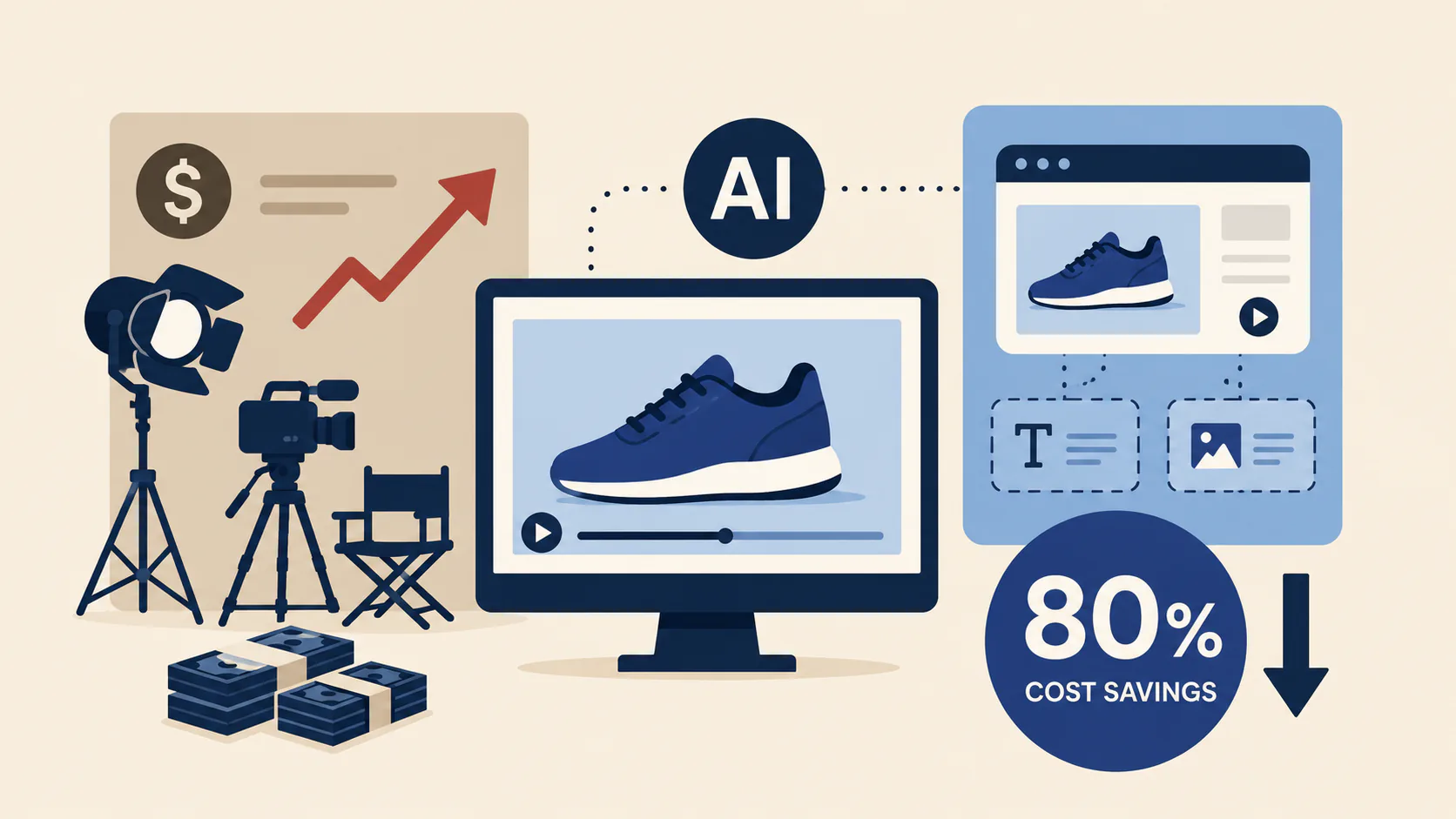
A 30-second national TV commercial that aired during Game 3 of the 2025 NBA Finals cost $2,000 and took two days to make. A typical commercial in that broadcast slot costs $250,000 to $500,000 and takes months. The brand was Kalshi, a prediction-market platform. The tool was Google's Veo 3. The ad reached over 30 million views in three weeks.
That single campaign crystallized a shift that had been building since text-to-video models crossed a usability threshold in 2024 and 2025: brands of every size are now using AI video generation, synthetic presenters, and digital twins to compress production timelines from weeks into hours, and to cut budgets that once required six or seven figures down to low thousands of dollars. The 80% cost reduction figure that gets cited constantly is not marketing exaggeration. It shows up consistently across independent case studies, agency benchmarking reports, and brand-disclosed numbers, sitting next to even more dramatic claims, including Kalshi's own roughly 95% reduction.
But the same year that produced Kalshi's viral success also produced Coca-Cola's second consecutive year of holiday-ad backlash over AI-generated content that critics called soulless. The cost savings are real and well documented. Whether they translate into advertising that actually works is a separate, more contested question, and that tension is the real story here.
What changed: Text-to-video models, AI avatars, and digital twin technology matured enough in 2025-2026 that brands stopped treating AI video as an experiment and started treating it as a standard production option. The IAB now projects GenAI-created ads will reach 40% of all ads by the end of 2026.
The technology stack behind the cost collapse
Four distinct categories of tooling are driving this shift, and brands are mixing and matching them depending on the use case.
Text-to-video generation models are the foundation of the Kalshi-style approach. Google's Veo 3 and 3.1, OpenAI's Sora, Runway's Gen-4, Kling 3.0, and ByteDance's Seedance all let a creative director write prompts that the model renders into short video clips, which a human editor then assembles into a finished spot. Veo 3 specifically generates native synchronized audio alongside video, eliminating a separate sound design step that traditionally added both cost and calendar time. For a detailed breakdown of how these models compare on output quality and pricing, see our Sora vs Veo vs Kling comparison.
AI avatars and synthetic presenters, including Synthesia, HeyGen, Leadde, and Colossyan, generate a photorealistic speaking presenter from a script without filming a human at all. These tools dominate training content, internal communications, and direct-response advertising, where a consistent on-camera spokesperson needs to deliver localized or frequently updated messaging across many markets and languages.
Digital twins are AI-generated, photorealistic replicas of real, consenting human models or celebrities. Unlike fully synthetic AI talent, a digital twin is built from a real person's likeness, captured once through extensive photography and motion data, then reused indefinitely across campaigns without that person needing to physically attend every shoot. H&M's program with Swedish AI firm Uncut and Cadbury's facial-mapping campaign with Bollywood star Shah Rukh Khan are the clearest examples.
Prompt-to-edit and algorithmic in-platform creative tools round out the stack. Adobe Firefly's Prompt to Edit and Generative Extend let editors modify existing footage through natural language instead of reshooting. Separately, Meta Advantage+, Google Performance Max, and TikTok Symphony increasingly handle creative assembly automatically inside the media-buying platforms brands already use, generating and testing video variants without an agency manually producing each one. Most marketing teams using these platforms are getting AI-driven cost reduction without consciously labeling it "AI video" at all.
Why the cost structure changes so dramatically
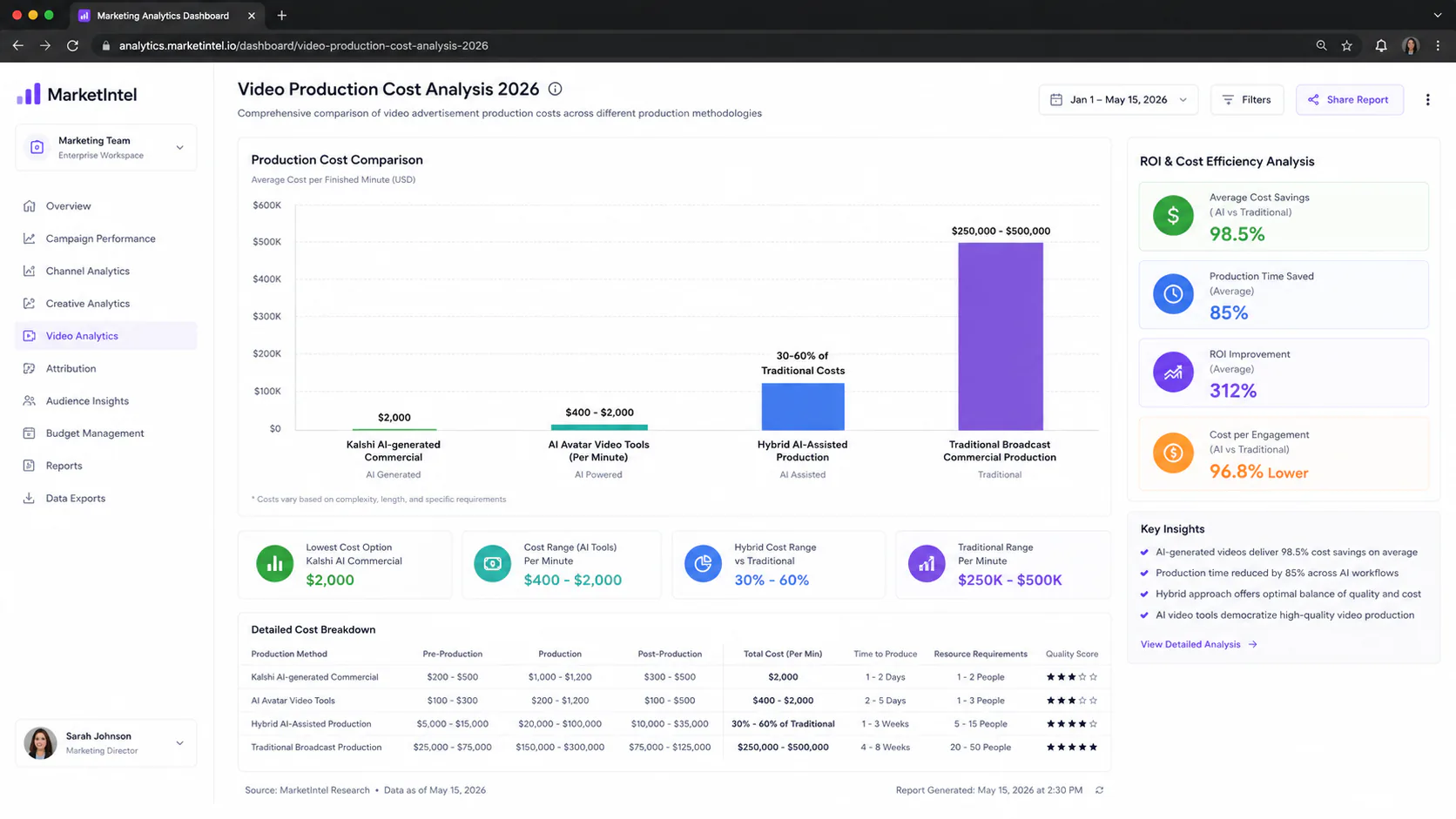
Traditional video ad production cost is dominated by labor and logistics: location scouting, camera crew, lighting and grip equipment, talent fees and union requirements, multi-day shoot schedules, and post-production editing and color grading. Each line item adds both direct cost and calendar time. AI generation collapses most of these into a single software subscription or per-generation credit cost. In benchmarked comparisons, AI tools have cut production costs by as much as 91%, from $4,500 per minute down to roughly $400, while compressing the average production time for a 60-second marketing video from 13 days to 27 minutes.
The case study that started the conversation: Kalshi's $2,000 NBA Finals ad
Filmmaker PJ Accetturo created Kalshi's 30-second spot alone, in two days, for $2,000. He used Gemini to generate a shot list and prompts, Veo 3 to render roughly 300 to 400 generations to land on 15 usable clips, and standard editing software, CapCut and Premiere Pro, to assemble the final cut.
A Kalshi spokesperson confirmed the ad went from idea to live broadcast in three days and was on track to finish with 20 million impressions, eventually surpassing 30 million views on X alone within three weeks. Kalshi employee Tarek Mansour noted a comparable traditionally produced commercial would typically cost seven figures and take months, putting the savings on this specific ad in the 95%-plus range.
What makes the case study durable rather than a one-off stunt is that the ad aired on ABC during a nationally televised primetime sporting event and passed network content standards despite its deliberately chaotic, surreal style. Kalshi has confirmed it plans to keep using AI for advertising.
Accetturo's own reflection on the project is worth keeping in mind before treating "cheap" as the whole story: "This was cheap, yes. But it still takes direction, taste, and storytelling skills to make something work. Brands still care about that."
Where else brands are deploying this in 2026
Kalshi is the most viral example, but it is far from the only one, and the pattern looks different depending on the industry.
Financial services: Coign's "first fully AI-generated TV commercial"
Coign, a credit card brand, released what it described as the financial services industry's first fully AI-generated TV commercial, produced by Justin Germany Productions using Veo 3. CEO Rob Collins framed the strategic rationale explicitly: AI wasn't used for novelty, but for speed, scale, and cost efficiency, as a way to level the playing field against larger, better-funded competitors while freeing up budget for community programs. That reallocation logic, redirecting saved production spend toward distribution or other priorities rather than just pocketing the margin, shows up repeatedly across the brands using this approach successfully.
Fashion and retail: H&M's digital twin models
H&M partnered with Uncut to create photorealistic digital twins of 30 professional models, announced in March 2025. Models retain full ownership of their digital likeness and are compensated for each use, with H&M describing the arrangement as letting models "potentially work for any brand and get paid on each occasion just like on any campaign production." The campaign images, denim styled across various city backdrops, were explicitly labeled "digital twin" for transparency.
Technically, a diffusion-based generator fine-tuned on licensed fashion photography and H&M's garment CAD files drapes digital garments over the avatars, lights them in virtual studios or street scenes, and renders high-resolution stills or looping video in minutes. Marketing teams choose the SKU, target market, and mood board, and the system generates on-brand visuals automatically. H&M's stated rationale centers on avoiding model and crew scheduling conflicts across simultaneous global campaigns rather than purely cutting cost, which is a meaningfully different motivation than Kalshi's or Coign's.
Localized campaigns: Cadbury's Shah Rukh Khan facial mapping
Cadbury used AI facial mapping to create a digital version of Bollywood star Shah Rukh Khan, then geotargeted the campaign to promote small, local businesses across India during Diwali. The hyperlocal, AI-personalized approach drove a 35% sales lift for Cadbury Celebrations, making it one of the clearest documented revenue-impact case studies in this space, as opposed to a pure cost-savings story.
Enterprise and B2B: the less visible adoption category
Stellantis Financial Services cut video production costs by 70% and production time by 75% using AI video for training and internal communications. The British Council reduced ad production costs by 70% and time-to-market by 50% using AI to localize over 1,000 assets across markets. Nestlé cut content production time by 60% using AI-assisted creative workflows, and Adidas reported a 91% cost reduction specifically on personalized email creative production. These examples rarely go viral, but they represent a larger share of total AI video adoption than the headline-grabbing brand campaigns.
The case that shows the limits: Coca-Cola's repeated backlash
For the second consecutive year, Coca-Cola released an AI-generated version of its "Holidays Are Coming" holiday ad, produced with AI studios Secret Level, Silverside AI, and Wild Card using four different generative models. Coca-Cola's global VP for creative strategy and content, Islam ElDessouky, said the 2025 ad "scored off the charts" with consumers. System1, a firm that rates ads on a 1 to 5.9 scale for potential to drive long-term brand growth, gave the ad the highest possible score. Creative testing firm DAIVID reported higher-than-average attention and brand recall.
Despite all of that, the ad faced significant public backlash for the second straight year, with critics calling it soulless and disconnected from the emotional warmth associated with the brand's historic holiday advertising. The 2024 version had already drawn criticism for flickering wheels, awkward lighting, and uncanny humans, a pattern that recurred with Toys R Us's widely criticized AI-generated depiction of its late founder.
Neeraj Arora, who chairs marketing research and education at the University of Wisconsin-Madison, offered a specific explanation for why this particular brand and moment is so exposed: holidays represent connection, community, and family, and AI doesn't fit that emotional register or what Coca-Cola specifically means to people. The gap between strong quantitative ad-testing scores and real public sentiment is the central risk that brands underestimate when they treat cost reduction as the only metric that matters.
That gap has an industry-wide pattern behind it. Creative quality accounts for 56% of sales lift from digital ad campaigns, more than media placement or targeting, which means cost reduction only pays off commercially if the AI-generated creative performs close to what traditional production would have delivered. One creative-industry source put the underlying problem bluntly: AI is being used to make more content, faster, cheaper, and safer, and that confuses efficiency with effectiveness, which is the wrong goal.
The pattern to watch for: High measured attention and recall scores do not predict immunity from backlash. Coca-Cola's ad scored at the top of two separate testing frameworks and still triggered public criticism in back-to-back years. Standardized ad-testing metrics appear to miss authenticity and brand-sentiment risk that only shows up after launch.
What this is doing to the advertising agency industry
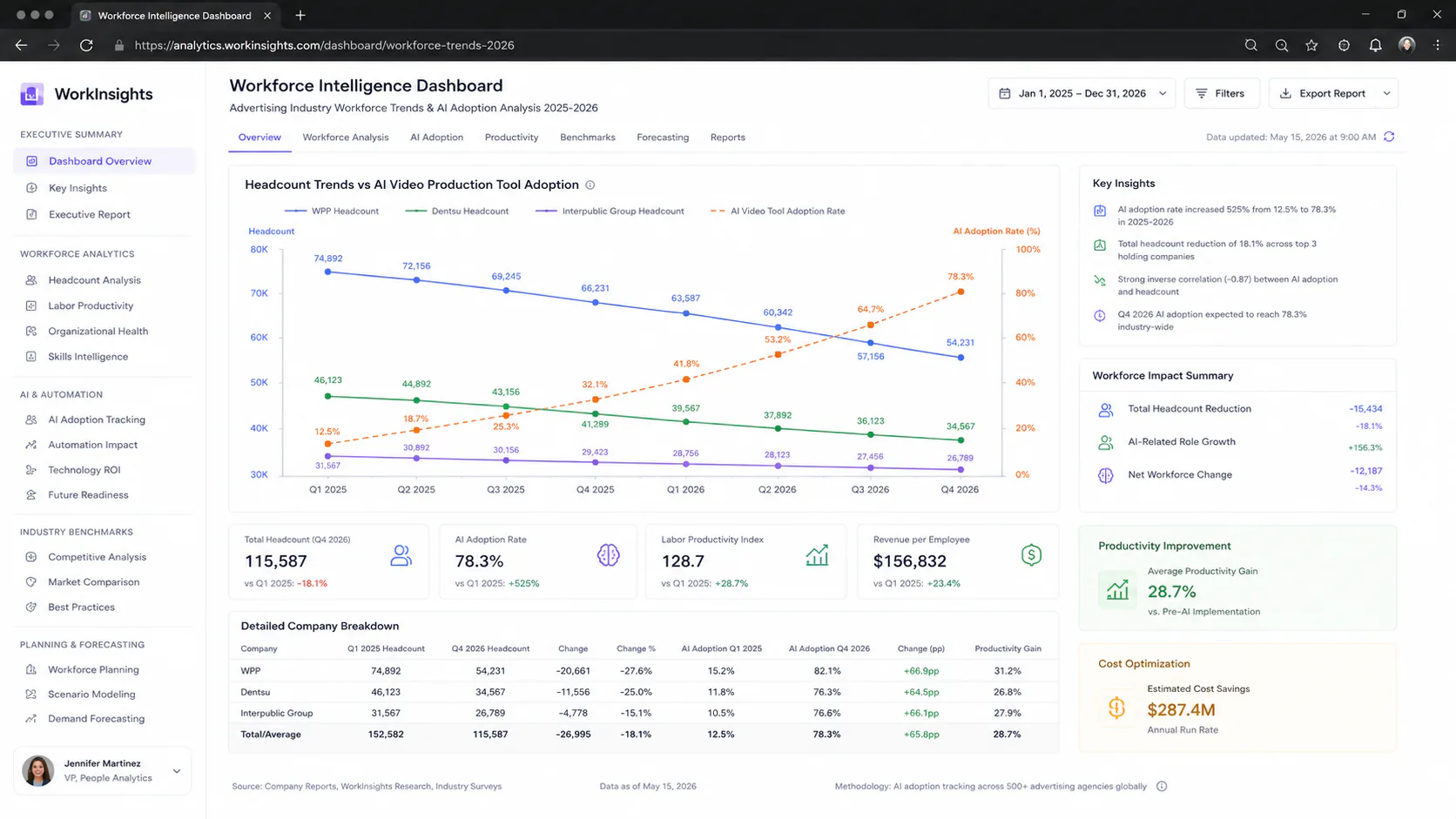
The cost savings for brands correspond directly to job losses across the agency ecosystem, and the numbers are not subtle. Sir Martin Sorrell, WPP's founder and current CEO of S4 Capital, put it directly: there are 250,000 people in media planning and buying today, and there won't be 250,000 jobs in two to three years.
The restructuring is already underway. WPP's headcount dropped from 111,000 to 104,000 in roughly a year, while 85% of client-facing staff adopted the company's internal AI platform, a correlation the company's own leadership has acknowledged. Dentsu committed to eliminating 3,400 jobs, about 8% of staff. Interpublic Group laid off 3,200 employees amid its merger with Omnicom, a deal explicitly targeting $750 million in cost savings, with the CFO noting that labor costs always lead the balance sheet. Forrester analysis suggests agency headcounts fell roughly 8% across 2025 overall.
Forrester analysts describe the underlying mechanism as a "workforce inversion." Agencies historically made money through labor arbitrage: expensive creative directors overseeing cheap junior talent, expensive account directors managing through junior coordinators. AI video and image generation increasingly eliminates the need for that cheap junior tier entirely. Tasks that used to require teams of junior staff, resizing assets, generating creative variants, removing backgrounds, are now one-click operations. That inversion fundamentally changes the economics that built the modern advertising agency, and it is symbolically visible in the Omnicom-IPG merger's retirement of agency brands including DDB, FCB, and MullenLowe, some founded in the 1800s.
Where AI video makes sense, and where it doesn't
The comparison below reflects how different production approaches actually perform across cost, timeline, and risk, based on documented brand outcomes rather than vendor claims.
| Approach | Typical cost (60-sec spot) | Typical timeline | Best fit | Key risk |
|---|---|---|---|---|
| Fully AI-generated (Kalshi model) | $2,000-$5,000 | 1-3 days | Challenger brands, social-native content, rapid testing | Quality and authenticity perception, resolution ceilings |
| AI avatar / synthetic presenter | $400-$2,000 per minute | Hours | Training, direct response, multilingual localization | Limited emotional range, "spokesperson" feel |
| Digital twin (H&M model) | High upfront capture cost, low marginal cost per use | Days for setup, hours per asset after | Fashion and retail with recurring campaign needs | Consent and compensation complexity, labeling requirements |
| Hybrid (AI-assisted traditional) | 30-60% of full traditional cost | Days to 1-2 weeks | Most enterprise brand campaigns today | Requires both AI tooling and traditional production expertise |
| Fully traditional production | $4,500+/minute; $250K-$500K+ for major broadcast spots | Weeks to months | High-end brand campaigns, regulated industries, human-connection storytelling | High cost limits volume and iteration |
Full AI generation wins for brands prioritizing speed and budget efficiency over polish, particularly social-native brands where a deliberately stylized or surreal aesthetic is an asset rather than a liability, and where the target platform culture (X, TikTok) tolerates or rewards lower production polish.
Digital twins win specifically for brands with recurring campaign needs built around the same talent across many SKUs, markets, or seasons, where the upfront investment in capturing a high-quality digital replica pays off across dozens or hundreds of subsequent uses.
Traditional production remains the right call for flagship campaigns where cinematic quality and real human performance are non-negotiable, complex multi-person dialogue or live-event capture, physical product demonstrations requiring authentic real-world interaction, regulated industries like healthcare, finance, and legal where compliance demands verified real people on camera, and human-connection content like customer testimonials where genuine, unscripted emotion drives the result.
Most established enterprise brands, including Coca-Cola and H&M, are actually operating in hybrid mode in practice: using AI for B-roll, background generation, localization, and iteration while keeping human talent and direction at the creative core. The binary "fully AI" versus "fully traditional" framing that viral case studies suggest is not how most brands are actually deploying this technology.
The parts of this story that don't make the case studies
Three issues sit underneath the cost-savings headlines, and all three are becoming harder to ignore.
Consent and compensation are unresolved industry-wide, even in well-intentioned programs. H&M's digital twin initiative pays and credits participating models, and one featured model, Vanessa Moody, called it a good precedent that's professional, collaborative, and transparent. But labor activist Sara Ziff raised consent and compensation concerns regardless, and Paul W. Fleming, general secretary of UK union Equity, welcomed H&M's pledge while stressing it needs to be backed by widespread AI protections in union agreements and legislation, of which he said few currently exist.
Disclosure is shifting from ethical preference to legal requirement. New York's Fashion Workers Act, effective June 2025, requires written consent for use of digital replicas. The EU AI Act, rolling out through 2026, will mandate clear labeling of AI-generated content. The cost-savings calculus brands run today increasingly has to account for compliance overhead that didn't exist even a year ago.
Audience sentiment lags well behind industry enthusiasm. For the second year running, IAB research finds that Gen Z and Millennial consumers feel less positive about AI-generated advertising than ad executives believe they do. The same research found these consumers are receptive to disclosure, and that disclosure can actually increase purchase likelihood when present, which suggests transparency rather than concealment is the more commercially sound long-term path.
Why it matters now
The IAB reports that 86% of ad buyers are already using or planning to use generative AI for video ad creative, and GenAI-created ads are projected to reach 40% of all ads by the end of 2026. Wistia's State of Video Report found that 41% of brands now use AI for video creation, more than doubling from 18% in 2024. That is one of the fastest year-over-year adoption shifts the report has tracked.
For decades, digital advertising's efficiency gains came almost entirely from better targeting and programmatic media buying. AI video generation introduces a second, independent efficiency lever at the production-cost layer itself, and it's compounding with the targeting gains rather than replacing them. A Mondelez executive has already indicated the company expects AI tools to generate short, broadcast-ready TV ads as early as the 2026 holiday season, with an eye toward the 2027 Super Bowl, which would move the Kalshi case study from novelty to category norm at the very top of the advertising budget pyramid.
The practical takeaway for any brand evaluating this shift: the cost savings are real and well documented across a 70% to 95% range depending on the production approach, but the savings only matter commercially if the resulting creative performs. Coca-Cola's repeated backlash, despite topping two separate quantitative testing frameworks, is the clearest evidence that production cost and audience reception are now separate variables that need separate measurement. Brands chasing the 80% number without a parallel plan for authenticity and disclosure are optimizing the wrong half of the equation. For more on how this fits into broader enterprise AI tooling spend, see our analysis of AI SaaS spend growth in 2026.
Frequently asked questions
Documented savings range from 70% to over 95% depending on the production approach and use case. Stellantis Financial Services and the British Council both reported 70% cost reductions on AI-assisted production. Zebracat's broad industry benchmark puts the typical figure at 80%, the most commonly cited average. A per-minute cost comparison found AI tools cutting costs from $4,500 to roughly $400, a 91% reduction. Kalshi's specific NBA Finals ad, made for $2,000 against a comparable traditional commercial costing seven figures, represents the high end at roughly 95%-plus savings for that individual case.
Filmmaker PJ Accetturo used Google Gemini to generate a shot list and video prompts, then used Google's Veo 3 model to render approximately 300 to 400 video generations until he had 15 usable clips. He assembled the final 30-second spot using standard editing software, CapCut and Adobe Premiere Pro. The entire production took two days and cost approximately $2,000, compared to the hundreds of thousands of dollars and months of production time a comparable traditionally shot commercial would typically require.
A digital twin is a photorealistic AI replica of a real, consenting human, built from extensive photography and motion-capture data of that specific person, then reused across campaigns without them physically attending every shoot. H&M's program with 30 professional models and Cadbury's facial-mapping campaign with Shah Rukh Khan are both digital twin examples; the real person retains likeness rights and is compensated for each use. This differs from fully synthetic AI presenters (like those built with Synthesia or HeyGen), which are not based on a single real person's licensed likeness and typically serve as generic, reusable spokespeople rather than recognizable individuals.
Coca-Cola's 2025 AI holiday ad received the highest possible score (5.9) from System1's ad-testing framework and above-average attention and recall scores from DAIVID, yet still triggered significant public criticism calling it soulless for the second consecutive year. Marketing researcher Neeraj Arora attributed this to a mismatch between AI production and what the holiday season and the Coca-Cola brand specifically represent to consumers: connection, community, and family. The gap illustrates that standardized ad-testing metrics measuring attention and recall don't fully capture authenticity and brand-sentiment risk, which only becomes visible after public launch.
Yes, and the changes are already measurable. WPP's headcount dropped from 111,000 to 104,000 in roughly a year while 85% of client-facing staff adopted the company's internal AI platform. Dentsu committed to cutting 3,400 jobs (about 8% of staff), and Interpublic Group laid off 3,200 employees amid its merger with Omnicom, a deal explicitly targeting $750 million in AI-linked cost savings. Forrester analysts describe the underlying shift as a "workforce inversion," where AI eliminates the need for the cheap junior staff tier that agencies traditionally relied on for resizing assets, generating creative variants, and similar production tasks.