ElevenLabs Voice Cloning Review: Use Cases, Risks (2026)
ElevenLabs voice cloning in 2026: Eleven v3, IVC vs PVC, pricing, legal risks, and which plan is worth paying for in production.

Bytewaves Score Card
ElevenLabs can clone a voice from 60 seconds of audio and produce output that a human listener will correctly identify as synthetic only 73% of the time. That number matters whether you are a creator building a content pipeline, a developer deploying voice agents, or someone trying to understand why AI voice fraud costs billions of dollars a year.
The technology is genuinely impressive. It is also genuinely risky, and understanding both sides honestly is the only way to make a sound decision about using it. This review covers what ElevenLabs actually does in 2026, what the Eleven v3 model changed, what the pricing really costs in production, and who should be on which plan.
What's covered here: ElevenLabs voice cloning specifically (Instant and Professional), the Eleven v3 model, Studio 3.0, pricing across all plans, legal and compliance context, and how ElevenLabs compares to PlayHT, Murf, Cartesia, and open-source alternatives. This is not a tutorial on how to clone a voice. For step-by-step setup, see ElevenLabs' official documentation at elevenlabs.io/docs.
What ElevenLabs actually is in 2026
ElevenLabs launched in 2022 as a text-to-speech startup. By April 2026 it had reached an estimated $500 million in annualized revenue, an $11 billion valuation after a $500 million Series D led by Sequoia Capital, and 41% of Fortune 500 companies as customers. It is not a niche audio tool anymore.
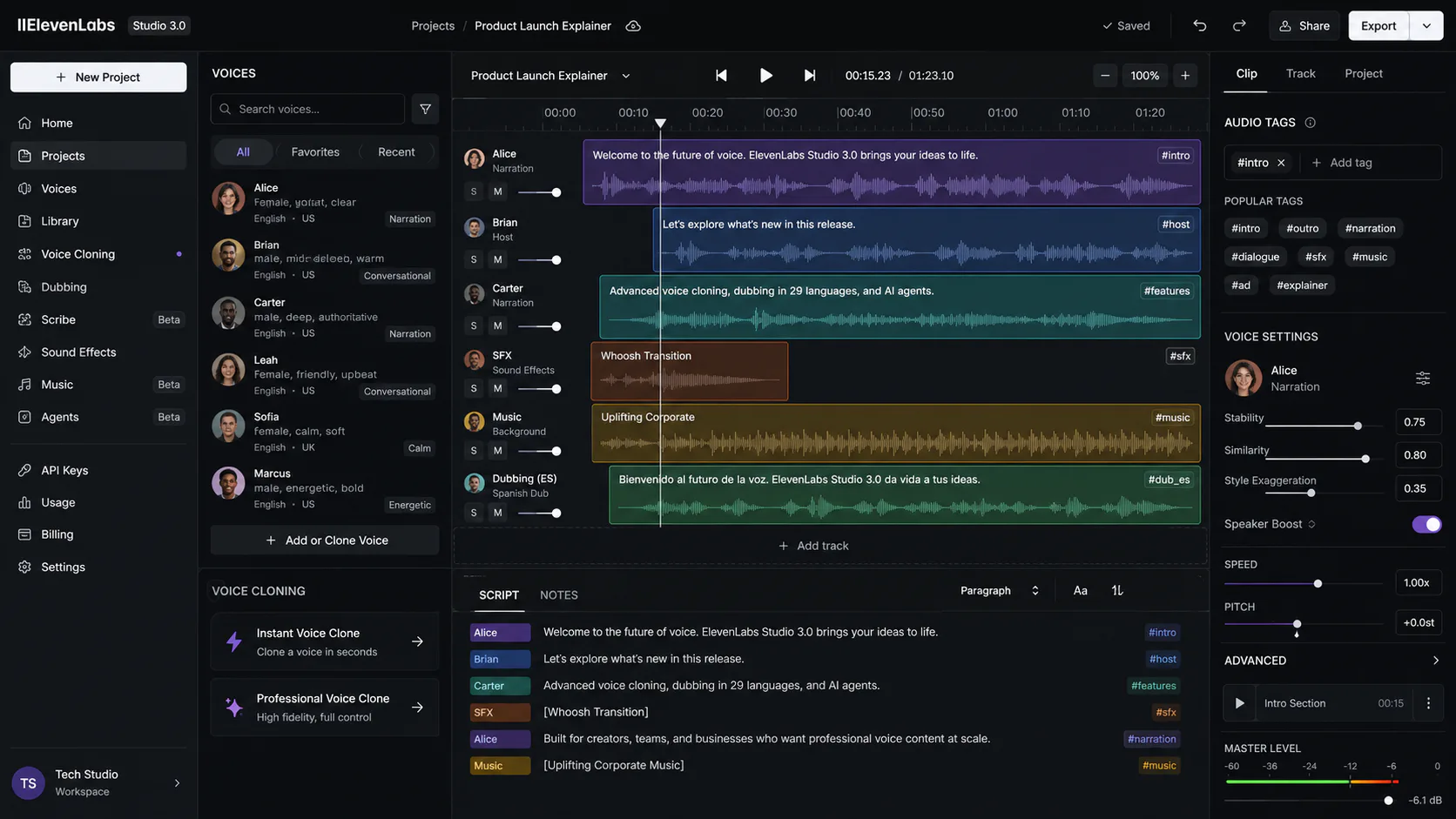
The platform now spans text-to-speech with 5,000+ pre-built voices, voice cloning (both instant and professional), speech-to-text via the Scribe API, AI dubbing across 29 languages, sound effects and music generation, and a Conversational AI Agents platform for building voice-enabled customer service bots. Studio 3.0 ties most of these together in a single production environment.
Voice cloning is the capability that defines ElevenLabs competitively, and it comes in two meaningfully different tiers.
Instant vs Professional Voice Cloning
The distinction between these two tiers is not just quality. It determines what you can build, who can use it, and what legal exposure you carry.
Instant Voice Cloning (IVC)
IVC requires approximately 60 seconds of clean audio. The model is generated in minutes. It is available on Starter plan and above ($5/month). No identity verification is required beyond a self-attestation checkbox confirming you have the right to clone the voice in question.
Quality is described in ElevenLabs' own documentation as "good for quick social media posts or internal drafts." In independent tests, IVC captures broad vocal identity well: pitch, general cadence, accent. It is noticeably less accurate on breath patterns, micro-pauses, and the subtle cadence variations that distinguish a convincing long-form narration from something that sounds slightly processed.
The self-attestation requirement for IVC is the most criticized element of ElevenLabs' safety posture. A March 2025 Consumer Reports study found that ElevenLabs and three competitors used only this checkbox as the primary fraud prevention measure. The company has added identity verification for Professional cloning since then, but IVC remains accessible without verification.
Professional Voice Cloning (PVC)
PVC requires 30+ minutes of clean, high-quality audio, with 2-3 hours recommended for the best results. Training takes approximately 3-4 weeks as of early 2026. It is available on Creator plan and above ($22/month) and requires identity verification before access is granted.
The output is a qualitative step above IVC. ElevenLabs describes PVC as "indistinguishable from the real you," and independent reviews broadly support this for English-language content. The model captures breath patterns, laugh, and cadence variations that IVC misses. This is the tier for audiobooks, branded voice assistants, enterprise agents, and any production use case where voice consistency across hours of output matters.
PVC voices can also be shared in ElevenLabs' Voice Library with consent settings enabled, earning revenue share when other users generate audio with them. Voices become commercial assets.
The 3-4 week training window is the primary operational constraint. Teams that discover mid-production that IVC quality is insufficient face a month of wait time before the upgrade lands.
The Eleven v3 model
Eleven v3 went into general availability on March 14, 2026, after an alpha release in late 2025. It is the most significant model change ElevenLabs has shipped.
What v3 actually changes
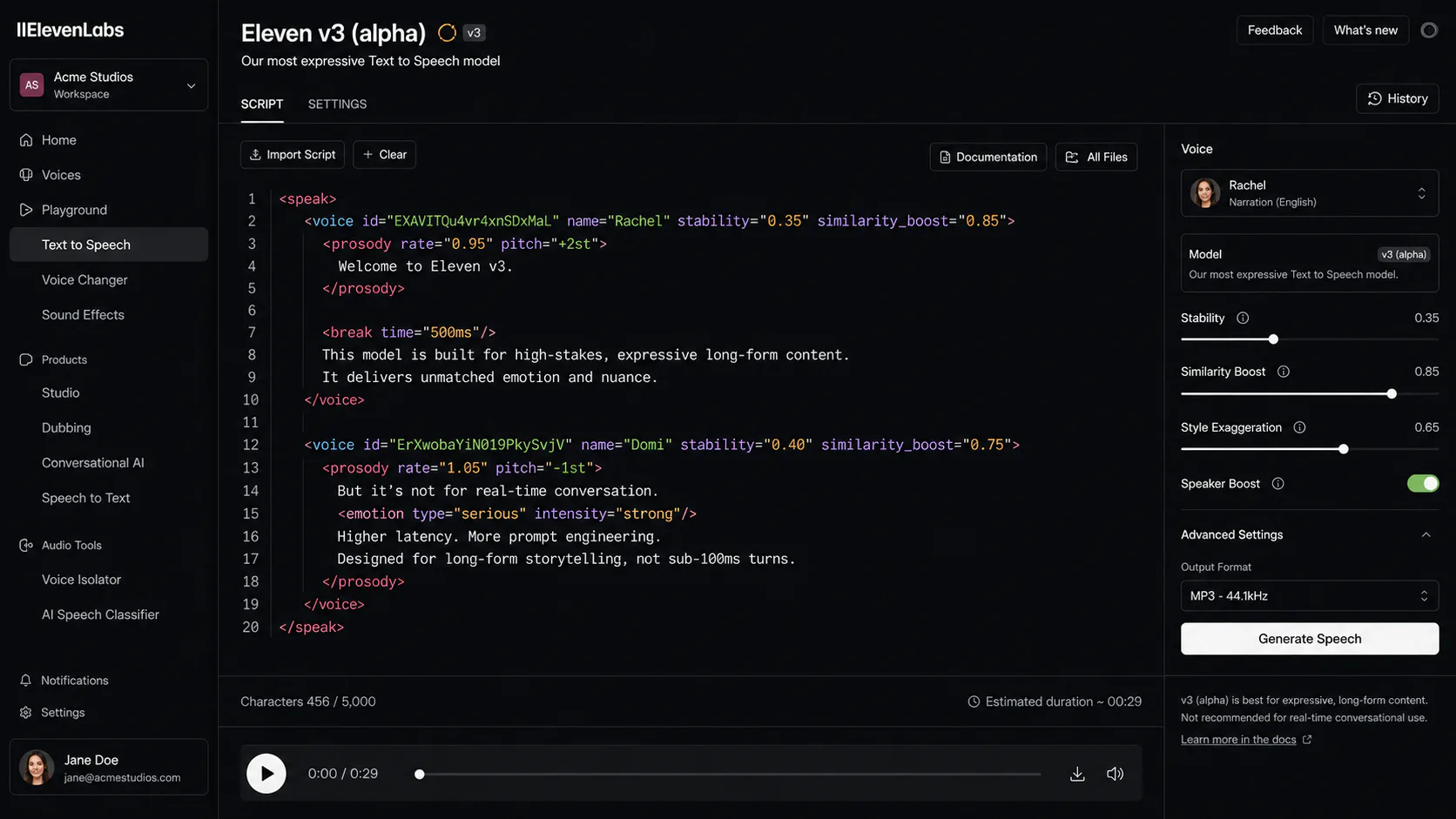
Audio Tags are the headline feature: inline emotional and non-verbal direction embedded directly in text scripts. Rather than adjusting model parameters to get an emotional tone, you write [laughs softly] or [sighs, then continues more firmly] in the script itself. Independent reviewers have described this as "a director's toolkit for AI narration" and "a genuine breakthrough" in expressive control.
Dialogue Mode generates multi-speaker audio from a single generation pass. Two or more characters can speak in natural back-and-forth within one output, with no splicing required. This matters for audiobook narration with dialogue, podcast production, and training content with scenario-based conversations.
70+ language support is an expansion from 28 languages in Multilingual v2. The practical result for global content teams is access to a much wider target language set within a single model.
68% error reduction on complex text addresses a consistent complaint in earlier models. Numbers, abbreviations, technical terms, and mixed alphanumeric strings now render more reliably. For any content involving product names, model numbers, or technical documentation, this is a material improvement.
What v3 does not do
ElevenLabs explicitly recommends against using v3 for real-time or conversational agent deployments. The model requires more prompt engineering than earlier versions, runs at higher latency, and is designed for high-stakes expressive long-form content, not sub-100ms conversational turns. If you are building voice agents, use Flash v2.5. This is in the official documentation and is worth repeating because the marketing around v3 does not always make it clear.
Real-world performance: what it's like to use in production
The quality ceiling is high. English-language output from a well-trained PVC model with v3 is genuinely impressive: natural pacing, emotionally appropriate delivery, and fidelity that holds up in long-form content without the listener fatigue that synthetic voices used to produce.
The ceiling is not the whole story.
Non-English performance is inconsistent. Multiple independent reviewers note a meaningful quality gap between English and other languages even with v3. One reviewer testing English, Spanish, and French for a product demo described English as excellent and other languages as "problematic." Testing in your target language before committing to a production plan is mandatory, not optional.
Credit consumption in production surprises teams consistently. ElevenLabs charges by character (1 character = 1 credit on Multilingual v2; Flash v2.5 costs 0.5 credits/character). Conversational AI agents are billed by minute ($0.10/minute on Creator, $0.08/minute on Business annual) with LLM costs separate. The critical problem: failed generations still consume credits. Audio that comes out with long pauses, volume shifts, or unexpected voice changes costs the same as clean output. Power users across multiple independent reviews converge on the same advice: budget 3x the advertised pricing for real production projects.
The stability slider and v3 prompt engineering have a learning curve. Casual users and power users are not having the same experience.
Pricing: what you actually pay
| Plan | Monthly Price | Characters/Month | Voice Cloning | Commercial Use | Key constraint |
|---|---|---|---|---|---|
| Free | $0 | 10,000 | None | No (attribution required) | Testing only; must attribute ElevenLabs |
| Starter | $5/mo | ~30,000 | IVC only | Yes | No PVC; limited for production volume |
| Creator | $22/mo | ~100,000 | IVC + PVC | Yes | API access; recommended entry for serious work |
| Pro | $99/mo | ~500,000 | IVC + PVC | Yes | 192kbps via API; high-volume production |
| Business | ~$330/mo | Custom | IVC + PVC | Yes | Teams; RBAC; lower agent rates ($0.08/min) |
| Enterprise | Custom | Custom | IVC + PVC | Yes | HIPAA BAA, SSO, Zero Retention Mode |
The free plan is for testing only. Output requires ElevenLabs attribution and cannot be used commercially. Creators who test on free and then publish are in terms-of-service violation.
Creator at $22/month is the realistic entry for anyone doing actual work. It includes PVC, commercial rights, and API access. Starter ($5/month) is priced attractively but IVC-only limits make it a prototype tier.
HIPAA-eligible deployments require Enterprise. ElevenLabs only provides a Business Associate Agreement with Zero Retention Mode to Enterprise customers. Healthcare organizations cannot use patient-facing audio applications on any lower tier.
Unused credits roll over up to 2x your monthly quota but are lost on downgrade or cancellation. Factor this into annual vs. monthly decision-making if you have uneven production volume.
Where ElevenLabs leads
Voice quality at the frontier. Across every category that matters for expressive content, ElevenLabs is the benchmark against which competitors are measured. The v3 model with audio tags produces output that independent reviewers consistently place above PlayHT, Murf, and Resemble for naturalness and emotional range. Cartesia tests faster for real-time latency specifically, but breadth of capability belongs to ElevenLabs.
Two-tier cloning for different production needs. The IVC/PVC distinction lets teams start fast (IVC in minutes, $5/month) and invest in quality when the project justifies it (PVC, $22/month, 3-4 weeks). Most platforms force a single cloning approach.
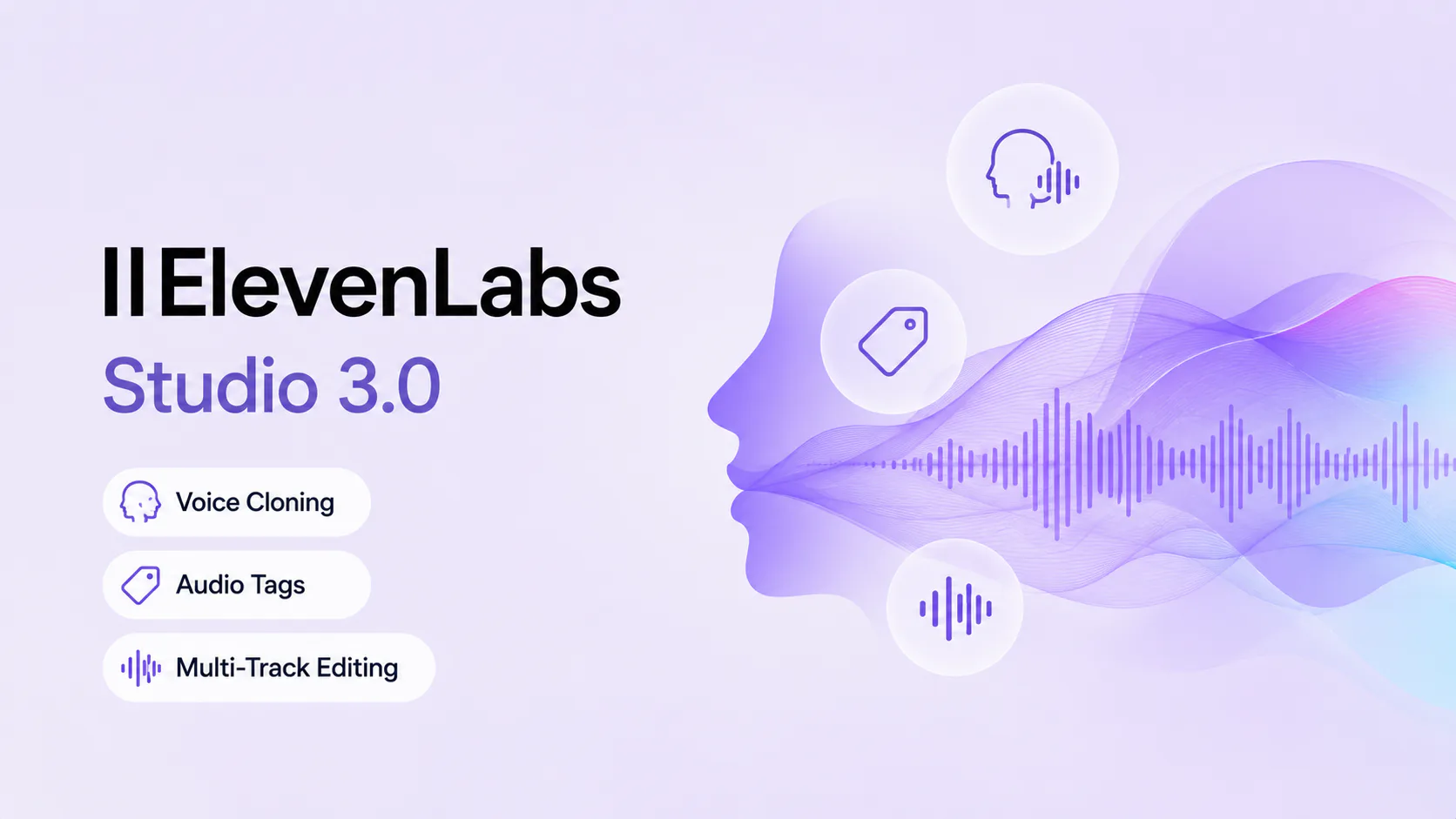
Full production platform. Studio 3.0 with multi-track timeline, video preview, and caption overlay means many creator workflows no longer require separate audio editing software. This integration is a genuine time reduction for content producers.
Cross-language voice cloning. Speaking in your voice in 29 languages via AI Dubbing is the application that no traditional localization workflow can match economically. A single creator or a 200-book publishing catalog can reach global markets at a fraction of the cost of re-recording.
Developer platform depth. The ElevenAgents platform supports MCP server integration, WebSocket streaming, batch calling, conversation tagging with configurable retention, and integration with GPT-4, Claude, and Gemini as reasoning layers. For developers building voice-enabled applications, this is the most complete managed platform.
Limitations to know before you commit
v3 is not for real-time agents. This is worth repeating because it is easy to miss. If you are building customer service bots, voice assistants, or anything that needs sub-100ms response, use Flash v2.5. v3 is for long-form expressive content.
PVC takes 3-4 weeks. For productions on tight schedules, this is a real constraint. Discovering mid-project that IVC quality is insufficient means a month of delay.
Non-English quality is inconsistent. English is excellent. Other languages are variable. Always test your specific target language before committing to a production plan.
Credits disappear on failed generations. Failed outputs cost the same as clean ones. Budget conservatively.
The license terms carry real obligations. ElevenLabs retains a perpetual, irrevocable license to use your voice data to train its models. The line between "commercial use" and "building a competing product" is not clearly defined in the current terms. Organizations deploying PVC in enterprise contexts should get legal review of the terms before signing up.
No IVC biometric verification. The checkbox self-attestation for Instant Voice Cloning remains a gap that regulators, journalists, and a Senate committee have all flagged. ElevenLabs has added identity verification for PVC and improved celebrity voice blocking, but IVC abuse remains a real risk and a reputational exposure.
The legal and ethical context
Voice cloning sits in an actively changing legal landscape. This is not background information. It is operationally relevant in 2026.
At least 12 US states have enacted voice cloning laws. The EU AI Act requires clear labeling of AI-generated audio content, with deepfake labeling obligations taking full effect in August 2026. The NO FAKES Act is advancing through US Congress to criminalize unlicensed voice replicas. In April 2026, US Senator Maggie Hassan formally demanded anti-fraud safeguard disclosures from ElevenLabs and three other AI voice platforms. Seven journalists and voice actors filed suit in Illinois alleging ElevenLabs trained models on their recordings without consent.
ElevenLabs has built genuine safety infrastructure: an AI Speech Classifier (publicly available for anyone to check whether audio was generated by the platform), C2PA content provenance participation, inaudible watermarking on synthetic files, and identity verification for PVC. The company participates in the Content Authenticity Initiative.
The compliance checklist for anyone using voice cloning in 2026:
- Get explicit, documented, revocable consent from the person whose voice you are cloning. Written consent is the minimum; documented consent with scope definition (what the voice will be used for, in what territories, for how long) is the standard to aim for.
- Do not clone public figures or celebrities without a negotiated license through ElevenLabs' Voice Marketplace. The celebrity voice blocking in the platform exists for a reason.
- Disclose AI-generated audio in published content wherever required by platform policy or applicable law. Several states and the EU already require this disclosure. More jurisdictions are following.
- Use a paid commercial plan for any published content. Free tier output requires attribution and has no commercial rights.
- Healthcare deployments require Enterprise with a signed BAA and Zero Retention Mode enabled.
This is not legal advice. If your organization is deploying voice cloning in a regulated context, retain qualified counsel.
How ElevenLabs compares to competitors
| Tool | Voice Quality | Cloning | Best For | Entry Price |
|---|---|---|---|---|
| ElevenLabs | Best overall | IVC + PVC, 2-tier | Everything; the all-rounder | Free / $5/mo |
| PlayHT | Very good | Strong, fast | Long-form narration, bulk, RSS | Free / $29/mo |
| Murf AI | Very good | Available | E-learning, slides, Canva/PowerPoint | Free / $19/mo |
| Resemble AI | Very good | Highest enterprise fidelity | Regulated enterprise, multi-language identity | Custom |
| Cartesia | Excellent | Available | Real-time agents, lowest latency | Usage-based |
| WellSaid Labs | Very good | Available | Enterprise compliance, security review | Custom |
| Descript | Good | Overdub (moderate) | Podcast/video editing all-in-one | Free / $12/mo |
| F5-TTS / XTTS | Very good | Open source | Self-hosting, high-volume cost control | Free (self-host) |
ElevenLabs vs. PlayHT: ElevenLabs leads on voice realism and expressiveness. PlayHT leads on voice library breadth (600+ voices, 142 languages), RSS-to-audio feeds, and per-character pricing predictability at scale. Choose ElevenLabs for quality; choose PlayHT for volume and variety.
ElevenLabs vs. Murf AI: ElevenLabs leads on emotional range and multilingual naturalness. Murf leads for marketing and e-learning teams working in Canva or PowerPoint, where its native integration removes tool-switching friction. Choose based on your workflow context, not just voice quality.
ElevenLabs vs. Cartesia: Cartesia was preferred over ElevenLabs 36 out of 50 times on voice quality in one independent head-to-head test, and it has the lowest latency of any current managed platform for real-time conversational agents. If building voice agent infrastructure is your primary use case, evaluate Cartesia seriously. ElevenLabs wins on platform breadth and production tooling.
ElevenLabs vs. open-source (F5-TTS, XTTS): For organizations with infrastructure and technical resources, self-hosted open-source models can deliver 90% of ElevenLabs' quality at zero per-character cost. The trade-off: no managed safety features, no watermarking, no compliance support, and the maintenance burden. For regulated industries or teams without DevOps capacity, managed is the right call.
For a broader look at how AI audio and video tools fit into content workflows, see AI media tool reviews on Bytewaves and our Sora 2 vs Veo 3 vs Kling 2 comparison.
Who it's for
Use ElevenLabs if:
- You need the highest naturalness and emotional range available and English-language quality is the primary requirement
- Your use case is audiobook narration, podcast production, branded voice assistants, or multilingual content localization
- You are building voice agents and want a managed platform with MCP integration, LLM flexibility, and conversation management tooling
- You want IVC for fast prototyping and the option to invest in PVC quality when a project justifies it
- You are a content creator who wants to narrate video in your own voice across 29 languages without re-recording
Skip ElevenLabs if:
- Real-time agent latency is your primary constraint (Cartesia is the better choice)
- You are a high-volume team generating audio at scale in non-English languages where quality inconsistency is a production risk
- You have enterprise data sovereignty requirements that cannot be met by cloud infrastructure (wait for on-premise options or evaluate WellSaid/Resemble)
- You are a developer who wants maximum flexibility and cost control at volume with internal infrastructure (evaluate F5-TTS or XTTS self-hosted)
Pros and cons
Pros
- Eleven v3 with audio tags sets a new benchmark for emotional expressiveness and director-level delivery control
- Two-tier voice cloning (IVC for fast iteration, PVC for production fidelity) matches different budget and timeline constraints within a single platform
- Studio 3.0 reduces the tool-switching overhead that fragmented audio production workflows for creators
- Cross-language voice cloning via AI Dubbing makes multilingual content distribution economically viable for individual creators and publishers
- Developer platform depth (MCP integration, WebSocket streaming, multi-LLM agent support) is the most complete managed offering in the market
- The Impact Program provides free access for nonprofits and individuals with accessibility needs, which is a meaningful commitment given the technology's dual-use potential
Cons
- Credit billing by character (not by minute) and charges on failed generations create real cost unpredictability; budget 3x advertised pricing for production projects
- v3 is unsuitable for real-time conversational agents; the Flash v2.5 recommendation is clearly documented but easy to miss in the marketing
- PVC training time of 3-4 weeks is a production constraint that IVC quality cannot always substitute for
- Non-English voice quality is inconsistent across languages; always test your target language before committing to a production plan
- IVC safeguards rely on self-attestation, which remains insufficient by independent regulatory and journalistic assessment
- ElevenLabs retains a perpetual, irrevocable training license over voice data; enterprise deployments require legal review of terms before signing
Is it worth it?
For English-language content production, professional audiobooks, branded voice assistants, or multilingual creator workflows: yes, and there is no close competitor at the Creator plan price point ($22/month). The v3 model with audio tags is a genuine capability step above what any alternative offers in expressive long-form content.
For real-time voice agents: evaluate Cartesia before defaulting to ElevenLabs. The latency advantage is meaningful and the quality is competitive.
For high-volume non-English production: test your target language thoroughly before committing. The quality gap is real and the credit costs add up quickly on failed generations.
The legal and compliance context matters regardless of use case. Consent documentation, disclosure obligations, and plan tier requirements are not fine print. In 2026 they are enforcement-adjacent.
Start with the Creator plan at $22/month. It is the minimum tier that gives you PVC access, commercial rights, and API access. Test non-English output before scaling. Budget generously.
Frequently asked questions
Instant Voice Cloning (IVC) requires about 60 seconds of audio and generates a voice model in minutes. It is available from the $5/month Starter plan and requires no identity verification beyond a self-attestation checkbox. Professional Voice Cloning (PVC) requires 30+ minutes of clean audio (2-3 hours is optimal), takes 3-4 weeks to train, and requires identity verification. PVC produces noticeably higher fidelity output, including breath patterns and cadence that IVC misses. PVC requires Creator plan ($22/month) or above.
Using ElevenLabs to clone your own voice or a voice for which you have explicit, documented consent is legal in most jurisdictions. Cloning someone's voice without their consent is illegal or legally contested in at least 12 US states, and the EU AI Act requires clear labeling of AI-generated audio by August 2026. The NO FAKES Act is advancing through US Congress. ElevenLabs' terms require consent for cloning; violations of this can result in account termination and potential legal liability. This is not legal advice; consult qualified counsel for your specific use case.
Eleven v3 is ElevenLabs' flagship model, generally available from March 14, 2026. It introduces audio tags (inline emotional direction in scripts), dialogue mode for multi-speaker generation, 70+ language support, and 68% error reduction on complex text. Use v3 for expressive long-form content: audiobooks, narrated video, podcast production. Do not use v3 for real-time or conversational agents. ElevenLabs recommends Flash v2.5 for those use cases due to v3's higher latency and prompt engineering requirements.
The advertised pricing underestimates real costs. ElevenLabs charges by character (not by minute), and failed generations still consume credits. Power users across independent reviews consistently recommend budgeting 3x the advertised pricing for real production projects. Conversational AI agents are billed by the minute ($0.10/min on Creator, $0.08/min on Business annual) with LLM costs separate. Unused credits roll over up to 2x monthly quota but are lost on downgrade or cancellation. Start with Creator at $22/month for any serious work; scale to Pro ($99/month) when character volume demands it.
For real-time voice agents: Cartesia (lower latency, strong quality). For high-volume bulk narration: PlayHT (larger voice library, predictable pricing at scale). For e-learning teams working in Canva or PowerPoint: Murf AI (native integrations reduce workflow friction). For regulated enterprise with data sovereignty requirements: WellSaid Labs or Resemble AI. For high-volume self-hosted deployment: F5-TTS or XTTS v2 (open source, no per-character cost, requires infrastructure). ElevenLabs is the all-rounder that leads on quality and platform breadth; the alternatives above win on specific dimensions.